

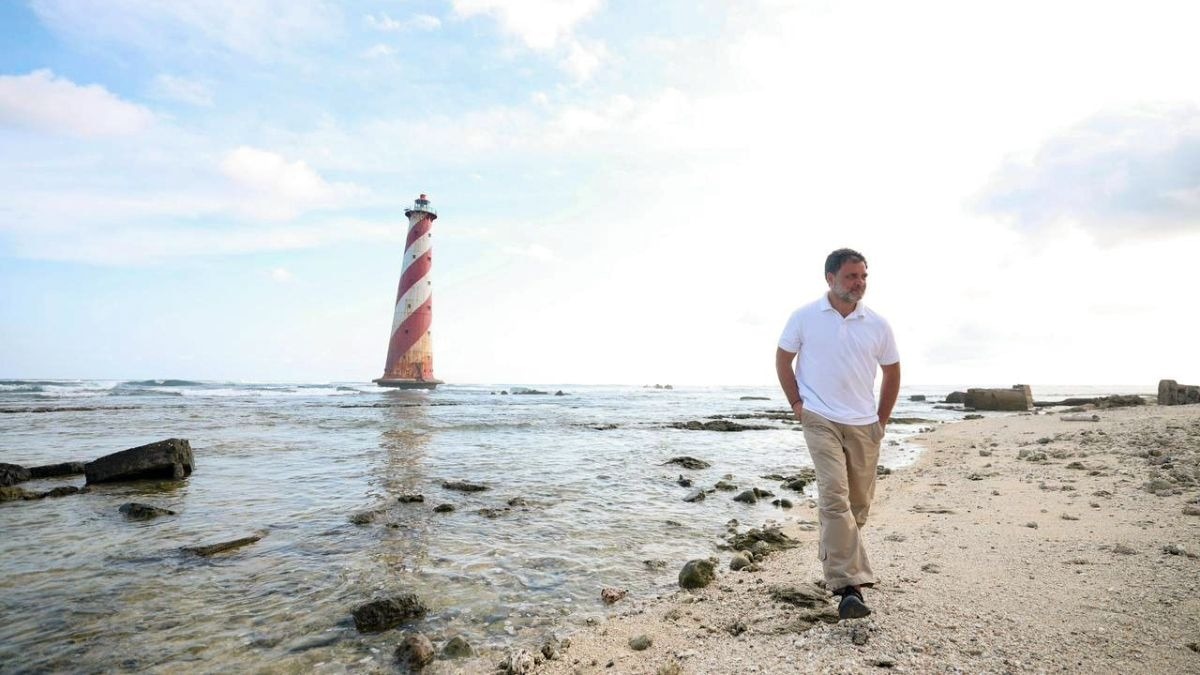
If exit polls are right, May 4 will hand Rahul Gandhi a rarity: unambiguously good news. The Congress-led United Democratic Front (UDF) seems on course to dislodge Pinarayi Vijayan’s Left Democratic Front (LDF) government in Kerala, with Axis My India giving it 78-90 out of the legislative assembly’s total 140 seats and Manorama News-CVoter pushing the band to 82-94.
The headache is what tends to follow a Congress win: a stampede for the chief minister’s chair. There are four men in the frame. K.C. Venugopal, AICC general secretary and Alappuzha MP, is Rahul’s most trusted aide. V.D. Satheesan, leader of the Opposition in the outgoing assembly and a sitting MLA, has the strongest claim from the floor.
Ramesh Chennithala, a former home minister of Kerala, has waited two decades for his turn. K. Sudhakaran, the Kannur MP, has not entered his name, but his Facebook endorsement of Venugopal has already lit fires in the rival camps.
Rahul has handled this kind of three-way contest before, not without some unwanted consequences though. Madhya Pradesh and Rajasthan in 2018 produced festering wars between Kamal Nath and Jyotiraditya Scindia, and Ashok Gehlot and Sachin Pilot, respectively. In both, it is the party that lost. Karnataka in 2023 ended in an awkward truce between Siddaramaiah and D.K. Shivakumar that already shows signs of fraying. Given all that, the Kerala squabble may be the easiest of Rahul’s problems.
Beyond Kerala, the cupboard is bare. Assam looks set to elude the Congress again. In West Bengal, where some exit polls now predict a BJP majority, the party faces what every survey calls extinction. Tamil Nadu accommodates the Congress only at the DMK’s pleasure. With the Kerala victory, the Congress completes its transformation into a southern outfit, with Himachal Pradesh as a high-altitude footnote.
This is why the BJP’s parliamentary upset of April 17 matters to Rahul in a way political punditry has under-priced. The defeat of the Constitution (131st Amendment) Bill—the Narendra Modi government’s attempt to bundle women’s reservation with delimitation—was the first time in nearly 12 years that a Modi-sponsored constitutional amendment failed the two-thirds test. Rahul’s circle now believes the Opposition has the floor strength in Parliament to dictate, not just react. The aim, they say, is to set the agenda rather than chase it.
Rahul’s aides point to the caste census as proof of concept. From the day in 2023 that he reversed the Congress’s historical squeamishness on the question, Rahul pounded one slogan—“jitni abadi, utna haq” (rights in proportion to population)—until the BJP, which had once dismissed the idea as an “urban Naxal” plot, agreed in April 2025 to fold caste enumeration into the next census.
The electoral pay-off in 2024 was modest, but the pressure was real. In Uttar Pradesh, where caste arithmetic decides everything, the BJP fell from 62 Lok Sabha seats to 33. Post-poll data from the Centre for the Study of Developing Societies (CSDS) showed the National Democratic Alliance (NDA) losing 19 percentage points among Koeri-Kurmi OBCs (Other Backward Classes) and 13 percentage points among other OBCs. This was on the back of an Opposition campaign that warned that a “400 paar” majority for the NDA would dismantle reservation.
Rahul’s next slogan was “vote chori”—his charge was that the Election Commission (EC) and the BJP had colluded to inflate, prune and redirect electoral rolls. Rahul turned it into a series of high-decibel press conferences, complete with what he called “Hydrogen-bomb” evidence. In Bihar, where he timed his second presentation a day before the November 6 vote last year, the pitch sank: the Congress won only six of the 62 seats it contested, its second-worst showing in the state’s history, and forfeited deposits in most of the rest.
The argument resurfaced only in West Bengal, where the EC’s invented category, “logical discrepancy”, was used to red-flag some 2.7 million voters during the Special Intensive Revision of rolls—a disproportionate share of them allegedly Muslim. The EC has dismissed every accusation. The Congress’s own fortunes in Bengal will be unaffected either way.
Rahul’s pattern is now clear. He picks issues that may not win the next election but will deny Prime Minister Modi the comfort of an unchallenged narrative. After May 4, and especially if Bengal goes the BJP way, the saffron camp will want a chorus about the Opposition’s decimation. Rahul wants a counter-tune cued up for the rest of 2026, ideally one with a moral charge.
Standing with the locally aggrieved is, by now, his most dependable register. The list runs from Yavatmal in 2008, when he sat in Kalawati Bandurkar’s hut in Vidarbha, through Niyamgiri (2008-10), where he marched with the Dongria Kondh against Vedanta’s bauxite plan, to Mirchpur (2010), Bhatta Parsaul (2011), Gopalgarh (2011), Satara (2012), Shakur Basti (2015), Una (2016), Saharanpur (2017), Mandsaur (2017) and Hathras (2020). The template never varies: travel to the wronged, embrace the cause, exit.
In the era of the UPA (United Progressive Alliance), the pay-offs could be substantial—Jairam Ramesh’s 2010 rejection of Vedanta’s environmental clearance was a Niyamgiri trophy. In the NDA era, the land acquisition ordinance lapsed on August 31, 2015, with Modi citing farmer “fear” in his Mann Ki Baat radio message as the trigger. Since then, the splash has rarely converted: the Yavatmal-Washim seat in Maharashtra has voted the Shiv Sena (in its various avatars) in every Lok Sabha poll since 2009; in 2022, the Sikandra Rao assembly seat in Uttar Pradesh’s Hathras gave the Congress 1,159 votes against the BJP’s 98,094.
Now, in the summer of 2026, Rahul has chosen Great Nicobar. On April 26, he flew to Sri Vijaya Puram (the renamed Port Blair). Two days later, despite a curiously timed suspension of helicopter services to the Nicobars from April 28 to May 1, he reached Campbell Bay. He met Nicobarese elders at Rajiv Nagar, settlers at Gandhi Nagar and laid flowers at Indira Point, India’s southernmost tip, named after his grandmother.
Rahul emerged describing the Rs 81,000 crore Great Nicobar project—a transhipment port at Galathea Bay, an international airport, a township and a power plant—as “one of the biggest scams and gravest crimes against this country’s natural and tribal heritage in our lifetime”, and also as “destruction dressed in development’s language”.
Rahul’s objections, stripped of theatrical varnish, are fourfold. The project will erase some 160 sq km of rainforest, grounds for which the National Green Tribunal cleared in February, but with conditions environmentalists call cosmetic. It will reshape the habitat of the Shompen, a Particularly Vulnerable Tribal Group of around 300 hunter-gatherers whom Survival International, a human rights group, has petitioned the United Nations to protect, calling the project “tantamount to genocide”.
The consent of the Nicobarese was obtained, local Congress leaders allege, through a “no-objection” process that withheld the project’s true scale. And, gesturing towards old Congress themes, Rahul has accused the Modi government of clearing the forest so that “one businessman, Mr Adani” can fulfil his “fantasies”.
Sustaining the campaign will be harder than launching it. Great Nicobar lies 1,200 km from the mainland, beyond the political imagination of most Indians. Ecological causes seldom move the electorate as Delhi’s chronic air-pollution crisis attests. Niyamgiri and Bhatta Parsaul yielded results because UPA-era institutions could be made to bend. The Modi government has not retreated from a flagship project since the farm laws, and that took a year of farmer encampments at the national capital’s gates.
The bigger problem, of course, is Rahul himself. In July 2008, Rahul sat in the hut of Kalawati Bandurkar, a cotton farmer’s widow in Jalka village, Yavatmal. Her husband had killed himself in 2005. Three days later, during the trust vote on the Indo-US nuclear deal, he named her in the Lok Sabha to argue that atomic power would one day light homes like hers. The cameras left, the misfortune did not. Kalawati’s son-in-law took his life in December 2014, her daughter Savita died by self-immolation in April 2015.
The BJP quickly seized on Rahul’s failure to follow through, turning it into a potent propaganda point. In May that year, Union minister Nitin Gadkari drove to hand Kalawati Rs 1 lakh, observing that Rahul had visited but paid nothing. “Where is Kalawati?” duly entered the political lexicon as shorthand for the gulf between Rahul’s cameos and his follow-through. Kalawati met him again only 14 years on, in November 2022, when Congress workers brought her to the Bharat Jodo Yatra at Washim.
That is the test Great Nicobar will impose: sustained follow-through. The National Green Tribunal cleared the project in February. Sonia Gandhi’s editorial in September 2025 did little to stop the bulldozers. The Modi government has shown little appetite for retreat on flagship infrastructure. Its lone climbdown—the farm laws—came only after 15 months of farmers camping at Delhi’s borders.
Rahul says he will take up the Great Nicobar issue in Parliament. But Yavatmal, Niyamgiri, Una and Hathras all reached that stage too, and did not always swing in his favour.
Subscribe to India Today Magazine
– Ends