



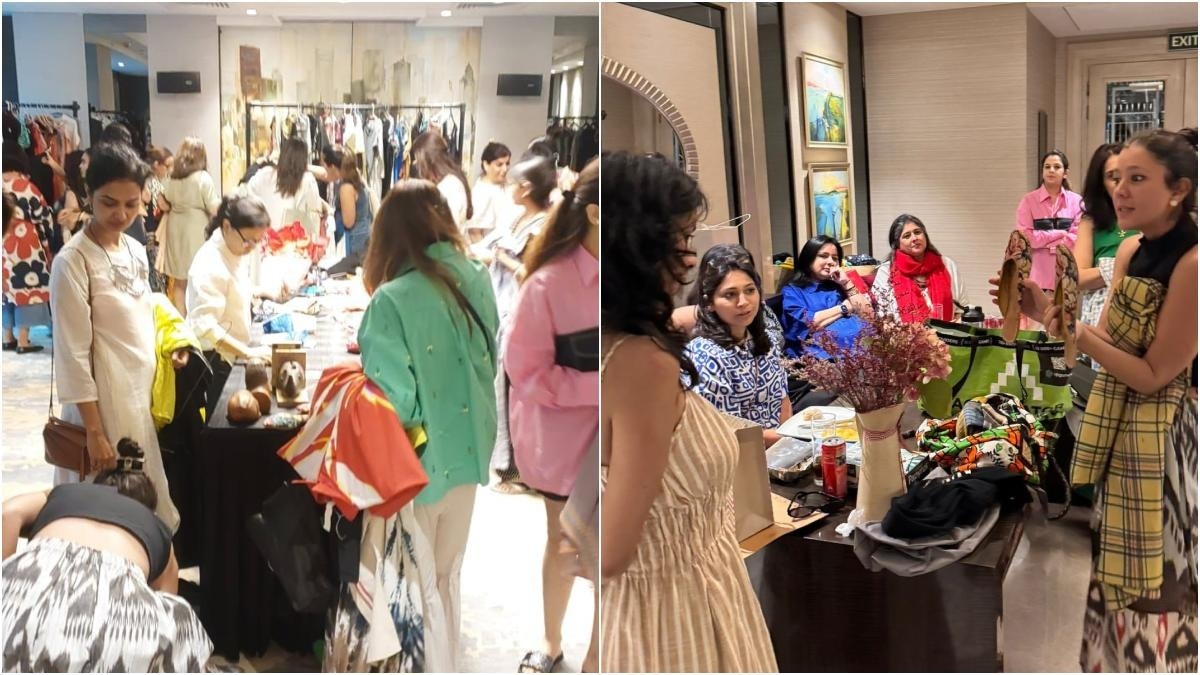
It’s a breezy Sunday afternoon in GK II, the room doesn’t look like a typical fashion gathering. There are no price tags, no sales racks, no stylists hovering with curated edits. Instead, there are women, well-dressed, sharp-eyed, and quietly excited, moving through rows of clothing, pausing, touching, discovering.
Somewhere in a corner, someone lets out an audible, “Oh wow, this is gorgeous.”
Welcome to Delhi’s most interesting fashion experiment—one that doesn’t involve buying anything at all.
At the centre of it is Mandavi Sharma, Anu Sawhney, Sonali Amla and Monisha Sakraney, a quartet that has, over the last two years, been rethinking what it means to consume fashion in a city that thrives on excess.
Their answer? A “Vintage Xchange.” Or, as they like to call it, a ‘swap with a soul’.
Closet, but make it circular
The idea is deceptively simple.
Bring at least five pieces from your wardrobe, clothes you’ve loved but no longer wear, still in excellent condition. Hang them up. Browse. Pick what you like. Take home as much as you’ve brought in.
No money changes hands.
But to call it just a clothing swap would be missing the point.
“We were all feeling the fatigue of fast fashion,” Mandavi says. “You go online, you scroll Instagram, and you’re constantly being pushed to buy something new. We wanted to step away from that and ask—how do we use what we already have?”
What started as a small, word-of-mouth gathering among friends has now quietly grown into something far more compelling. The latest edition saw 60-plus participants walk in with over 800 items. More than 500 found new homes.
The rest? Not discarded, not forgotten.
“All leftover clothes were shared with the staff at the venue for their families. Nothing went to waste,” she says.
No plastic. Recycled decor. Hangers saved for the next edition.
Sustainability, here, isn’t a buzzword. It’s just how things are done.
Not for everyone
There’s no public RSVP link. No Instagram blast. No influencer grid posts inviting the city in. The exchange operates on something far more old-school: trust and word of mouth.
“Friends bring friends. It’s important that people coming in understand this isn’t transactional,” explains Mandavi.
Which means this isn’t the place for wardrobe dumps or half-hearted decluttering.
“What you bring should be something you’d be happy to take back,” she says, almost like a rulebook without actually calling it one.
It’s a subtle filter, but an effective one.
The thrill of the find
If there’s one thing that defines the energy of the space, it’s the joy of discovering things.
“It’s like a treasure hunt,” Mandavi laughs.
And the finds are anything but predictable.
A handcrafted bag picked up years ago in Kenya. A barely-worn dress from a homegrown label. A statement piece someone wore once and then forgot about.
There’s something deeply satisfying about that moment when a piece finds its next life, not in a landfill, but in someone else’s wardrobe.
And perhaps even more satisfying? The fact that it didn’t cost a thing and your wardrobe is updated.
A different kind of fashion high
For a city that loves its labels, its launches, its luxury drops, this feels almost counter-intuitive.
“It’s a social experiment in many ways,” Mandavi admits. “There was a time when people would say, ‘Who would wear someone else’s clothes?’ But that thinking is changing.”
And fast.
Globally, resale and pre-loved fashion have moved from the fringes to the mainstream. In Delhi, this little gathering in GK feels like its most intimate, most personal version.
Four women, one idea that stuck
The exchange didn’t come out of nowhere.
Before this, Mandavi and Monisha were part of a charitable initiative that involved collecting and reselling donated goods. That early exposure to reuse and redistribution stayed.
Add to that Sonali’s instinct for bringing people together and Anu’s fashion sensibility, and the foundation was set.
“We’re all very different, but this just clicked,” she says.
There’s no rigid calendar. No aggressive scaling plan.
“It has its own energy,” Mandavi shrugs.
– Ends