

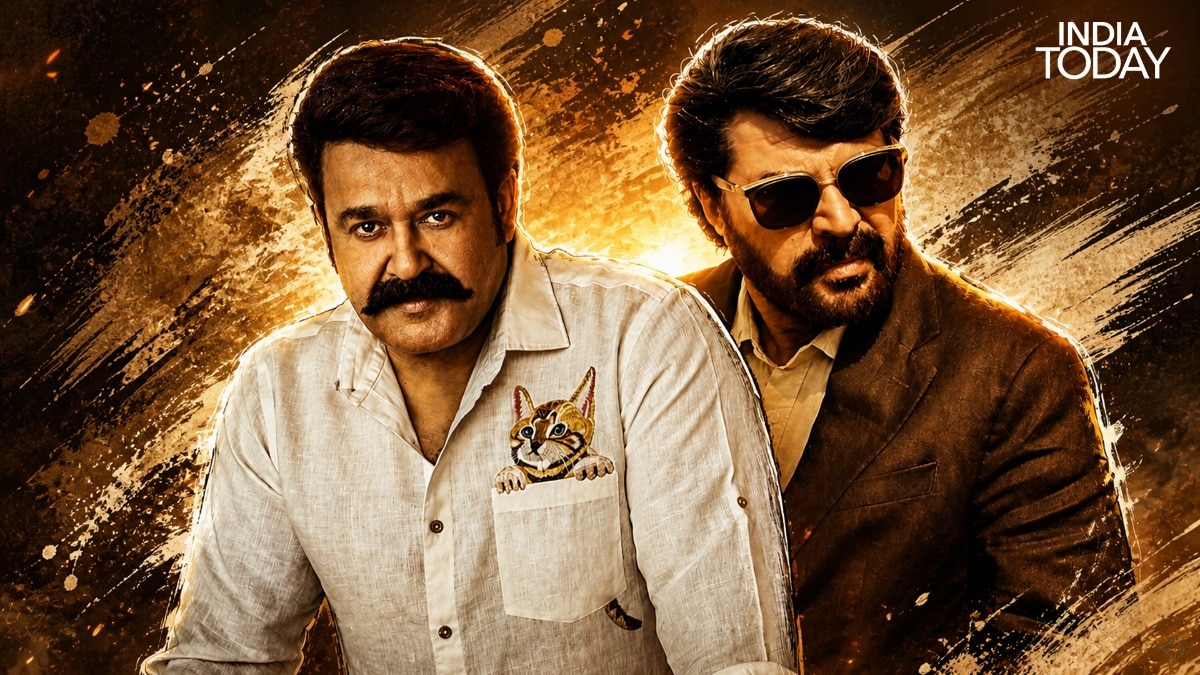
A day ahead of Patriot’s release, actor Nivin Pauly posted on X that stopped many people mid-scroll. “The last time they shared a screen, a generation grew up watching it on repeat,” he wrote. “Eighteen years later, Mammookka and Lalettan are back together and Malayalam cinema is calling it a Magnum Opus for a reason. May the screens not be enough.”
It is the kind of tribute that could feel like a promotional gimmick. Instead, it landed as simple truth. Because here is the thing about Mammootty and Mohanlal: a post about them from a younger star who is himself a bona fide name in Malayalam cinema reads less like peer appreciation and more like a fan paying respect to something larger than himself. That gap — between the Big M’s and everyone who came after them — is the most interesting phenomenon in Malayalam cinema, and almost no one talks about it directly.
Here is a test you can run on almost anyone in India who vaguely follows films beyond their own language. Ask them to name an actor from Malayalam cinema. Nine times out of 10, the answer will be Mohanlal or Mammootty. The tenth person is likely to name both. Those who caught on Mollywood after the Covid-19 pandemic would perhaps name Fahadh Faasil.
This is remarkable for reasons that go beyond fame. Mohanlal is 65. Mammootty is 74. Both have been working continuously since the early 1980s.
Since then, Malayalam cinema has seen entire generations of new stars rise, make their mark and find their ceiling — Prithviraj, Fahadh Faasil, Dulquer Salmaan, Tovino Thomas and Nivin Pauly, among others. Each of them is a legitimate star with a genuine following. Yet none of them has displaced the two M’s or even come closer to their stardom, and that is a point to be noted for an entire country’s understanding of what Malayalam cinema means.
Patriot, directed by Mahesh Narayanan, this week brings the two actors together on screen for the first time in nearly two decades.
The film is being treated as an event — the return of a cinematic language audiences had almost forgotten how to speak. That alone tells you something. In most film industries, a reunion of two actors who last appeared together in 2008 would be nostalgia programming. In Malayalam cinema, it is different.
The question worth asking is: how did they get here? And more interestingly — why did no one else?
How they rose
Neither man arrived as an instant phenomenon. Mammootty, born in 1951 in Kerala’s Chandiroor, studied law before films took over — a detail that would later feel entirely consistent with the kind of precise, authority-carrying roles he would make his signature. His early years in Malayalam cinema through the late 1970s and early 1980s were a long apprenticeship: capable, present, but not yet defining. The film that changed things was New Delhi in 1987, directed by Joshiy — a thriller in which he played G Krishnamoorthy, a journalist who methodically arranges the killing of the politicians who framed him. New Delhi became the highest-grossing Malayalam film at that point.
Mohanlal’s trajectory, though parallel in time, was temperamentally its opposite. Born in 1960 in Kerala’s Kollam, he made his screen debut in 1980 as an antagonist in Manjil Virinja Pookkal — a sadistic husband, notably, not a hero. From there, he moved through villain and character roles before establishing himself as a lead. His sealing moment came with Rajavinte Makan in 1986, in which he played Vincent Gomez, an underworld don, with a magnetic assurance that made him — at 26 — a new kind of screen presence in Malayalam cinema. That year alone, he appeared in 34 films.
By the late 1980s and through the 1990s, both Mammootty and Mohanlal ascended to a level of stardom that Malayalam cinema had rarely seen before. Three National Film Awards each. Mammootty’s portrayal of Vaikom Muhammad Basheer in Adoor Gopalakrishnan’s Mathilukal (1990) was listed by Forbes India among the 25 greatest acting performances in Indian cinema. Mohanlal’s work in Bharatham (1992) received the same honour. These were not just box office stars — they were being written into the history of Indian cinema.
And then Malayalam cinema nearly lost them both.
The lost decade
The 1990s and 2000s were a complicated period for Malayalam cinema as a whole. In an attempt to compete with the scale and spectacle of Tamil and Telugu productions, the industry began making films that were neither true to its own storytelling instincts nor genuinely competitive with the bigger industries. The result, as actor-filmmaker Kamal Haasan observed in an interview during this period, was that Malayalam cinema — historically a mentor to other Indian film industries in terms of writing and craft — was producing mediocre, forgettable work by abandoning its essence.
Mammootty and Mohanlal were caught in this drift. They continued to be the biggest names in their industry, but the films did not always bring them laurels. This is the paradox of superstardom: the bigger you become, the harder it is to take a genuine risk, because the weight of expectation — from producers, distributors, fans, and the entire ecosystem that surrounds a star — pushes relentlessly toward the safe and the familiar.
What rescued them, eventually, was not a single film but a shift within the industry.
The new wave that saved them
Around 2011, something changed in Malayalam cinema. A group of young directors — influenced by global cinema but rooted firmly in Malayali life — began making films on modest budgets that prioritised story over star. Early new-wave films were budgeted at Rs 2-3 crore, a fraction of the Rs 6-8 crore average for mainstream productions. Because the films were small, the directors could take risks. Because the risks paid off, audiences came to expect something more demanding from Malayalam cinema.
This wave is usually discussed in terms of the new stars it produced — Fahadh Faasil becoming the face of the movement, Dulquer Salmaan (Mammootty’s son) and Nivin Pauly establishing himself as a different kind of hero. But the wave also had a profound effect on the two established superstars, because it raised the standard of storytelling they were expected to meet.
Mammootty moved first and more decisively. He began working with new-wave directors on projects that bore no resemblance to the formula vehicles of his lean years. Puzhu (2022) cast him as a regressive, quietly menacing Brahmin patriarch — a villain of ideology and complacency rather than action — in a film directed by first-timer Ratheena PT. Rorschach (2022), directed by Nissam Basheer, was a psychological thriller in which he played a grieving man pursuing revenge through psychological manipulation.
Then there was Kaathal — The Core (2023), directed by Jeo Baby. Mammootty played Mathew Devassy, a middle-aged who’s publicly acknowledging that he is a homosexual. In a country where mainstream cinema has historically either avoided or caricatured gay characters, Mammootty — one of Indian cinema’s most iconic male presences — played the role with quiet precision, without a trace of caricature at the age of 70. The film drew boycott calls from religious groups and was banned in Kuwait and Qatar. Mammootty did not flinch. The film has since been received as a watershed moment for Malayalam cinema’s engagement with LGBTQ+ identity.
More recently, there was Bramayugam (2024), directed by Rahul Sadasivan. The film is a black-and-white supernatural thriller set in medieval Kerala, shot almost entirely in a single decaying mansion. Mammootty plays a feudal lord possibly possessed by a demon, in a tale that was part horror, part caste allegory, part arthouse provocation. The film was selected for a special screening at the Academy Museum of Motion Pictures in Los Angeles in 2026 — the first Mammootty film to be shown there.
These were not safe choices. An actor of Mammootty’s stature, in his seventies, choosing to work with debut directors on black-and-white horror films, or to play a gay man at a time when doing so invited organised backlash — it requires a confidence in one’s own instincts that most superstars, across industries, do not have.
Mohanlal’s reinvention has operated on different tracks simultaneously. On one hand, there’s the Drishyam franchise — in which he played Georgekutty, an ordinary cable TV operator who covers up a killing to protect his family. The first film, released in 2013, became the highest-grossing Malayalam film of its time and spawned a sequel in 2021, with a third instalment coming later this year.
Georgekutty is arguably the most loved character in recent Malayalam cinema, precisely because he is so resolutely not heroic in any conventional sense: no physical power, no authority, no advantage except his own intelligence and his willingness to do anything for his family. Mohanlal played him with an ordinariness that was its own kind of virtuosity.
On the other hand, Lucifer (2019), directed by Prithviraj Sukumaran, repositioned him as a political power-broker of almost mythic proportions. L2: Empuraan (2025), its sequel, grossed over Rs 265 crore worldwide, becoming one of the highest-grossing Malayalam films ever. And then, remarkably, Mohanlal did it twice more in the same year. Thudarum, a modestly budgeted drama about a humble taxi driver and his cherished Ambassador car, became the first Malayalam film to gross over Rs 100 crore in Kerala alone — a feat driven entirely by content and audience love, not scale.
Hridayapoorvam, a family drama released later that year, added further to his tally. Three films in 2025, three completely different registers — mythic political thriller, small-town emotional drama, domestic family story — and all three profitable. Mohanlal’s domination of the 2025 Kerala box office, across genres that could not be more different from each other, was its own kind of argument about what his stardom actually consists of. Three completely different registers, three completely different versions of what Mohanlal film can be — and he inhabits all of them with equal conviction.
In 2025, the Government of India honoured Mohanlal with the Dadasaheb Phalke Award, the highest recognition in Indian cinema. Mammootty received the Padma Bhushan in January 2026.
Why Malayalam cinema makes this possible
In most large film industries, the idea of two equally-billed superstars sharing a screen is primarily a business problem. Tamil cinema’s famous parallel between Kamal Haasan and Rajinikanth — who appeared together frequently in the early part of their careers — saw their joint appearances taper off almost precisely as individual superstardom took hold. When either man alone could fill a theatre, the industry had no financial incentive to put both in the same film and split the equation.
Malayalam cinema has historically operated differently. Its budgets, while growing, remain relatively modest compared to Tamil or Telugu productions. A film does not need to become a pan-India blockbuster to be considered a success on Malayalam cinema’s own terms. This creates space for storytelling decisions that might seem commercially irrational elsewhere.
Director Jeethu Joseph, who made both Drishyam films, has spoken about how the title of “superstar” can itself become a trap. When he approached Rajinikanth about a Tamil remake of Drishyam, he was told the star was interested but ultimately could not commit because he was concerned about how it would sit with his star image. Mohanlal, who played the original Georgekutty, has no such hesitation — precisely because Malayalam cinema has never demanded that its superstars be invulnerable. Their characters can fail, suffer, be wrong, be ordinary, without threatening the architecture of their stardom.
The economist of all this is the story. Malayalam cinema’s relationship with writing — the centrality of the script, the tradition of literary adaptation, the influence of directors like Padmarajan, K.G. George and Bharathan who prioritised characters over spectacle — created an audience that responds to performance, not just presence. Mammootty and Mohanlal have survived because they are constantly reinventing themselves, and because the industry they work in keeps giving them material that tests them. The two things feed each other.
It takes an outsider, sometimes, to see this most clearly. Actor Manoj Bajpayee, speaking on Galatta Plus, reached for the highest comparisons he could find. He said the two come from different schools of acting — like Naseeruddin Shah and Om Puri, or like De Niro and Al Pacino.
De Niro, Bajpayee said, understands his character deeply but remains open to grasping anything that comes in the moment. Pacino believes in thorough preparation and arrives on set with every nuance already in place. “Mohanlal sir is somebody who knows his script backwards; I think after that, he must be living it, and he is ready with each and every nuance,” Bajpayee said. “Mammootty is a true craftsman.”
The comparison landed because it was precise — two different philosophies of acting, both capable of producing greatness, both still operating at the highest level decades into their careers.
Still Here
Patriot is, among other things, a reminder of what Malayalam cinema can do that no other Indian film industry quite manages: put two of its biggest stars in a serious, grounded, story-first film and ask them to serve the narrative rather than the other way around. In the film, Mammootty is Dr Daniel James, a scientist turned dissident YouTuber. Mohanlal plays Colonel Rahim Naik, a military man operating from the margins. Neither role is a vanity project. Neither man is being protected from complexity.
They have been here before — across nearly 56 films together, from the frenetic early 1980s when both were still finding themselves, through Harikrishnans (1993) with its legendary dual-climax strategy, to Twenty:20 (2008), their last full-fledged collaboration before this one. Each time, the industry around them has changed. Each time, they have changed with it.
That is, finally, what separates them from every actor who has tried to occupy the same space since. Malayalam cinema produced Fahadh Faasil and Dulquer Salmaan, Prithviraj and Tovino Thomas — genuinely talented actors who have built real careers. But they are yet to become the first answer to the question: who do you think of when you think of Malayalam cinema?
Partly that is history — you cannot manufacture four decades of accumulated presence. But partly it is something more active, more chosen. Two men who could have coasted have kept working, kept risking, kept turning up for good stories regardless of whether those stories protect their image or complicate it.
The original superstars in Malayalam cinema are superstars because they never stopped being actors first.
– Ends