

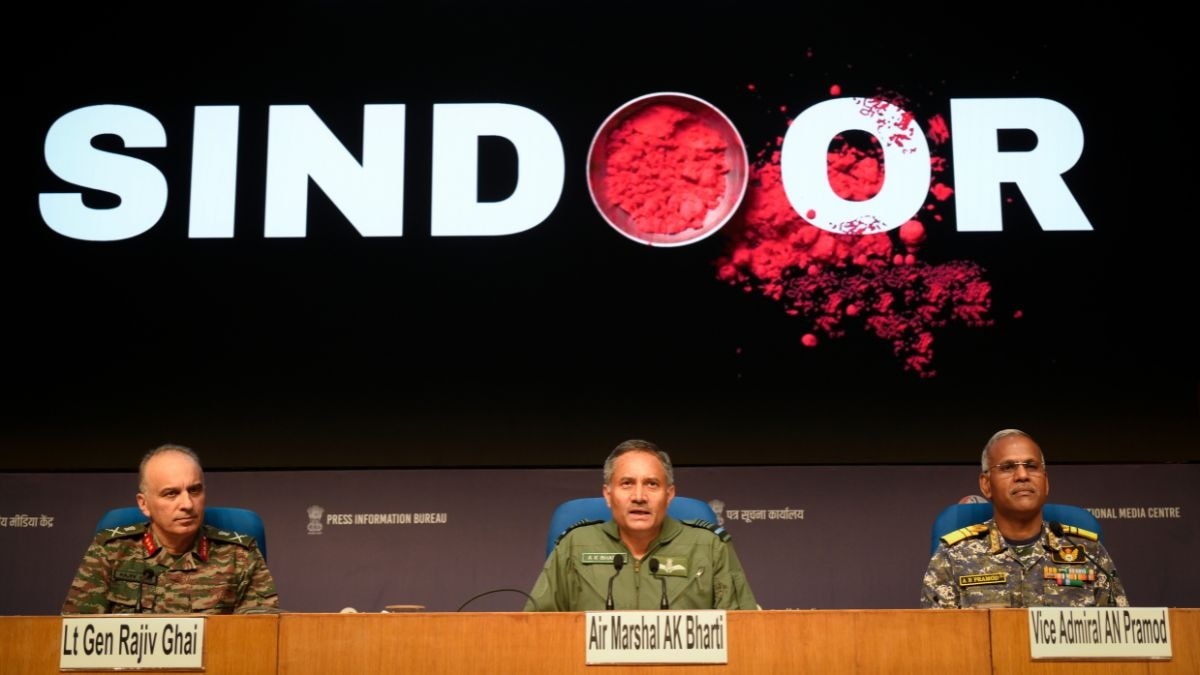
A year after India launched Operation Sindoor against Pakistan in response to the Pahalgam terror attack, its scars remain far from healed.
India struck 11 critical defence locations and nine terror sites under Operation Sindoor in May last year, according to government statements. A year later, what remains of them?
An analysis of medium and high-resolution satellite imagery of at least eight airbases suggests that Pakistan took, on average, six to seven months to repair individual structures hit at defence sites — mostly hangars. While some facilities appear to have been rebuilt and returned to normal operations, several others remain under maintenance.
Even runway patchwork at some bases took months, with reconstruction activity at other sites continuing nearly a year after the strikes.
India Today’s Open Source Intelligence (OSINT) analyses historical satellite imagery from ESA’s Sentinel-2 and high-res imagery from US-based space technology firm Vantor of the 8 PAF bases: PAF Base Bholari, PAF Base Murid, PAF Base Sukkur, PAF Base Rahim Yar Khan, PAF Base Mushaf in Sargodha, PAF Base Nur Khan (Chaklala), and PAF Base Shahbaz in Jacobabad to assess the intensity of damage inflicted and the pace at which Pakistan is restoring its air bases.
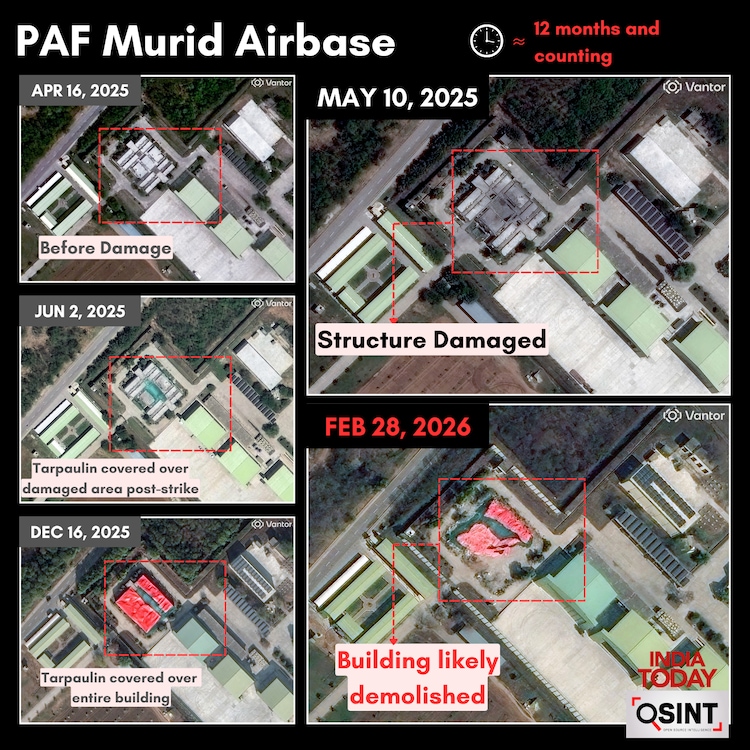
At Murid and Sukkur, the damage was so severe that repairs likely required the damaged structures to be razed first. PAF Base Bholari still appears to be under restoration.
Reconstruction activity has also been observed in its final stages at four other bases: PAF Base Rahim Yar Khan, PAF Base Mushaf in Sargodha, PAF Base Nur Khan in Chaklala, and PAF Base Shahbaz in Jacobabad.
PAF Base Rafiqui (Shorkot) was another military installation targeted by Indian forces during Operation Sindoor. However, owing to the lack of accessible high-resolution satellite imagery and the absence of independently verifiable evidence, India Today could not conclusively assess the extent or nature of the damage inflicted at the base following the strikes. Additionally, the medium-resolution imagery available for review lacked the spatial fidelity required to reliably identify structural damage or post-strike repair activity.
Our analysis does not include terror sites such as Bahawalpur and Muridke, which were struck on the first day of Operation Sindoor. Limited access to high-resolution imagery, and the constraints of medium-resolution imagery in dense built-up areas, makes it difficult to assess their restoration status.
High-resolution satellite images sourced from the US-based space technology firm Vantor and analysed by India Today’s Open-Source Intelligence (OSINT) team show fresh repair work, machinery deployment at strike-damaged compounds in Bahawalpur and Muzaffarabad.
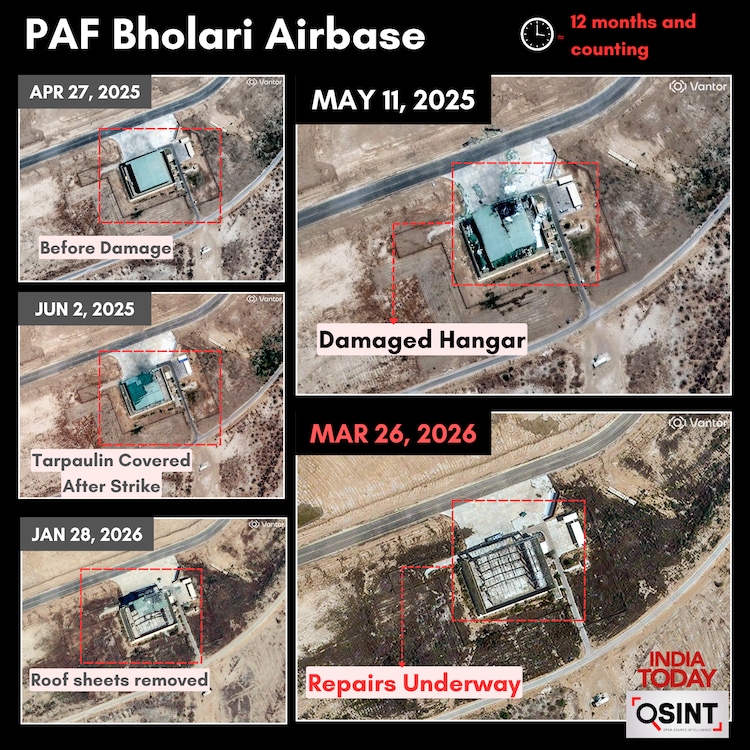
At PAF Base Bholari, Vantor imagery indicates that restoration work remains incomplete even after a year. Imagery following last year’s May strikes showed a heavily damaged hangar complex. Subsequent imagery from June 2, 2025, showed the structure covered with tarpaulin, while imagery dated January 28, 2026, indicated that roof sheets had been removed from the damaged section. By March 26, 2026, visible repair and reconstruction activity could be observed at the site, suggesting that restoration efforts at the hangar complex are still underway.
The base, located in Sindh’s Jamshoro district, was among the hardest hit during the Indian strikes, with over 50 individuals, including Squadron Leader Usman Yusuf and four airmen, killed. Inaugurated in 2017 under the PAF’s Southern Air Command, the base holds strategic significance for the security of the China-Pakistan Economic Corridor (CPEC). EMBED PAF Base Murid
Further, satellite imagery indicates a far more severe impact at PAF Base Murid, located in Punjab’s Chakwal district. Imagery dated May 10, 2025, showed significant structural damage immediately after the Indian strike. In the months that followed, the affected section remained covered with tarpaulin, as seen in imagery from June 2, 2025, and December 16, 2025. However, by February 28, 2026, the structure appeared to have been cleared, with imagery suggesting that the damaged building was likely demolished, pointing towards extensive reconstruction requirements at the site.
Following the Indian strikes, the same base revealed a roughly 3-metre-wide crater near a high-value underground facility. Pakistan, however, moved quickly to cover the impact site with a tent, definitely not for aesthetics but to obscure what lay beneath. The location and nature of the crater suggested that the Indian strikes may have targeted hardened infrastructure at the base, including facilities believed to support protected or underground assets.
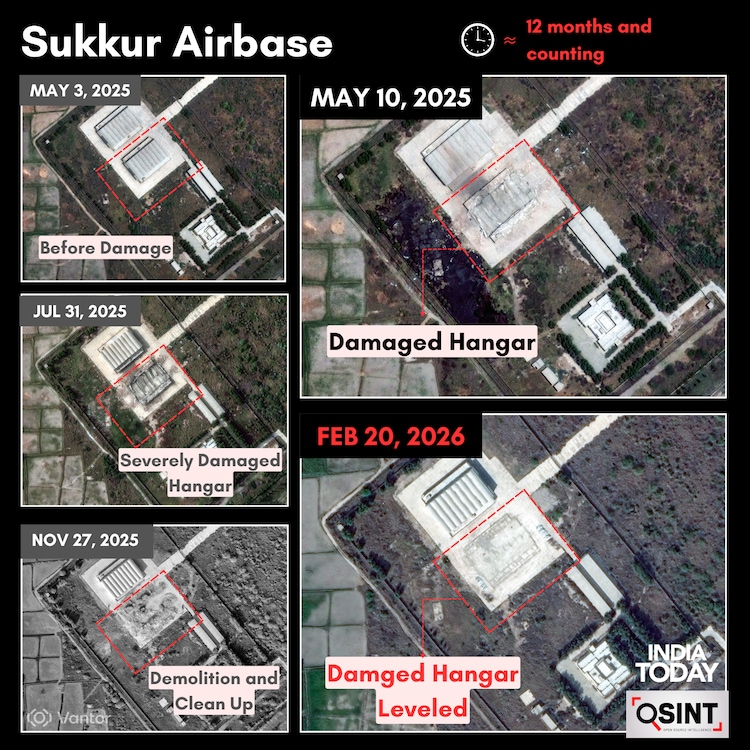
PAF Base Sukkur, a dual-use facility that also operates as Begum Nusrat Bhutto International Airport, was also among the Pakistani air bases struck by India on May 10, 2025. Imagery sourced from Vantor shows that a hangar damaged during the strikes remained heavily affected in imagery dated July 31, 2025.
Subsequent imagery from November 27, 2025, indicated demolition and clean-up activity at the site, while imagery dated February 20, 2026, showed the damaged hangar had been completely leveled. Nearly a year after the strikes, parts of the site still appear unrestored to their pre-conflict state, suggesting prolonged reconstruction efforts at the base and the intensity of the Indian strike.
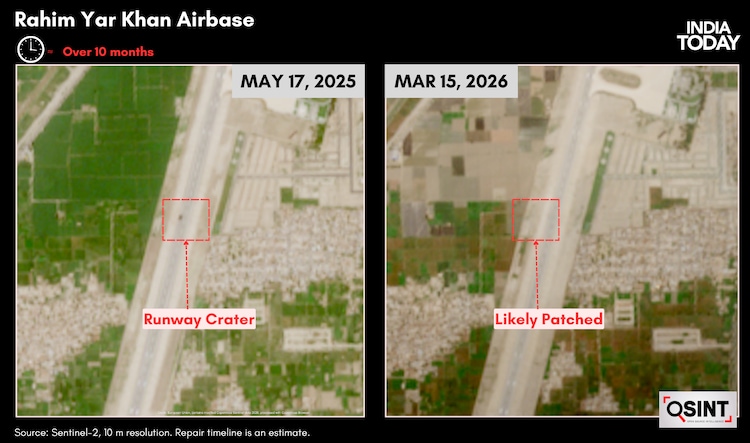
Next in line is Rahim Yar Khan Air Base, where the Indian Air Force strike demonstrated a clear runway denial capability, leaving behind an approximately 6-metre-wide impact mark on the runway. Low-resolution Sentinel 2 satellite imagery, reviewed by India Today, suggests that by March 15, 2026, the damaged section had likely been patched and resurfaced.
However, in the aftermath of the May 2025 strike, Pakistan issued multiple NOTAMs for Rahim Yar Khan Airport as the runway underwent prolonged repairs and safety assessments, remaining unavailable for operations for months. The runway was eventually declared operational again only on September 10, 2025, nearly 120 days after the Indian strikes.
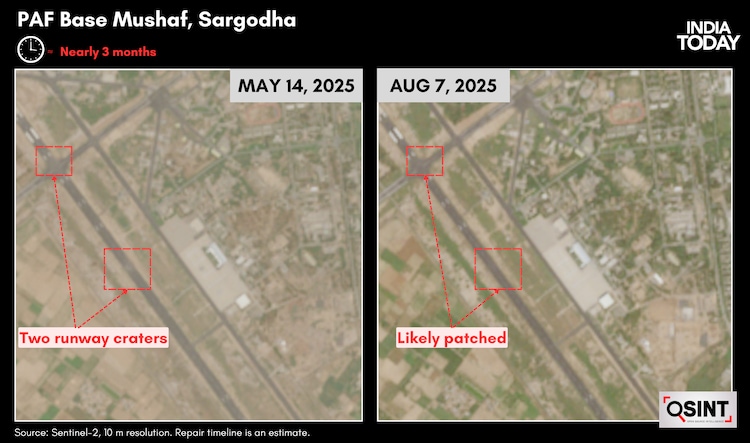
According to Sentinel 2 satellite imagery reviewed by India Today, at least two runway craters were visible at PAF Base Mushaf in Sargodha on May 14, 2025, following the Indian strikes. However, imagery dated August 7, 2025, suggests that the craters were likely patched within nearly three months, indicating that runway restoration work at the base had largely been completed.
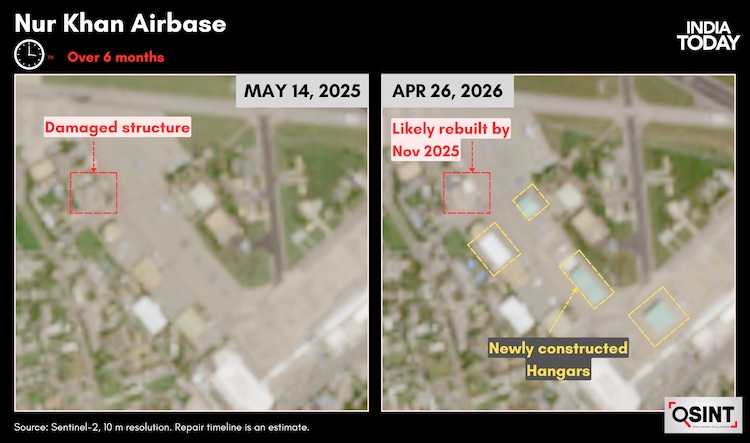
Satellite imagery from Nur Khan Airbase in Islamabad, a major logistics and transport hub of the Pakistan Air Force, indicated damage to a key structure within the operational area of the base following the Indian strikes in May 2025. Imagery reviewed from April 2026 suggests that the damaged section was rebuilt, likely by around November 2025, indicating a restoration timeline of roughly six months.
The latest imagery also points to continued construction activity at the site, including multiple newly built hangar-like structures and a new facility within the airbase complex.
Notably, the base was also used during the high-level US-Iran delegation visit involving US Vice President JD Vance for peace talks held in Pakistan’s capital on April 11, 2026, marking one of the first such prominent diplomatic arrivals at the facility since the May 2025 conflict.
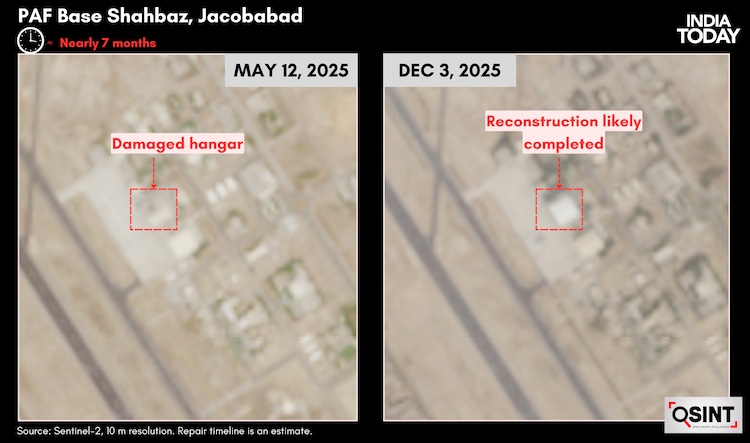
Satellite imagery from PAF Base Shahbaz in Jacobabad indicates that a hangar on the base’s main apron was damaged during the Indian strikes in May 2025. Imagery reviewed over the following months showed the roof of the targeted structure being gradually dismantled, likely as internal damage assessments and repair work progressed.
By December 2025, the hangar appeared to have received a new roof, suggesting that reconstruction of the targeted structure was likely completed nearly seven months after the strike.
– Ends