

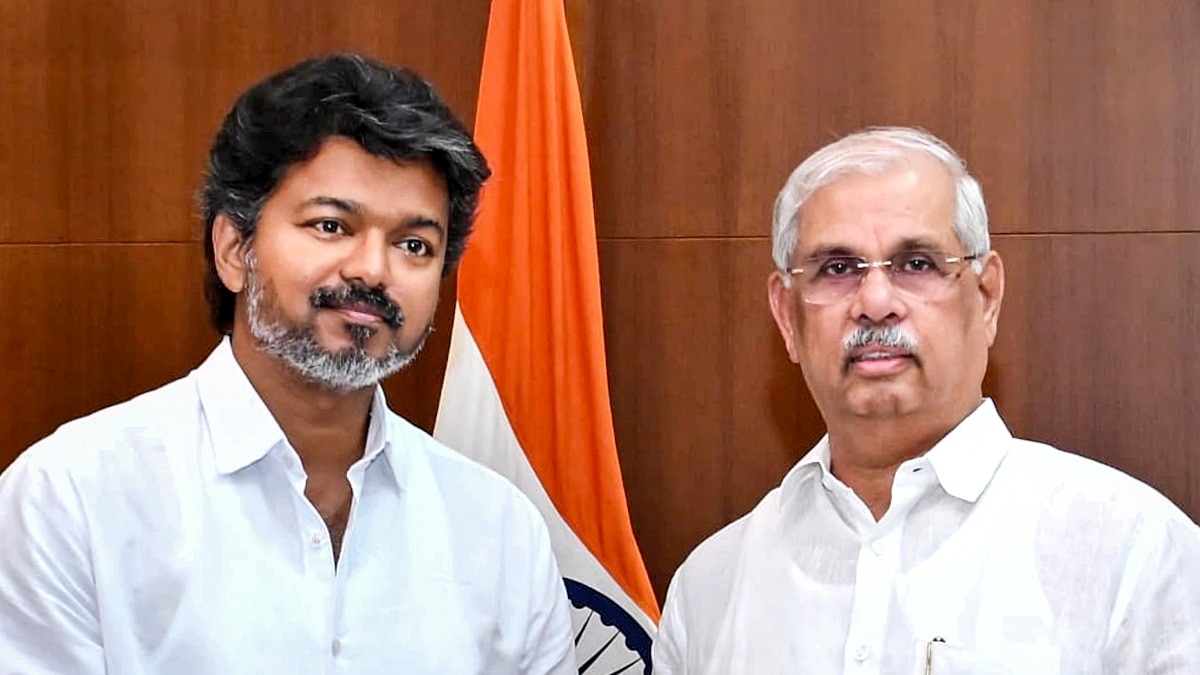
Vijay soared on his debut in Tamil Nadu elections, emerging as the single largest party with 108 seats. But it’s still 10 short of the 118-majority mark. To Governor Rajendra Arlekar, he presented the signatures of 107 MLAs, including himself, and verbally informed him about the backing of five Congress legislators to stake claim to form a government. However, there has been no luck two days in a row. The governor has asked him to return with 118 signatures. With only three days left for the current DMK government’s term to end, controversy around the formation of the new regime has reignited a larger constitutional debate on the powers and discretion of governors in a parliamentary democracy. Is he constitutionally bound to invite the single largest party to form the government, or can he exercise discretion in assessing competing claims to majority support before extending an invitation?
Several leading constitutional experts and senior advocates have weighed in, with differing interpretations of constitutional conventions, Supreme Court precedents, and commission recommendations. While there is broad agreement that a floor test in the Assembly is the ultimate mechanism to determine majority support, legal experts differ on the extent of governor’s discretion before that stage.
Former Attorney General Mukul Rohatgi said the governor is constitutionally bound to invite the single largest party first. He strongly criticised the governor’s reported stance, calling it unconstitutional. According to Rohatgi, the governor is duty-bound to invite the single largest party to form the government and allow it to prove its majority on the floor of the House. He argues that the governor cannot insist that a party first demonstrate support from 118 MLAs before being invited to take office.
Rohatgi further said that the governor’s role at this stage is limited. “At most, the governor can check whether the signatures of MLAs are correct,” the former Attorney General said, stressing that numerical strength must ultimately be tested publicly in the Assembly rather than in Raj Bhavan. He also pointed out that India has witnessed several minority governments in the past, underlining that a pre-verified majority is not a constitutional prerequisite for being invited to form a government.
Senior Advocate Neeraj Kishen Kaul offered a more nuanced interpretation of the constitutional position. He explained that Article 163 of the Constitution gives the governor a degree of discretion in deciding whom to invite to form the government. According to him, the Constitution does not lay down a rigid formula mandating whether preference should be given to the single largest party or to a post-poll alliance claiming majority support.
However, Kaul agreed that the governor cannot insist on proof of support from 118 MLAs before inviting a party to form the government. He cited the landmark Supreme Court judgment in SR Bommai vs Union of India (1994), where the Court held that legislative numbers are “capable of being demonstrated and ascertained publicly in the House”. This principle, Kaul argued, makes the floor test the decisive constitutional mechanism.
At the same time, Kaul pointed out that the Supreme Court in Bommai case had deliberately left unresolved the precise sequence in which a governor should invite parties after a fractured mandate. He referred to the recommendations of the Sarkaria Commission (1988) and the Punchhi Commission (2010), both of which attempted to formulate guidelines for such situations. The Sarkaria Commission suggested preference for a pre-poll alliance, followed by the single largest party, and then a post-poll coalition. Yet Kaul noted that these recommendations have never received definitive judicial endorsement.
Importantly, Kaul observed that the Punchhi Commission introduced some ambiguity by stating that the Governor may invite the “party or combination of parties which commands the widest support in the Legislative Assembly”. This wording, he said, does not restrict the claim only to pre-poll alliances and may also include post-poll combinations.
Kaul further referred to Supreme Court interventions in Goa and Karnataka. In Chandrakant Kavlekar vs Union of India, the governor invited a post-poll alliance, and the Supreme Court refused to interfere, instead directing an immediate floor test. Similarly, in G Parmeshwara vs Union of India (2018), the governor invited the single largest party, and once again the court refrained from questioning the governor’s discretion while ordering a floor test. According to Kaul, these cases show that courts have generally respected gubernatorial discretion so long as the majority is tested quickly on the Assembly floor.
Senior Advocate and Congress MP Abhishek Manu Singhvi, however, took a sharply critical position. Singhvi argued that constitutional morality, established precedent, and democratic convention all require the governor to invite the single largest party when no rival alliance has formally staked claim. He described the governor as the “repository of constitutional wisdom” and said there was “no alternative” but to call the largest party to form the government.
Singhvi also dismissed concerns over a marginal shortfall in numbers, pointing out that the gap was only seven or eight seats and could be tested through a floor vote within 10 to 12 days. He warned that any deviation from long-standing constitutional conventions would amount to a dangerous dilution of democratic norms and federal principles.
The Tamil Nadu controversy has therefore become more than a state-level political dispute. It has once again exposed the unresolved constitutional tensions surrounding the governor’s discretionary powers and the absence of a universally accepted convention for government formation in a hung Assembly. Ultimately, as all sides acknowledge, the decisive test of legitimacy remains the confidence vote on the floor of the House.
– Ends