



In 95 of the 207 West Bengal seats that the Bharatiya Janata Party won, the Election Commission’s voter-roll deletions exceeded the candidate’s victory margin, an India Today Data Intelligence Unit analysis found.
That amounts to roughly 46 per cent of the BJP’s tally on May 4, when the party ended 15 years of Trinamool Congress rule with a two-thirds majority. Applying the same arithmetic to the 80 seats won by the TMC shows that deletions exceeded the margin in 44 of them, a higher share than the BJP’s.
The finding does not establish that the deletions changed the result. It does establish that, on a seat-by-seat basis, the cuts were arithmetically large enough to matter.
The Election Commission removed nearly 79 lakh names, about 10 per cent of West Bengal’s voter roll, between the 2024 Lok Sabha elections and the May 2026 Assembly polls under its Special Intensive Revision. The commission says the exercise was aimed at removing duplicate, deceased, and undocumented voters. Mamata Banerjee alleged the cuts were an attempt to shrink her support base.
What does ‘larger than the margin’ mean?
Of the 95 BJP wins where deletions outnumbered the victory margin, 80 were seats the party had not held previously. The BJP retained all 77 seats it won in 2021 and added 130 more.
Take Bhabanipur, Mamata Banerjee’s own seat in south Kolkata. She lost it to BJP CM hopeful Suvendu Adhikari by 15,105 votes. The cleanup removed 45,240 names from the constituency, three times the margin.
In Tollyganj, also in Kolkata, TMC minister Aroop Biswas lost by 6,013 votes after holding the seat for 20 years. The SIR removed 33,533 names there. Jadavpur, once a Left stronghold in south Kolkata, gave the BJP its first win in the seat. The margin was 27,716 votes; SIR deletions totalled 45,892.
Indus, in Bankura district, had been a BJP seat since 2021. The party retained it on May 4 by just 900 votes. Deletions there stood at 4,617, more than five times the margin.
Data shows that the TMC’s strongest performance in 2026 came in the seats where the SIR cuts were deepest. Of the 21 seats the party held in 2021 that lost more than 20 per cent of voters, fewer than half flipped to the Opposition — well below the 63 per cent flip rate the party recorded statewide. In seats that lost less than five per cent, by contrast, 86 per cent flipped.
The cuts fell hardest on Trinamool strongholds, and the party performed best in areas hit the hardest. Where it lost, often by margins smaller than the deletions, was largely in the middle ground.
The same arithmetic also applies to the TMC’s victories. In 44 of the 80 seats the party won on May 4, SIR deletions exceeded the victory margin. That is 55 per cent of its tally, higher than the BJP’s 46 per cent.
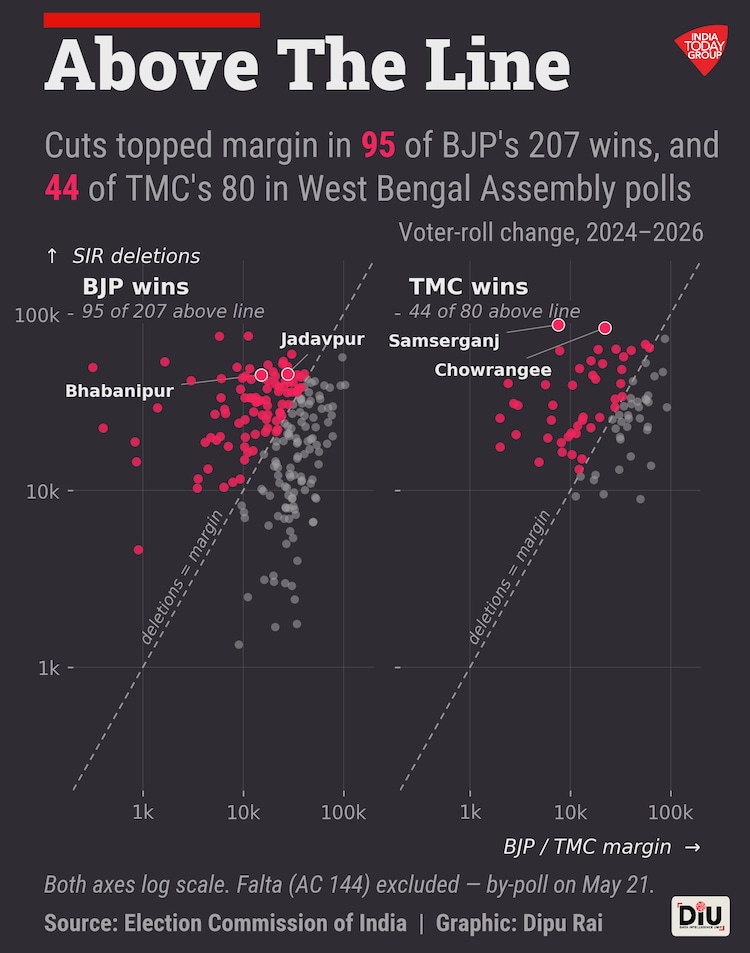
In Samserganj, Murshidabad, the SIR removed 86,977 voters, the largest single-seat deletion total in the state. The TMC retained the seat by 7,587 votes. In Chowrangee, in north Kolkata, the cleanup removed 83,364 names; Trinamool won by 22,002 votes.
The cuts affected seats that the TMC won just as they affected seats it lost.
Other explanations
A different interpretation of the May 4 result has come from pollsters who argue that the SIR was not the decisive factor. Yashwant Deshmukh of CVoter said in a post-result interview with The Federal that women’s anger over the Sandeshkhali allegations, along with perceptions of corruption in the TMC’s local-body system, drove more of the electoral swing than voter-roll deletions did.
Whether the deletions disproportionately affected particular religious or social groups has prompted sharply conflicting claims. The Sabar Institute, citing ECI publications, reported higher Muslim deletion rates in seats such as Nandigram and Bhabanipur. Other outlets, meanwhile, cited other data batches showing Hindu-majority deletions elsewhere in the state.
The DIU seat-margin analysis, however, is limited to checking whether the cuts were numerically large enough to matter in each constituency.
The Election Commission has signalled similar revisions in other states ahead of the 2027 election cycle. If the Bengal pattern persists, debate over the SIR is likely to outlast this election.
Note: A seat where deletions exceeded the victory margin is not evidence that the result would have changed; it only shows that the number of removed voters was large enough to have mattered.
– Ends