





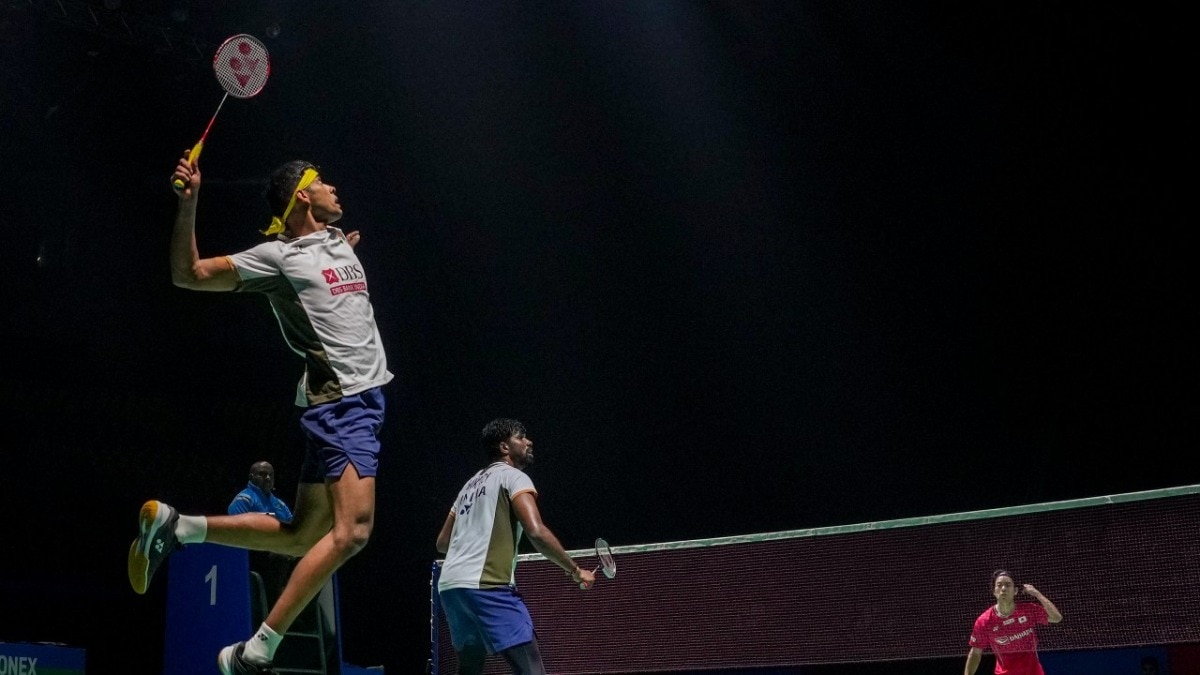
The Instagram story was twelve words long. “Back home now. As usual, no one knows what happened over the past two weeks, and it seems like no one really cares.” Satwiksairaj Rankireddy posted it after the Indian badminton team returned from Horsens, Denmark, with a Thomas Cup bronze medal and no reception to speak of. No official, no fan, no camera. The post went viral. The debate has raged on. India will move on from this.
But Chirag Shetty, Satwik’s doubles partner, the other half of the most successful men’s doubles pair in Indian badminton history, did not move on. He sat down and spoke. Not with the raw grief of a man who had just landed from a long, deflating flight. But with the measured, almost weary clarity of someone who has been carrying this thought for a long time and has finally decided to put it down on the table.
And he had the numbers to back it up.
“I honestly feel more people recognise me in Malaysia or Indonesia than they do in India,” he tells IndiaToday.in.
For a country of 1.4 billion people, one that has produced precious few world-beaters across sports, that is not just an irony. It is an indictment.
What he said was not a complaint. It was a diagnosis.
THE 1983 THAT INDIA FORGOT
There is a number that stops you when Chirag says it: 75.
“As Prannoy also said, people don’t realise Thomas Cup is basically badminton’s equivalent of a World Cup. It’s one of the oldest tournaments in the sport after the All England Championships. It has a 75-year history,” he adds.
India, in 2022, won that tournament for the first time. They beat Malaysia, then Denmark, then Indonesia, the 14-time champions and defending title-holders, to lift a trophy that had existed since 1948 and had never once had an Indian name on it. Then they returned home, were felicitated by the Prime Minister, and watched the moment quietly dissolve into the background noise of the IPL season.
“For me, the Thomas Cup win was a watershed moment for Indian badminton, similar to what 1983 was for Indian cricket — but it wasn’t celebrated the way it should have been,” Chirag says.
The 1983 parallel is not nostalgia. When Kapil Dev’s team beat the West Indies at Lord’s, something structural happened to Indian sport. Money entered cricket. Stardom followed. Infrastructure followed. A generation of children began dreaming differently. The ripple effects of one tournament reshaped an entire ecosystem over four decades.
“In cricketing terms, it’s like Bangladesh suddenly winning a Cricket World Cup,” Chirag says of the 2022 Thomas Cup.
“India had never even won a Thomas Cup medal in 75 years, and then we went and beat Malaysia, Denmark and Indonesia — who were 14-time champions and defending champions — to win the title. It honestly felt like a dream. I couldn’t sleep properly for almost a week after it happened because I couldn’t process that something like this had actually happened.”
And then he lands the line that should make everyone uncomfortable: “After 1983, India didn’t win another Cricket World Cup till 2007. That doesn’t mean cricketers weren’t celebrated during that period.”
The argument is not cricket versus badminton. Chirag is careful and consistent on this.
“This shouldn’t become cricket versus badminton or cricket versus other sports. Sports in general should be celebrated.”
But the comparison exposes something honest about how India builds, or fails to build, its sporting culture. Recognition in India is not a reward for excellence. It is a reward for visibility. And visibility, it turns out, is a product you have to manufacture. Excellence alone does not make it.
“I used to think that if you keep winning, recognition will automatically come,” Chirag says. “But that’s not always true. If we hadn’t voiced our opinion this time, people probably wouldn’t even have noticed any of this.”
THE NUMBERS THAT BUILT THE WILL
Cricket, let us be direct, is not the villain here. It is a different atmosphere entirely. And pretending otherwise is both dishonest and unhelpful.
The IPL’s broadcast rights for 2023–2027 were sold for Rs 48,390 crore, making it the second most valuable sports media property in the world per match, behind only the NFL. The 2024 season was watched by an average of 620 million viewers, with 350 billion minutes streamed. The 2023 IPL final set a world record for concurrent live-stream viewership, peaking at over 32 million viewers. State leagues — the Tamil Nadu Premier League, the UP T20 League, built around domestic cricketers most fans could not name — pull television audiences that the Premier Badminton League, at its peak, could only have dreamed of.
The PBL is the story that should be told more often. Launched in 2016, it was a genuinely compelling product — world No. 1 players, international stars, a shortened format built for the attention economy. At its height, the 2017–18 season drew around 40 million viewers across television and digital platforms. It was growing. Then Covid-19 struck in 2020. Sponsorship dried up. Scheduling conflicts with the packed BWF international calendar made viable windows almost impossible to find. Disputes between the BAI and its promoter paralysed revival plans. The league has not been held since.
Five seasons. Then silence. The PBL’s Instagram account has 84,000 followers. The IPL has 57 million.
The Hockey India League, revived after a seven-year hiatus, limped through its 2025–26 edition with little of the fanfare its return deserved. The Indian Super League nearly did not happen at all — a Supreme Court intervention and a Sports Ministry emergency meeting in January 2026 were needed just to get it off the ground, with clubs slashing budgets and players taking salary cuts of up to 25%. Two of India’s most prominent non-cricket leagues, and both were fighting for survival. Pro Kabaddi remains the rare genuine success story, but it stands increasingly alone.
And then there is a problem unique to badminton, one that rarely gets discussed: its calendar is its own enemy. A player wins a BWF Super 1000 tournament on Sunday in Malaysia and is on a flight to China by Wednesday. There is no pause. No window for a narrative to build, for fans to process what just happened, for media to tell the story before the next story begins. Cricket has tours, gaps, bilateral series — extended periods where storylines can develop and audiences can invest. Badminton’s relentless circuit means that by the time a victory might trend, the player is already at the next venue, warming up.
“Even the Asian Championships weren’t broadcast in India, and that’s a huge event,” Chirag says, frustration breaking through the composure.
“The ranking points are equivalent to a World Tour 1000-level tournament. People should know instantly where they can watch badminton. It shouldn’t be difficult to find live coverage. I constantly see fans commenting, asking where matches are being telecast.”
Part of the blame sits with the BWF itself. The global governing body has long struggled to ensure consistent broadcast coverage from Day 1 of a tournament, across all courts. Early rounds — where India’s brightest young players often make their marks — are routinely unwatched, unstreamed, and unreported. By the time the Indian broadcast machinery wakes up to a story, the moment has already passed. Indian federations cannot entirely be held responsible for a structural failure that begins at the top of the sport’s own administration.
The wall, then, is not built from one brick. It is BWF’s broadcast gaps, collapsed domestic leagues, a relentless calendar, a sponsorship market that chases guaranteed eyeballs — and a media that has rarely chosen to push against any of it.
THE MEDIA’S UNPAID BILL
Which brings us to the press box.
Sundeep Misra, veteran sports journalist and founder of NNIS, has spent decades covering hockey, track and field, and Olympic sports across the country. He does not mince words about the industry he has spent his career in.
The evidence is not hard to find. IPL press boxes overflow with accreditations while a BWF Super 750 tournament in the national capital — one of the highest-ranked events in world badminton — draws fewer than ten journalists to cover it. The priorities are not hidden. They are just never said out loud.
Misra recalls what Neeraj Chopra — India’s most celebrated track and field athlete, an Olympic gold medallist — has said privately and publicly about this dynamic.
“If I’m throwing somewhere, and I win a medal, or I set a national record, or I win a domestic championship, what is the harm if you give me a little bit of space? What is the harm if you send a journalist to cover it? I feel overwhelmed and I feel I’m not getting what is due to me simply because you are lazy enough not to give it.”
Lazy. It is a precise word. Not malicious. Not conspiratorial. Just lazy.
“I agree that cricket gives you numbers,” Misra says.
“Everybody has a right to chase numbers. But there is a line that should be drawn. If 30 cricket stories are going daily, there is no harm in doing six stories from other sports. The moment you don’t do that, then you are basically saying, ‘I don’t understand long-distance running. I don’t understand what Chirag is doing or what Lakshya is trying to achieve.'”
There is also the question of craft. Not every sport can be understood on first viewing, and the media has largely abdicated the responsibility of teaching audiences how to watch. “If tomorrow you hold a triple jump national championship in the middle of Connaught Place, who will watch it?” Misra asks.
“Curious onlookers will stop for some time, but 60 percent will walk away because they don’t understand the technicality. Now whose job is it to put that sport on the stage and on the table? It is our job. Are we fulfilling that? Honestly, I don’t think so. It’s a big no.”
Every four years, when the Olympics arrives, Indian sports journalism has a brief, intense awakening. Medal counts are debated. Systemic failures are diagnosed. Columns are written. And then the Olympics ends, the column inches shrink, and the athletes go back to competing in tournaments that no one sends a reporter to cover.
THE ZOMATO FIX
So who fixes this? And how?
Misra has a framework that reframes the entire debate. “Federations need to create a ‘Zomato’ for sports — take the sport to the fan.”
The logic is simple: in an era of shrinking attention spans and infinite entertainment options, waiting for audiences to discover a sport is not a strategy. It is a surrender.
He watched Europe solve this problem in a different way.
“They took sports to railway stations and public places. People waiting for trains would stop and watch pole vault or athletics demonstrations. Slowly they started understanding the sport and cheering for it.”
This is not a romantic idea, it is an established practice. Every year at Weltklasse Zrich, one of the Diamond League’s most prestigious meets, the pole vault is staged inside the Zrich Hauptbahnhof — the city’s grand, cavernous main train station. The world’s best vaulters, including Mondo Duplantis, the greatest pole vaulter in history, compete as commuters stream past and curious crowds pack the concourse. Admission is free. The sport comes to the city. The city stops and watches.
And then, closer to home: “Why can’t we do that here? Nobody wants to go to stadiums because you don’t have parking, there’s too much hassle, too many checks. So put the sport in Sarojini Nagar, in Connaught Place, in colonies, in malls.”
He recently watched relay events in Chandigarh draw 300 to 400 spectators — in a stadium surrounded by residential sectors. Compare that to the Botswana World Relays, where 60,000 people packed a stadium to watch athletics. The difference was not the sport. It was the decision to make the sport feel like an event worth attending.
Misra’s most striking data point comes from a village tournament he witnessed in Bholath, Kapurthala, while researching a book on kabaddi.
“There were 18,000 people watching at 7 pm in a village. Harley Davidsons lined up outside. Huge prize money. People from Toronto, Vancouver, California were calling live and sponsoring players with cash rewards.”
A village tournament pulling more crowd than a national championship in a major Indian city. The appetite exists. The delivery mechanism is broken.
“If our hockey players are not finding enough space in this country, then federations need to be flexible enough to hold events in Gurgaon colonies, malls, markets — wherever people are,” Misra says.
“Why are we not taking sport to the people?”
Chirag, from the athlete’s side, points to the BCCI as the model that every other federation should study and adapt from, not resent. “Other sports can learn a lot from cricket. Cricket has set the gold standard in terms of promotion, fan engagement and leagues like the IPL. There’s a lot to learn from that model.” It is not a concession. It is a pragmatic challenge to every other sporting body in the country: stop complaining about the mountain and start building your own road.
THE MISSING RACKET
There is a generation of children watching all of this. And they are doing the math.
“Academies nowadays charge Rs 20,000 to Rs 40,000 per month,” Chirag says.
“For a regular Indian family, that’s a massive expense. And not every child in an academy is going to become an Olympic medallist. That’s the hard truth.”
Now layer on top of that financial burden the knowledge that even if you do make it, if you become one of the best doubles pairs in the world, win a Thomas Cup, reach BWF Super 1000 finals, you may still design and print your own national team jerseys. You may still come home to an empty airport.
“Before leaving for the Thomas Cup, we decided to create our own apparel — sort of a limited drop — to honour the tournament and also honour the fact that we had won the title in 2022,”
Chirag explains of the self-designed T-shirts that became the defining symbol of this moment. “It was basically a travel T-shirt. It had the Indian flag on the left side and ‘Thomas Cup 2026’ with a star on the right side, representing the one title we had already won.”
Here they were, two of the finest doubles players on the planet, representing India at one of the sport’s most prestigious team events, standing in an airport wearing jerseys they had bought, designed, and sent for printing themselves.
“When kids see that even after winning massive tournaments there’s hardly any recognition, they can naturally feel disheartened,” Chirag says. “If kids still feel there’s no recognition after that, they may wonder what the point is of even picking up a racket.”
Misra connects this to the wider cost of silence.
“Too many players have kept this inside themselves and suffered in silence. The sport suffers, but psychologically the player also suffers. Imagine living in a colony where everybody has a BMW and you are the only one with a small car. Even if you are good at what you do, you will feel suppressed. That’s what happens when athletes constantly compare themselves with cricket.”
“I think it’s great that this has finally come out in the open.”
WHAT WE OWE THEM
India is building a pitch to host the 2036 Olympics. Stadiums are being planned. Budgets are being announced. The language of a sporting revolution is everywhere.
But Chirag Shetty is not asking for a revolution. His ask, when you strip it back, is almost disarmingly modest.
“I think people should become more engaged with the sport and follow results regularly — good or bad. Criticism is absolutely valid, as long as it’s constructive. More fan engagement will help the sport grow tremendously.”
Not crores. Not parades. Not prime-time television slots. Just people following results. Just criticism that builds rather than burns. Just the basic infrastructure of a sporting culture — where achievement is acknowledged, where athletes feel the country is watching, where a kid in an academy believes that the grind is worth it.
The jerseys say it all. Not the medals on the chest, not the ranking points, not the Grand Slam titles or the Thomas Cup star. The jerseys they paid for themselves, standing in an airport where nobody asked where they were going.
India wants the 2036 Olympics. It wants the world to watch. But first, it might want to start watching itself.
– Ends