


A software developer who was laid off during probation and left without an income has shared how he bounced back to secure a new remote role, revealing the job-hunting strategies he believes helped him land an offer in a difficult tech market.
The techie detailed his experience in a post on Reddit’s r/developersIndia forum, explaining that just six weeks ago he was “completely broken” after losing his job. “Laid off during probation, zero income,” he wrote, recalling how uncertain the situation felt at the time.
Now, he says he has accepted a fully remote role, albeit at a 30 per cent lower salary than his previous job.
“That’s enough for me right now,” he wrote.
Sharing what worked during his search, the developer said he built a custom job scraper that automatically pulled openings from platforms including LinkedIn, Naukri, Instahyre, Wellfound and Uplers every four hours. He then applied aggressively, sending applications daily without spending too much time debating each role.
He also reached out directly to recruiters and hiring managers through LinkedIn messages and emails after applying. While most messages went unanswered, he said the approach did help generate a few opportunities.
The techie credited networking with former colleagues and even Reddit users for helping him sharpen his interview skills. According to him, three to four interview opportunities came through direct messages after his earlier Reddit post gained attention.
“Couldn’t crack them but the practice helped a lot,” he admitted.
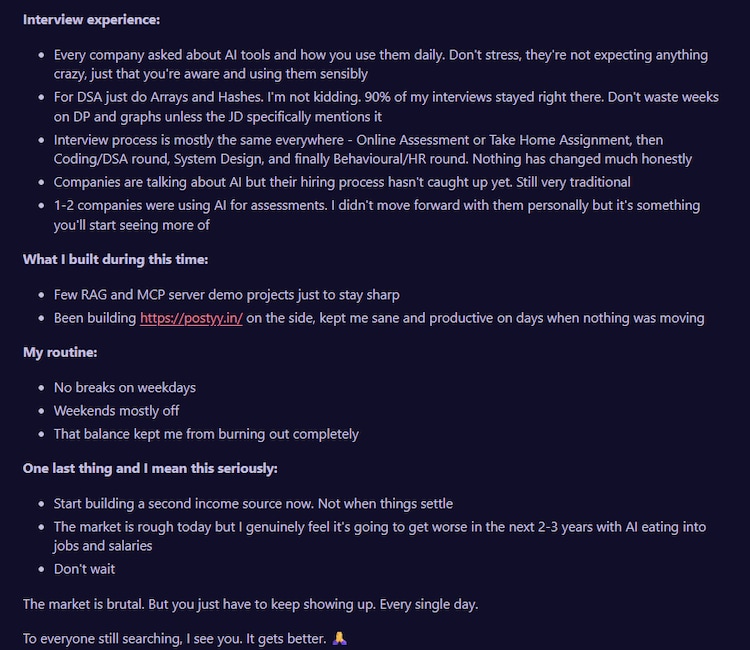
Reflecting on the interview process, he said nearly every company he spoke with wanted candidates to demonstrate familiarity with artificial intelligence tools. However, he stressed that interviewers were generally looking for practical usage rather than advanced expertise.
He also claimed that many software engineers overcomplicate interview preparation.
“For DSA just do Arrays and Hashes. I’m not kidding. 90% of my interviews stayed right there,” he wrote, arguing that candidates often spend too much time studying complex topics that rarely appear in interviews.
Despite widespread discussion about AI transforming workplaces, he observed that hiring processes remain largely unchanged. Most companies, he said, still rely on traditional rounds such as online assessments, coding interviews, system design discussions and behavioural evaluations.
Alongside his job search, the developer spent time building projects involving Retrieval-Augmented Generation (RAG) systems and MCP servers, while also working on a personal side project. He said having something productive to focus on helped him maintain momentum during periods when applications yielded little progress.
The developer also offered a warning for others in the industry, urging professionals to start creating additional income streams instead of relying entirely on a single employer.
“Start building a second income source now. Not when things settle,” he wrote.
He concluded by acknowledging the challenges facing job seekers while encouraging them to remain persistent.
“The market is brutal. But you just have to keep showing up. Every single day.”
Take a look at the post here:
The post struck a chord with many readers, who described the advice as practical and relatable. Several said the detailed breakdown offered useful guidance for those considering a career move or navigating unemployment, while others were particularly interested in his views on building secondary income streams.
Many also congratulated him on securing a role after a difficult period, with some asking him to share the exact DSA questions and preparation methods that helped him get back into the job market.
– Ends