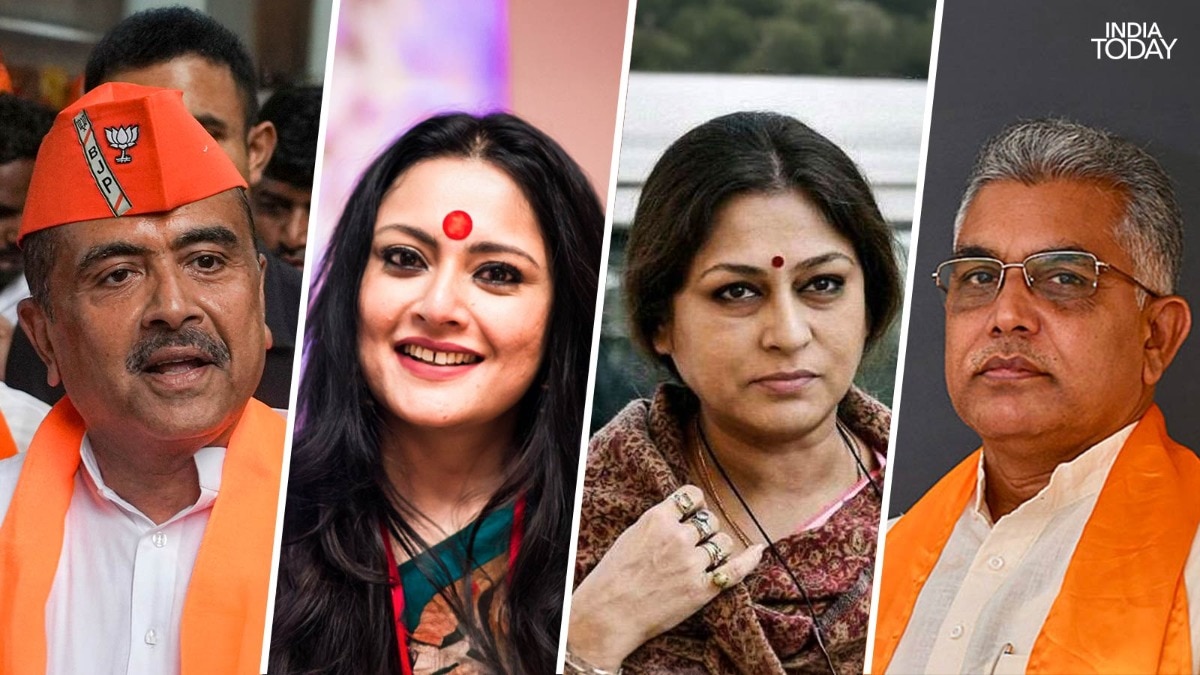





For the BJP and the Rashtriya Swayamsevak Sangh (RSS), the landslide election verdict in West Bengal carries a weight beyond numbers. This is the land of Syama Prasad Mookerjee, a foundational figure in the ideological lineage that shaped the party. It is also seen as a cradle of cultural nationalism, a region whose intellectual influence once defined much of India’s political imagination.
Over time, that legacy was believed by many in the BJP to have been eroded, first under 34 years of Left Front rule and then under Mamata Banerjee’s Trinamool Congress (TMC) since 2011. The May 4 election verdict is, therefore, being framed as a moment of ‘ideological return’.
As former Union minister and BJP leader Ravi Shankar Prasad puts it, it is “an emotional moment for the core base”, comparable in sentiment to the abrogation of Article 370 of the Constitution (that revoked the special status of Jammu and Kashmir) and the Ayodhya Ram Temple movement.
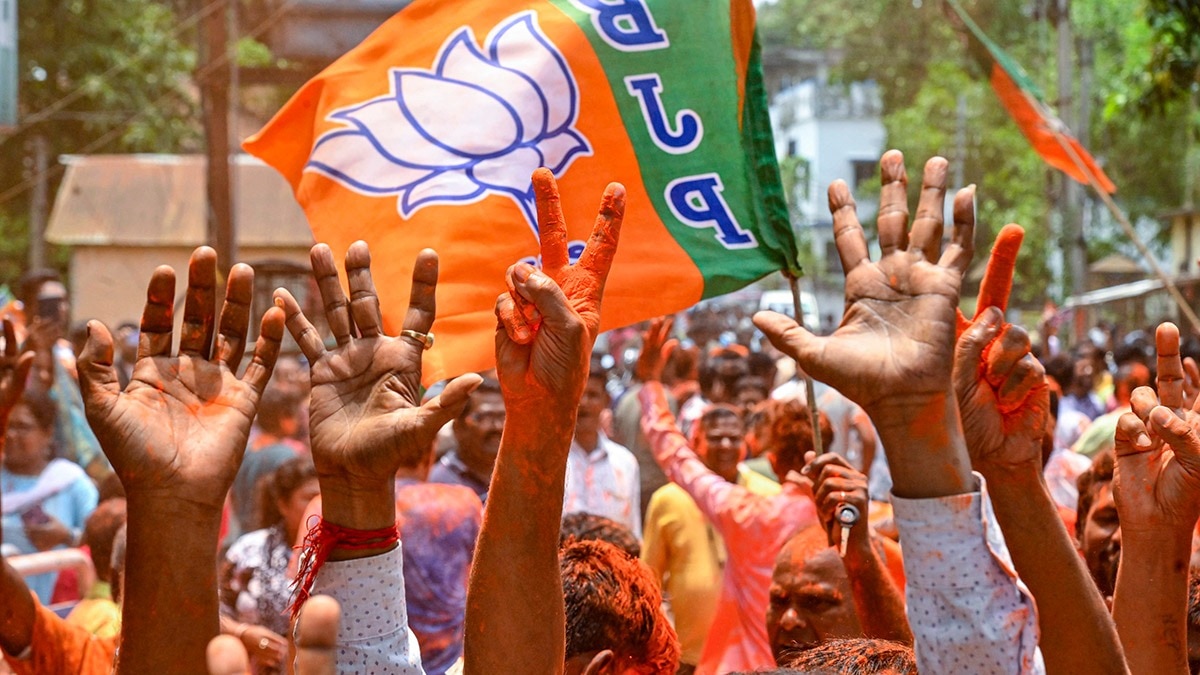
That emotion rests on a decisive shift in the BJP’s tally in the 294-member legislative assembly. The party has secured close to 200 seats, a gain of over 120 seats from its 2021 figure of 77. Its vote share has climbed to 44.5-45.5 per cent from about 38.1 per cent in 2021, a swing of 6 to 8 percentage points. Repolling is due in Falta seat.
The TMC, which swept the last election, has seen its dominance erode sharply. In a state where nearly 100 seats were decided by margins below 5,000 votes in 2021, such a swing does not just tilt contests. It overturns the mandate altogether.
Beyond Bengal, the electoral picture was mixed for the BJP. In Assam, it consolidated itself further with more than 75 seats, and along with allies may cross 100 seats in the 126-member legislative assembly. This would mean a third consecutive term in power.
In Tamil Nadu, the BJP by itself remained marginal with low single-digit seat numbers and a 6-8 per cent vote share. However, the churn in Dravidian politics now gives it a larger strategic role in stitching alliances as actor-turned-politician Vijay’s Tamilaga Vettri Kazhagam (TVK) has struck a blockbuster performance on debut. The effort would be to bring the TVK into the National Democratic Alliance (NDA), led in the state by the All India Anna Dravida Munnetra Kazhagam (AIADMK).
In Kerala, the BJP made incremental gains with two or three seats and around 15 per cent vote share, signalling slow organisational expansion. The state will remain the party’s focus. In Puducherry, the BJP retained a supporting role within the NDA, with five seats and roughly 11 per cent vote share. The contrast then underscores that Bengal has been a standout organisational breakthrough for the BJP.
What makes the Bengal outcome more striking is that the BJP itself had planned for something narrower. Its arithmetic was built around winning 135 to 160 seats. The strategy was to retain its base, flip 40-50 close contests and boost gains. The assumption was that a 3-5 per cent swing, or roughly 10 additional voters per booth across the 80,000-odd polling stations, would suffice. The actual result went well beyond that.
The swing touched 6-8 per cent and in many seats the booth-level addition was 15-20 voters. The BJP is estimated to have added 12 to 15 million votes compared to 2021. What was designed as a narrow path to power turned into a broad electoral sweep.
All along, BJP national general secretary Sunil Bansal knew that the party would have to build the organisation in Bengal first and embed the insurance that the leadership would trust the cadre and protect them from political violence. This was ensured in the ticket distribution, where the BJP kept out celebs, part-time politicians and turncoats.
Bansal deployed former Union minister Mahesh Sharma to anchor the election war-room and particularly keep an eye on violence by political opponents. An added blanket of assurance for the cadre and voters was the heavy deployment of central forces by the Election Commission (EC).
The story of the BJP’s victory begins not with rhetoric but organisational build-up. When Bansal took charge, the BJP in Bengal was expanding but internally fractured. The influx of TMC leaders had given it reach but also created tension between old-timers and new entrants. Bansal’s first intervention was structural. He balanced the old and new blocs, ensured representation for long-time workers and enforced discipline in ticket distribution and responsibilities. The idea was simple but critical: the BJP had to look like a party, not a loose coalition of defectors. The correction of perception was foundational.
Bansal’s own journey explains this instinct. As RSS pracharak, he was deputed to the BJP after spending years with the Akhil Bharatiya Vidyarthi Parishad (ABVP), where he learnt cadre-building and grassroots mobilisation. Ahead of the 2014 Lok Sabha elections, he was tasked with building the party’s structure in Uttar Pradesh. The results are now part of BJP’s institutional memory—the party won 71 of the 80 parliamentary seats. This was followed by 312 seats out of the total 403 in the 2017 assembly elections, 62 Lok Sabha seats in 2019, and 255 assembly seats in 2022. But more important than the numbers was the system at work: a booth-driven, data-backed organisational model functioning with precision.
In August 2022, Bansal was formally absorbed into the BJP as national general secretary and given charge of Bengal, Odisha and Telangana, three states where the party’s organisation was weak or unstable. Before Bengal came Odisha. In 2024, the BJP won 20 of the 21 Lok Sabha seats in the state and also formed the government by bagging 78 of the 147 assembly seats.
The Bengal test was always going to be harder. Bansal’s approach was that elections here be fought not through spectacle but thorough systems. The booth became the battlefield—roughly 44,000 of them were identified as priority zones and categorised into strong, weak and swing segments.
Each booth was mapped to micro workers, with panna pramukhs assigned 30 to 60 voters each. This was not just about coverage but also ownership. Each worker was responsible for specific families, building direct relationships with them and maintaining continuous contact until polling day. The BJP, persistently dubbed by the TMC as an ‘outsider’ force, began to have doorstep presence among people.
This micro-targeting was backed by scale. The party conducted more than 150,000 small meetings and outreach programmes, a silent ground campaign that created sustained engagement. At the same time, the cadre were trained through structured workshops on how to operate during polling and counting. Real-time coordination and feedback flowed between the booths and the state leadership.
What distinguished this effort was not just replication of the Uttar Pradesh model but its adaptation. Experienced organisers were brought in and the messaging calibrated to Bengal’s realities. Cultural identity, border concerns and local grievances were woven into the narrative. The campaign also consciously shifted tone. Unlike 2021, when aggression often overshadowed the messaging, this time the BJP balanced its approach. Corruption, law and order, and governance failures were foregrounded, alongside a welfare narrative built on central schemes reaching millions of beneficiaries.
The electoral pitch thus operated on two levels. Welfare promises and development appeals targeted aspirational voters while positions on citizenship, border control and identity spoke to those driven by cultural concerns. This hybrid model expanded the BJP’s social base.
The integration of the Sangh network amplified this effort. Swayamsevaks were deployed at the booth level while RSS affiliates worked among specific communities. This created a layered structure where ideological commitment reinforced electoral execution. The intensity of the campaign was reflected in Bansal’s own schedule. Over two years, he is understood to have visited each of the 294 constituencies at least 10 times, amounting to nearly 3,000 visits. Union minister Bhupender Yadav, tasked with coordination, toured each constituency at least twice in the final six to eight months. This was not symbolic oversight. It was continuous monitoring.
The role of Prime Minister Narendra Modi and the BJP central leadership remained critical, providing scale and narrative momentum through huge rallies and sustained campaigning. But the difference was that the leadership functioned as a force multiplier, not a substitute for organisation. The results bear out the method. The BJP consolidated its position in north Bengal and Jangalmahal while making decisive inroads into rural and semi-urban constituencies. A high turnout, often touching 85 to 90 per cent, worked in its favour because the organisational grid ensured conversion.
What Bansal achieved in West Bengal may be dramatic in the conventional political sense, but it was very much methodical. He reduced internal chaos, imposed structure and turned the BJP into a process-driven electoral machine. This victory is not the result of a single issue, a single leader or a single wave. It is the outcome of a system where organisation, micro-targeting and narrative discipline worked in alignment.
For Bansal, shaped in the Sangh, trained in the ABVP, tested in Uttar Pradesh and proven in Odisha, Bengal represents the most complex success yet. For the BJP, it marks the crossing of a frontier that once seemed beyond reach. And for Indian politics, it underscores a simple but decisive truth. Election results are no longer just fought and earned. They are engineered.
Subscribe to India Today Magazine
– Ends