







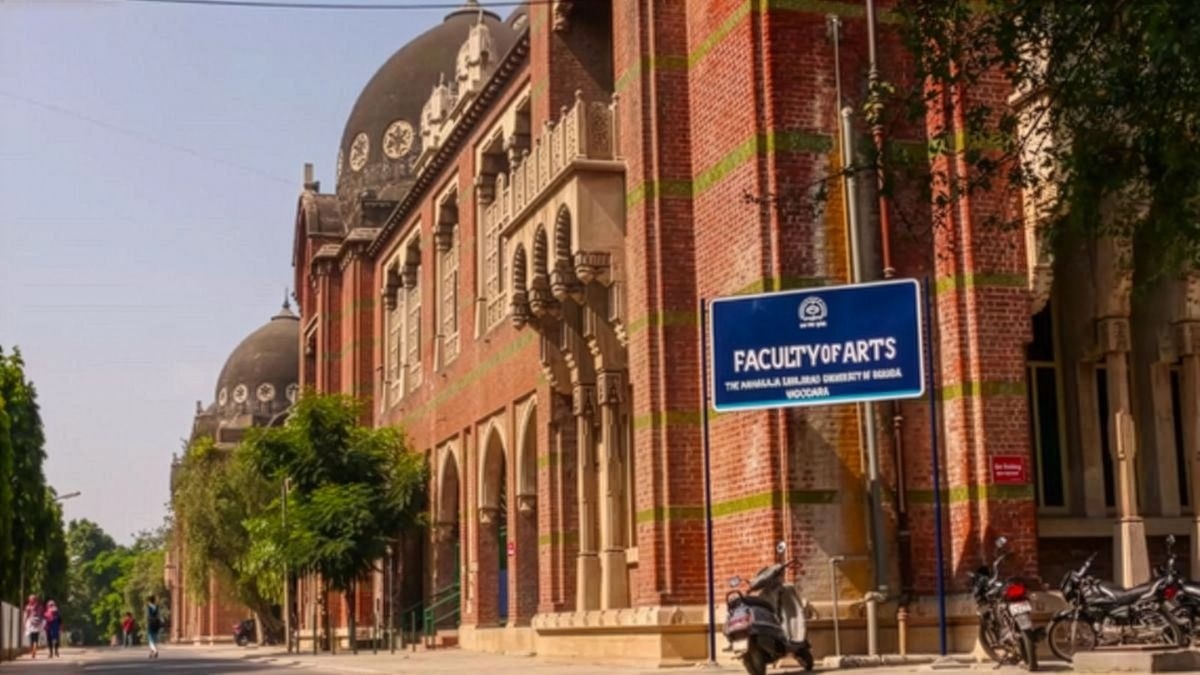
The Maharaja Sayajirao University of Baroda (MSUB), Gujarat’s oldest English-medium public university, has overhauled its sociology curriculum to include ‘Modi Tattva’, a module on Prime Minister Narendra Modi’s leadership philosophy, alongside a study of the Rashtriya Swayamsevak Sangh (RSS). The revision takes effect from the next academic year.
Founded in 1881 as Baroda College and reconstituted as a full university on April 30, 1949, MSUB houses 89 departments across six campuses and counts Nobel laureate Venkatraman Ramakrishnan among its alumni. It remains the only state-run English-medium university in Gujarat, offering programmes in fine arts, performing arts, medicine, science, technology and social sciences. For decades, it has carried reputation as one of western India’s most cosmopolitan campuses.
From the next academic year, three new four-credit modules on Sociology of Bharat, Hindu Sociology and Sociology of Patriotism will be included in the fourth year of BA Sociology programme and the first year of MA Sociology course. The most discussed of the three is Sociology of Patriotism, which will have four papers, each with 15 hours of teaching.
‘Modi Tattva’ is one of several thematic units, sitting alongside units on media and digital nationalism, citizenship and dissent, and globalisation and identity politics in the Sociology of Patriotism module, that will be offered in MA Sociology and the fourth year of BA Sociology.
‘Modi Tattva’ will use sociologist Max Weber’s concept of charismatic authority to examine Modi’s leadership style, poll performance, public perception and policies, treating him as a contemporary case study rather than a retrospective figure. Alongside, students will study RSS history and conduct structured fieldwork into the organisation’s grassroots activities.
Dr Virendra Singh, who heads MSUB’s sociology department and chairs its board of studies, explained the rationale. “In ‘Modi Tattva’, the word ‘tattva’ means ‘element’. An element is something that cannot be ignored wherever it exists. We felt it is better to study the leadership currently present and visible before our eyes. This makes it easier for students to understand [concepts],” he said.
Singh added that the RSS module emerged from fieldwork of MA students conducting surveys in remote villages as part of the NITI Aayog’s monitoring of public policies. They found RSS-affiliated groups active in grassroots implementation, prompting what he described as a need for scientific sociological inquiry.
That last detail raises questions Singh has not directly addressed. The curriculum was developed by Singh in his capacity as head of the sociology department and chair of the board of studies, while he is also associated with the NITI Aayog and the ‘Vadodara 2047’ district plan. Critics note that a curriculum architect with simultaneous government advisory roles designing a course on a sitting government’s leader is an institutional conflict of interest the university has yet to account for.
Political opposition was swift. Congress leader Tariq Anwar called the move “unfortunate”, saying that the organisations being included in the syllabus “had no role in India’s freedom struggle”.
The revision arrives against a fraught institutional backdrop. MSUB’s liberal tradition was badly strained in 2007 when fine arts student Srilamanthula Chandramohan exhibited works that hardline Hindu groups found offensive and protested against. Rather than defend academic freedom, then vice-chancellor Manoj Soni suspended fine arts dean Shivaji Panikkar for refusing to comply with the agitators’ demands.
While Chandramohan was arrested, no FIR was filed against protesters who stormed the MSUB campus. That same vice-chancellor later became chairman of the Union Public Service Commission under the Modi government. More recently, Soni’s successor Vijay Kumar Srivastava resigned in early 2025—a month before his tenure ended—even as a PIL challenging his appointment on UGC eligibility grounds was being heard in the Gujarat High Court.
A sitting prime minister’s leadership philosophy becoming examinable coursework in a public university while he is still in office is possibly without precedent in India’s post-Independence academic history. Whether the course delivers genuine sociological inquiry or ideological endorsement will depend, in large part, on reading lists and examination norms the university has yet to make public.
Subscribe to India Today Magazine
– Ends