

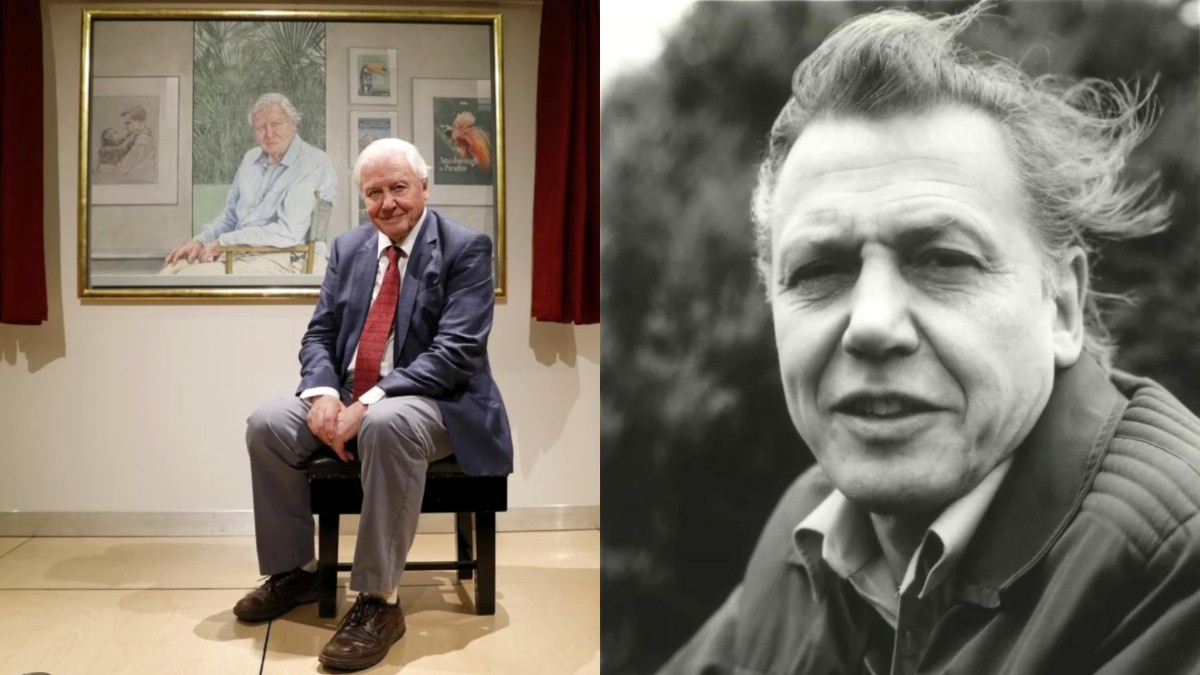
He has watched the Earth change in real time. Not from a distance, not through second-hand reports, but frame by frame, species by species, landscape by landscape.
Now David Attenborough turns 100, carrying with him not just years, but a record of the planet itself.
Born on May 8, 1926, Sir David Frederick Attenborough has lived through almost the entire modern environmental story.
There are very few people whose life can be used to measure environmental change. He is one of them.
A BOY WHO COLLECTED STONES AND STORIES
Born in 1926 in London and raised in Leicester, England, Attenborough grew up surrounded by curiosity. His father was principal of University College Leicester, and the campus became his playground.
He collected fossils, stones, anything that hinted at a larger story beneath the surface.
He was also the younger brother of Richard Attenborough (remember the old man from the 1993 Jurassic Park?), linking him to another towering figure in British cinema.
War arrived early in his life. During World War II, his family took in two Jewish refugee girls fleeing Nazi Germany. It was a quiet but lasting lesson in vulnerability, survival, and responsibility.
At the University of Cambridge, David Attenborough studied natural sciences. The path ahead could have been academic, but television was just beginning to open up. He stepped into it at the right moment.
THE MAN WHO TAUGHT THE WORLD TO WATCH NATURE
His early years at the BBC were behind the scenes. That changed with Zoo Quest, where he travelled to remote parts of the world, often under difficult conditions, to film animals few viewers had ever seen.
He even interviewed Edmund Hillary in 1972, capturing the voice of one of the first men to summit Everest at a time when such conversations still felt raw and close to history.
But the real shift came later.
In 1979, Life on Earth rewrote the rules. It told the story of evolution not as a lecture, but as a journey. Attenborough stood among animals, in caves, on islands, inside ecosystems. The camera followed him, and audiences followed both.
What came after built on that scale. The Blue Planet opened up oceans. Planet Earth turned wildlife into cinematic experience, using cutting-edge filming techniques that changed how documentaries were made globally.
He later helped launch BBC Two and played a key role in introducing colour television in Britain, changing how audiences experienced the natural world.
Decades later, series like Our Planet brought his voice to streaming audiences, reaching a new generation, bringing environmental urgency into mainstream viewing.
Across decades, he has worked alongside scientists, explorers, and conservationists across continents, from early field researchers to modern climate experts.
And throughout his career, he has received multiple BAFTA and Emmy awards, recognition that spans continents and generations.
A polar research vessel, the RRS Sir David Attenborough, now carries his name, exploring some of the most remote parts of the planet he spent a lifetime bringing to the world.
He was not just presenting nature. He was helping invent the language of modern natural history television.
THE PERSONAL LIFE BEHIND THE VOICE
In 1950, he married Jane Ebsworth Oriel. They had two children. While he travelled constantly, often for months at a stretch, she held life together at home. He has spoken about the balance not always being easy.
Her death in 1997 changed him deeply. Since then, he has lived alone, still working, still travelling, still narrating.
He was knighted in 1985 and later awarded the Order of Merit in 2005, becoming one of the most honoured public figures in Britain.
Over the years, he has maintained a respectful public association with the British royal family, even collaborating on environmental conversations with Prince William, though he has always kept a distance from royal circles in his personal life.
Despite global recognition, he has avoided celebrity culture. No loud reinventions, no controversy-driven visibility. Just work that speaks for itself.
FROM WONDER TO WARNING
Something shifted in the later years as our planet degraded faster and faster, breaking one record after another.
The tone changed. The awe remained, but urgency grew sharper.
In David Attenborough: A Life on Our Planet, he framed his own life as a witness account. Forests disappearing, oceans warming, wildlife declining. It was not abstract anymore. It was personal.
He began speaking directly about climate change, biodiversity loss, and human impact. He once said, “The natural world is the greatest source of excitement, the greatest source of visual beauty, the greatest source of intellectual interest.”
That belief runs through everything he has done.
A LIFE THAT BECAME THE PLANET’S MEMORY
A hundred years is a long arc.
David Attenborough saw the birth of television and helped define it. He travelled across a world that is now mapped, filmed, and shared in seconds. He recorded species that no longer exist in the same numbers, sometimes not at all.
What remains is not just footage. It is perspective.
When Attenborough speaks, it carries the weight of time. Not dramatic, not exaggerated, just steady and informed.
That may be why people listen.
Because he is not just telling stories about the planet anymore.
He is telling the story of what happened to it.
– Ends