


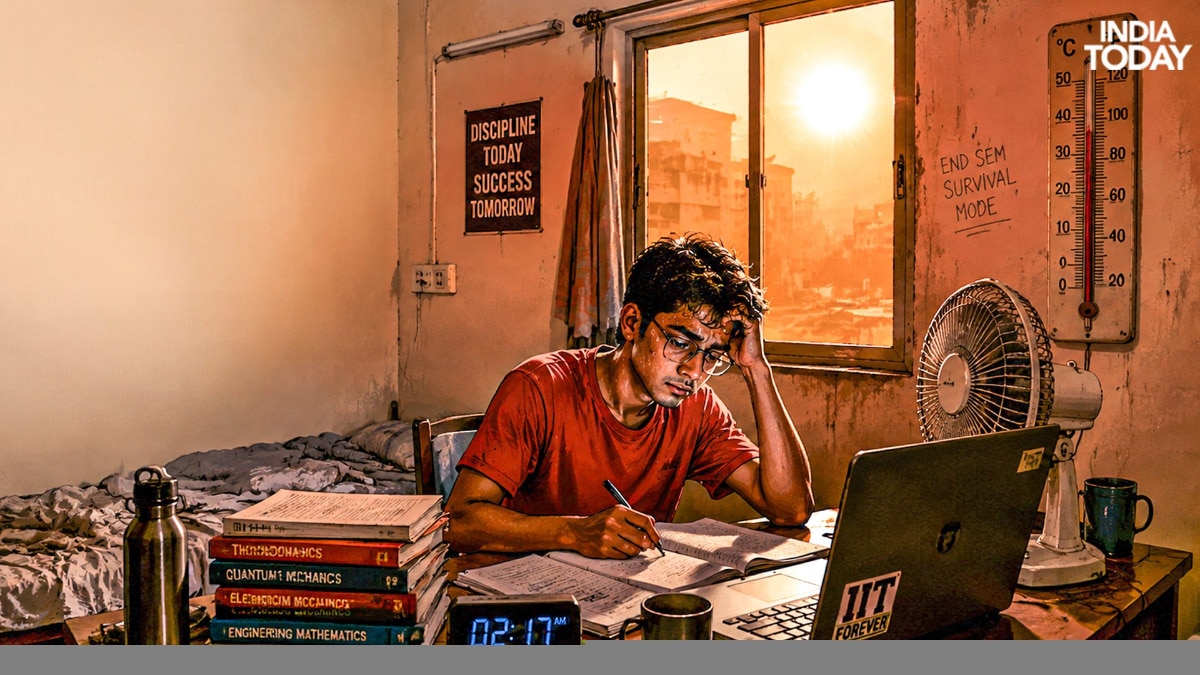
At 2 am, the hostel is awake. Not with the familiar anxiety of exams or the quiet tapping of laptop keyboards, but with the restless discomfort of students who cannot sleep. Ceiling fans spin endlessly above narrow hostel beds, pushing around hot air that refuses to cool.
The walls still radiate the heat absorbed during the day. Outside, temperatures remain above 35 degrees Celsius even after midnight.
Inside engineering campuses across India, students lie awake in sweat-soaked rooms, waiting for exhaustion to overpower the heat.
By morning, the effects spill into classrooms and laboratories. Lectures blur into fatigue. Concentration weakens. Tempers shorten. Students move through the day on too little sleep and too much heat.
India’s heatwave crisis is no longer confined to scorching afternoons. Increasingly, the heat lingers deep into the night, erasing the body’s only window for recovery. As temperatures repeatedly cross 40 degrees Celsius and in many cities edge toward 45 degrees Celsius, a quieter emergency is unfolding inside the country’s higher education campuses.
Hostels built for a cooler India are struggling against a climate they were never designed for. Poor ventilation, overcrowded rooms, and rising nighttime temperatures are turning student housing into spaces of chronic exhaustion.
And the question facing India’s education system is no longer whether the heat is uncomfortable.
It is whether students can continue to study, sleep, and succeed in a country that no longer cools down after dark.
PLANET GETTING HOTTER, SO WHY ARE HOSTELS STAYING THE SAME?
The world is entering an era of relentless heat. The World Meteorological Organisation has warned that global temperatures over the next five years are likely to remain at or near record highs.
Climate scientists now estimate there is an 80 percent likelihood that at least one year between 2024 and 2028 will temporarily breach the critical 1.5 degrees Celsius warming threshold above pre-industrial levels, and likely surpass 2023 as the hottest year ever recorded.
India is already living that reality.
The India Meteorological Department has repeatedly projected above-normal temperatures and more frequent heatwave days, with several regions expected to cross 45 degrees Celsius this summer.
Yet much of India’s higher education infrastructure still belongs to another climate era.
Many older IIT campuses were built decades ago, when hostel architecture relied on natural ventilation, shaded corridors, and ceiling fans rather than mechanical cooling. The assumption was simple: airflow would be enough.
Today, that assumption is beginning to collapse.
Campuses designed for a cooler, more forgiving India are now struggling to cope with nights that no longer cool down, leaving students trapped in relentless heat long after sunset.
WHAT DOES EXTREME HEAT ACTUALLY FEEL LIKE INSIDE A HOSTEL ROOM?
For students, the debate around cooling is not theoretical. It is deeply physical.
Dev Sahani, a student at IIT Kharagpur, describes hostel life during the summer as a test of endurance rather than education.
“It’s 35 degrees Celsius in Kharagpur, but it feels like 42 degrees Celsius. And we’re expected to live like this,” he says.
“Our hostels have no air conditioners. A few common areas do, but our rooms, where we sleep, study, and recover, are stifling,” he adds.
The worst hours begin after midnight. Many students take a bath and do not even towel off afterward, hoping the lingering water on their skin will offer enough relief to fall asleep. Even then, the sleep is restless and repeatedly interrupted by the heat.
The consequences, he says, are no longer limited to discomfort.
“This isn’t just discomfort anymore. It’s affecting our health. Several of us have had repeated dehydration. I myself suffered acute diarrhoea last week after what was essentially heat exhaustion,” Dev Sahani further explains.
“Hostels should definitely have AC, as during the exam season in summer finding a spot in the library or even the hostel’s study room becomes very difficult. In these situations, students are left with only 2 options — buy a personal cooler or withstand the heat,” says Biyas Chakrabarty, an MTech student from IIT Roorkee.
“I’d be willing to pay extra for AC, considering everything for IIT students comes with some subsidy,” she says.
“I find it weird that IIT Kharagpur and IIT Roorkee have a fee difference of hardly Rs 5,000 a semester, but the students at KGP enjoy air conditioning even in their single (non-sharing) rooms in some of the newer hostels,” Biyas adds.
What frustrates students most is not simply the heat, but the feeling that the issue is not being treated with urgency. Many say they have repeatedly raised concerns with wardens, mentors, and academic heads, yet little has changed, leaving them feeling unheard of and increasingly ignored.
And yet, students are not necessarily demanding luxury.
“We are not asking for charity. We are willing to pay. We’re only asking for rooms that are liveable in this heat. Because right now, they aren’t,” Dev adds.
His words reflect a growing sentiment across campuses: that survival should not become part of the academic experience.
WHY IS COOLING AN IIT CAMPUS SO COMPLICATED?
The demand for air conditioning may sound straightforward. Institutionally, it is anything but.
Ashish Dhawan, Managing Partner India at NGS Global, points out that installing ACs across thousands of hostel rooms is not simply a matter of purchasing machines. It requires large-scale electrical upgrades, rewiring, transformer expansion, load balancing, and long-term maintenance infrastructure.
The financial implications are enormous, not just in upfront capital expenditure, but in recurring electricity and maintenance costs.
For institutions, this creates an uncomfortable trade-off: should limited resources be directed toward cooling hostels, or toward laboratories, research facilities, faculty hiring, scholarships, and innovation?
That tension sits at the centre of the debate.
ARE STUDENTS EXPECTED TO ‘JUST ADJUST’?
There is also a long-standing institutional mindset shaping these decisions.
Most IIT campuses already provide air-conditioned academic and recreational spaces, libraries, lecture halls, labs, computer centres, and common rooms. The assumption has often been that students spend most of their day there, while hostel rooms are used only briefly for sleep.
Underlying this is a culture that has historically glorified endurance.
The image of the IIT student surviving on minimal sleep, pushing through discomfort, and prioritising academics above everything else has become deeply embedded in campus life.
That perspective is reflected, to some extent, in how institutions themselves have approached recurring summers.
Manindra Agrawal, Director of IIT Kanpur, notes that heatwaves are not new to campuses like his. “Heat waves have been a fairly common occurrence for as long as I can remember,” he says.
But rising nighttime temperatures are exposing the limits of this older mindset.
When nights themselves become unbearable, even basic recovery becomes difficult. And when sleep deteriorates, every aspect of academic performance follows.
HOW ARE CAMPUSES TRYING TO COPE WITH THE HEAT RIGHT NOW?
For many institutions, the current approach has been adaptation rather than transformation.
Agrawal says IIT Kanpur has already implemented several practical coping measures.
“At the institute, we already allow students to use coolers in their hostels,” he explains.
“Additionally, we’ve adopted some practical approaches to cope with the heat. There are several air-conditioned spaces across campus where students often go to rest, and some even sleep there during extreme conditions,” he adds.
This reflects the broader institutional logic that fully air-conditioning every hostel room may not yet be immediately feasible, but alternative cooling spaces can provide temporary relief.
Yet for students returning to overheated rooms at night, these arrangements often feel insufficient.
IS THIS YEAR’S HEATWAVE REALLY DIFFERENT?
Even as students describe worsening conditions, some administrators remain cautious about framing the current summer as unprecedented.
Agrawal, for instance, argues that extreme summers have become cyclical realities rather than anomalies.
“There isn’t anything particularly unusual about this year,” he says.
Agrawal, however, views the situation through a more measured lens, arguing that intense summer conditions have long been a recurring part of campus life.
But climate scientists increasingly warn that what was once considered “normal summer heat” is intensifying in both duration and nighttime persistence.
And it is the nights, not just the afternoons, that are beginning to alter student life most profoundly.
IF STUDENTS ARE PAYING MORE, WHAT SHOULD THEY EXPECT IN RETURN?
The debate over student living conditions becomes sharper when viewed against the rising cost of studying at IIT.
IIT BTech fees now typically range between Rs 1 lakh and Rs 1.5 lakh per semester, pushing the total cost of a four-year degree to nearly Rs 8 lakh to Rs 12 lakh, including hostel and mess charges. At the same time, IITs received Rs 12,123 crore in the Union Budget 2026–27, a 6.82% increase from the previous year.
As students pay more and institutions receive higher public funding, questions are growing over whether campus infrastructure and hostel facilities are keeping pace. Last year, students at IIT, Gandhinagar also raised concerns after a reported fee hike increased first-semester charges by over Rs 17,000.
India now has 23 IITs across the country, many of which continue to dominate national rankings.
Yet even as IITs strengthen their academic reputation, the debate over students’ quality of life is becoming harder to ignore.
SHOULD RESEARCH COME BEFORE STUDENT COMFORT?
Interestingly, even students and alumni themselves often view the issue with nuance.
Dhawan recounts conversations with IIT graduates who admitted that while air-conditioned rooms would undoubtedly improve quality of life, many students would still prefer institutional funds to prioritise research, laboratories, and academic infrastructure.
This reflects a deeper value system within elite technical institutions, one that has traditionally placed intellectual ambition above physical comfort.
But climate change is beginning to challenge that hierarchy.
Because when extreme heat affects sleep, concentration, and health, “comfort” can no longer be separated from capability.
WHO GETS TO ESCAPE THE HEAT, AND WHO DOESN’T?
The burden of extreme heat is also unevenly distributed.
Some students can afford private accommodation, portable cooling devices, or frequent travel home. Others depend entirely on hostel infrastructure.
The inequalities extend across campuses as well.
Newer institutions such as IIT Jodhpur have already begun adopting air-cooled or air-conditioned residential models, signalling an awareness that climate realities must shape infrastructure planning. Older campuses, however, face slower transitions because of ageing architecture and outdated electrical systems.
What often appears to be a shared culture of resilience can quietly conceal unequal living conditions.
ARE IITs FINALLY BEGINNING TO CHANGE?
Despite the slow pace, change is underway.
Agrawal says future infrastructure projects at IIT Kanpur are already being designed differently. “The new hostels we are constructing are being designed with air-conditioning in mind,” he says.
But transforming older campuses remains far more difficult.
“Upgrading older hostels is a bigger challenge, as they were not originally built to support such systems. Retrofitting them will take time and careful planning,” he adds.
His comments capture the larger transition underway across Indian higher education; Institutions are beginning to acknowledge that climate realities must now shape campus design itself.
WHAT HAPPENS WHEN ENDURANCE BECOMES THE SYSTEM?
The fan is still spinning. The heat is still rising.
Between those two realities lies an education system trying to reconcile its past with an increasingly unforgiving future.
Institutions must balance competing priorities, research, access, infrastructure, affordability. But climate change is forcing a reordering of what matters most.
Because the question is no longer whether students can endure the heat.
Many already do.
The question is whether they should have to.
In a warming India, resilience cannot be defined by how much discomfort students are willing to tolerate. It must be defined by how systems evolve to ensure that learning is not compromised by survival itself.
– Ends