





The iPhone has long stood the test of time. Come what may, it marches on, unencumbered. A new challenger now lurks in the shadows, waiting to strike when the moment is right.
Word on the street is OpenAI, maker of ChatGPT, is building a new smartphone. You might say, “Okay, one more smartphone, what’s the big deal?” The big deal, dear reader, is this new smartphone may be coming to eat Apple’s lunch. Rumour has it that this OpenAI phone aims to replace the sea of colourful icons and constant scrolling on your current iPhone with a singular, intelligent interface that understands a user’s life through the natural mediums of voice and vision. In other words, it may challenge the app-centric world Apple spent nearly two decades building. No wonder insiders are calling it the “anti-iPhone.”
Unlike the iPhone, which demands constant attention, the OpenAI phone is rumoured to do the opposite by minimising interactions so you can, perhaps, go out and touch the grass every once in a while, as Apple CEO Tim Cook too wants you to, lately. It would incorporate the design mastery of legendary Apple alumnus Jony Ive who has, on multiple occasions, condoned the “unintended consequences” of the iPhone, particularly screen addiction. It won’t be surprising if the OpenAI phone has no screen, or something they feel is the right size.
In this vision of the future, the friction of opening a specific app to book a flight or filter a restaurant menu disappears. Instead, you speak to a persistent, proactive AI agent – very likely ChatGPT – that manages these tasks in the background, effectively stripping away the layers of software that currently stand between human intent and digital execution. This shifts the focus from navigating a grid to fulfilling a need. Some in the industry already feel that it is a good idea. CEO of Nothing, Carl Pei, said recently, “the app grid had a good 15-year run, but the next interface is intent.”
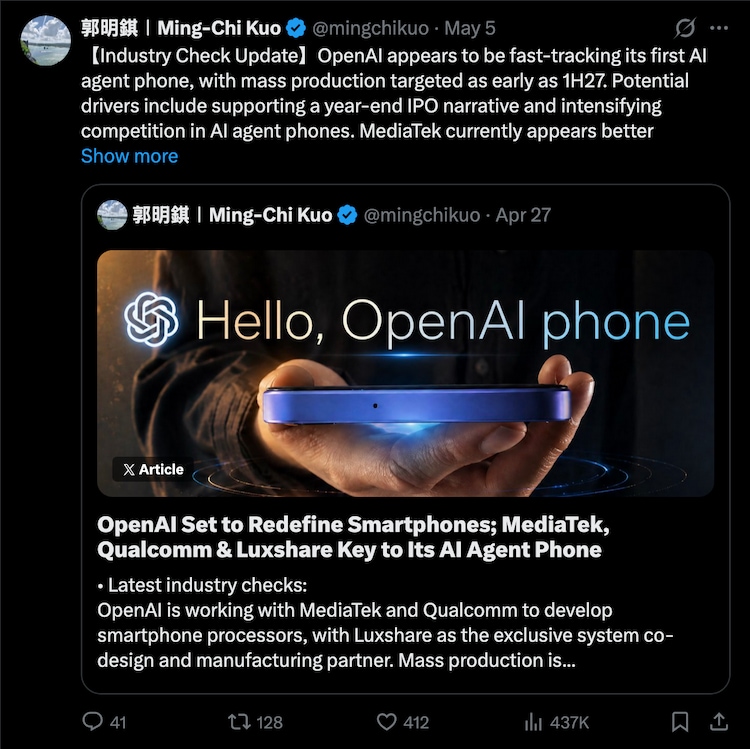
According to noted Apple analyst, Ming-chi Kuo, the timeline for this ambitious project has been significantly accelerated with the target for mass production pegged for early 2027. The phone is expected to use a 2-nanometre-class processor and a dual Neural Processing Unit architecture. This hardware setup is designed to handle complex AI reasoning locally on the device rather than relying entirely on the cloud. MediaTek is apparently the frontrunner for supplying the chips, while Luxshare – a key manufacturing partner for Apple – is being roped in to build the final units.
Can OpenAI’s anti-iPhone beat the iPhone?
In some ways, maybe. But not entirely. Apple has sold over 2.6 billion iPhones and currently maintains a base of 1.5 billion active users who are deeply locked into the iOS ecosystem. The iPhone is no longer just a communication tool. It has become a digital wallet, a professional-grade camera, and a primary gaming console. For OpenAI to displace such a deeply rooted cultural staple, it must prove that it can handle the hustle and bustle of daily life.
While OpenAI’s project may benefit from a custom chip partnership with MediaTek and the $6.5 billion acquisition of Ive’s design firm, LoveFrom, it is entering a hardware graveyard littered with failed AI-first devices. To win, OpenAI must do more than provide better software (or even hardware). Carl Pei has argued that the modern computer needs to be rebuilt around personal context, not apps. Whether it is email, travel, or even running recovery, the next paradigm is a computer that adapts to the person, quietly enough that life feels lighter, not louder.

The true threat to Apple (and even Samsung) is not necessarily that OpenAI will sell more phones, but that it may render the current operating system model obsolete. We are entering a potential post-app era where the interface is defined by agency rather than navigation. Currently, if a user wants to organise a night out, they must jump between a messaging app, a calendar, and a ride-hailing service. OpenAI is reportedly building an agent-first interface where the central AI handles the intent directly. In this world, the digital experience of every individual would look completely different because the system is reflecting their unique context rather than a standardised list of software.
By building its own phone, OpenAI gains a level of control that it currently lacks as a guest on other platforms. At present, OpenAI’s intelligence lives inside apps on iOS and Android, subject to the privacy rules and API restrictions of those gatekeepers. A dedicated device gives OpenAI direct access to raw sensor data, constant camera feeds, microphone input, and precise movement, which allows for a much more powerful, always-on AI context. This level of intimacy with the user’s environment is something Apple and Google have historically restricted for both privacy reasons and to maintain their competitive grip on the user experience.
As Palantir noted in its 22-point manifesto, it is time we must rebel against the tyranny of the apps. While the iPhone may be our greatest creative achievement as a civilization, the object that changed our lives may now be limiting and constraining our sense of what is possible, the company said.

Despite the advantages, history is full of cautionary tales, such as Amazon’s Fire Phone and Microsoft’s Windows Phone, which failed despite having billions of dollars in backing. Building hardware at scale is notoriously difficult and requires a global retail presence and carrier partnerships, assets that OpenAI will have to build. Breaking the gravity of ecosystem lock-in is a massive hurdle when users are tied to iMessage and existing wearable ecosystems. Convincing a consumer to spend money on an experimental device that is different may be the greatest marketing challenge in the history of consumer electronics.
Be that as it may, Apple and Samsung are not standing still while OpenAI plots its move. By embedding AI deep into their existing operating systems, they are offering users a path of least resistance. They are “easing” the global population into AI-driven features without requiring them to abandon their favourite apps or change their physical habits. While OpenAI seeks to start a revolution, Apple and Samsung are betting on an evolution that keeps the screen at the centre of their world. Time will tell if the smartphone was the final form of personal computing or merely a stepping stone toward a more invisible, intelligent future where the computer finally adapts to the person.
For now, as they say, two’s company, three’s a crowd. OpenAI would really have to go out of its way and deliver something revolutionary in the real-world, not just on paper, to beat the iPhone (and Samsung Galaxy).
– Ends