

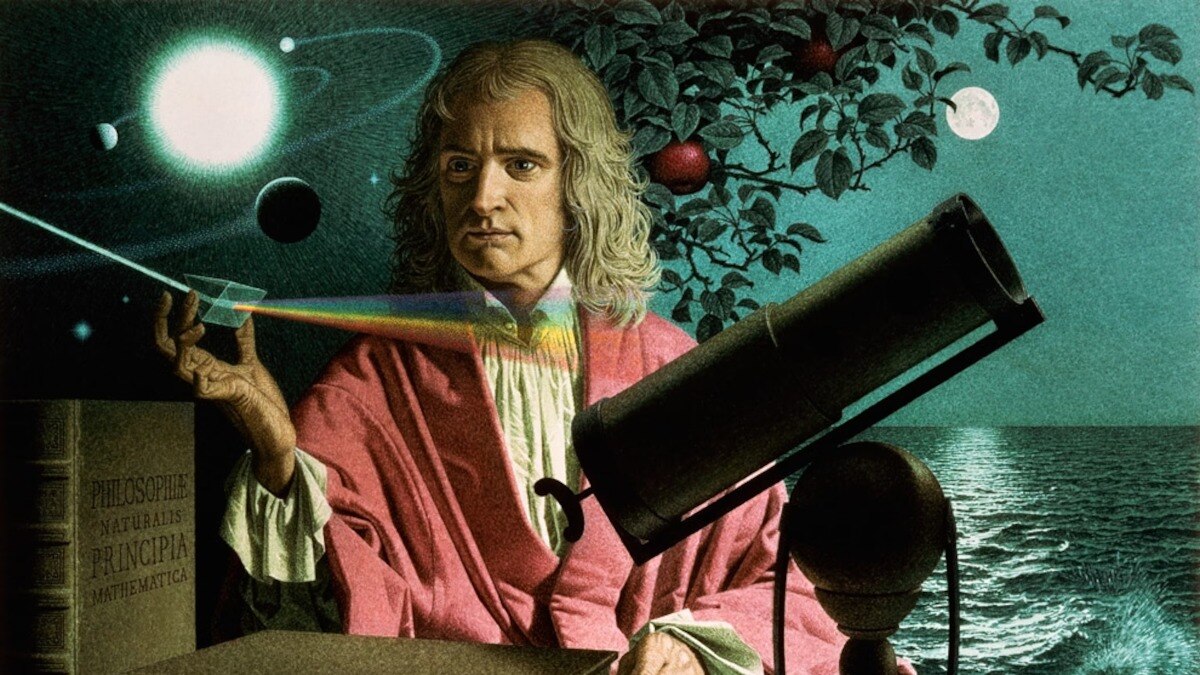
“What we know is a drop; what we do not know is an ocean.”
There is a certain restraint in this line, an economy of words that stands in contrast to the scale of the man who spoke it. Isaac Newton, the architect of classical mechanics, the mind behind the laws of motion and universal gravitation, did not speak here as a conqueror of knowledge, but as a witness to its vastness.
This is not the voice of triumph. It is the voice of perspective.
A MIND THAT DEFINED AN AGE
In the late 17th century, Europe was in the midst of intellectual churn. The old certainties of medieval thought were giving way to observation, measurement, and experiment.
Into this moment stepped Newton, whose work would alter the grammar of science itself.
His Principia Mathematica, published in 1687, did more than introduce equations, it imposed order on chaos. The fall of an apple and the motion of planets were no longer separate mysteries; they were governed by the same force.
The heavens and the earth, once thought distinct, were now part of a single system.
And yet, even as he drew these connections, Newton remained aware of the distance between discovery and understanding.
THE HUMILITY BEHIND THE FORMULA
The quote does not emerge from ignorance; it emerges from awareness. Newton had seen further than most, yet what he saw convinced him of how much remained unseen.
In many ways, this line reflects a deeper intellectual tradition, one that values doubt as much as certainty. It is a reminder that knowledge is not a destination but a process.
Every answer, when examined closely, opens the door to new questions.
For a student awaiting results, this may seem distant from immediate concerns. Marks, ranks, and percentages carry weight. They define opportunities, shape futures. But Newton’s words suggest a different lens.
What you know today, what any exam can measure, is only a fragment. It is not the whole story.
BEYOND THE RESULT SHEET
In the current academic cycle, as students across boards await results, whether from the Central Board of Secondary Education or state boards, the focus narrows to numbers. Scores become shorthand for ability. Outcomes begin to define identity.
But learning, in its truest sense, resists such compression.
Newton did not become Newton because he had all the answers. He became Newton because he pursued questions others did not think to ask.
His work was not driven by certainty but by curiosity, by a refusal to accept the visible as the final truth.
This is where the quote finds its relevance today.
THE OCEAN REMAINS
There is a quiet reassurance in the idea that knowledge is an ocean. It means there is always more, more to learn, more to understand, more to attempt.
A setback does not close the door; it merely shifts the path.
For those who perform well, the quote serves as a caution against complacency. For those who do not, it offers a form of release: the recognition that a single measure cannot contain the entirety of one’s potential.
Carry this line not as a slogan, but as a method. Approach your work with the awareness that certainty is provisional. Question what you read. Test what you learn. Allow room for doubt, not as weakness, but as a tool.
Newton’s legacy is not just in the laws he wrote, but in the mindset he embodied. A willingness to explore without the illusion of finality.
In the end, the drop matters. But it is the ocean that gives it meaning.
– Ends