

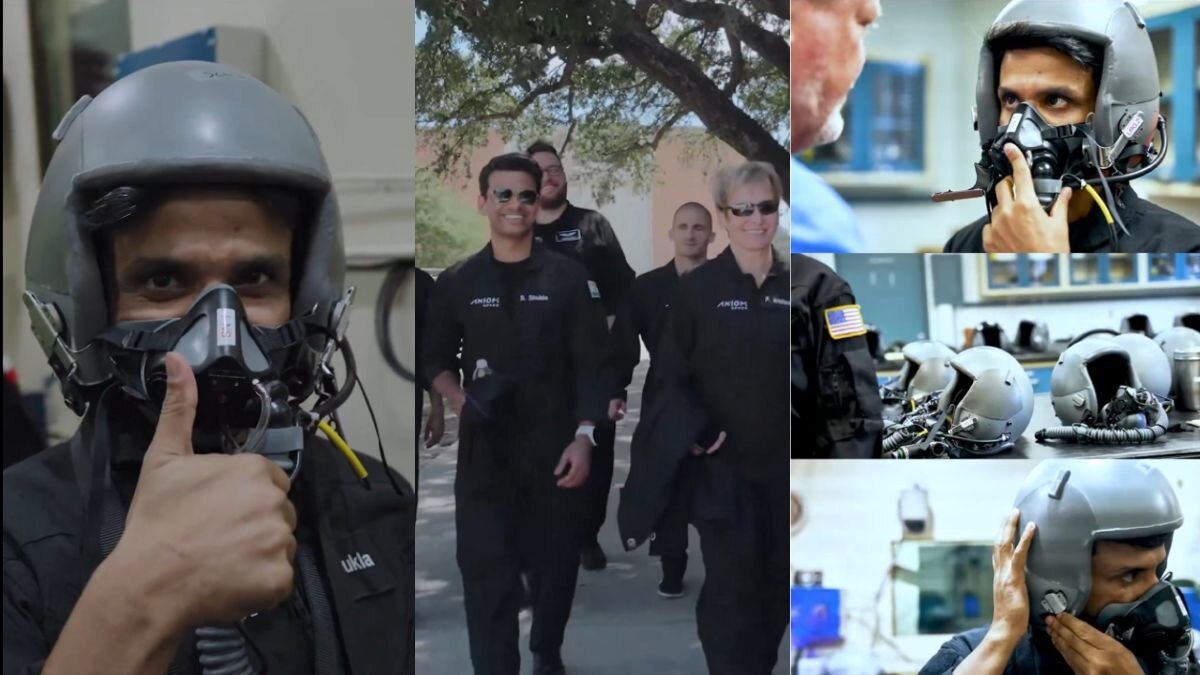
India’s Group Captain Shubhanshu Shukla recently gave the world a rare, unfiltered look at one of the most quietly unsettling parts of astronaut preparation: training to survive hypoxia, the oxygen starvation that can incapacitate a person before they even realise something is wrong.
In a video shared on X, Shukla, who went to the International Space Station (ISS) last year as part of Axiom-4 (Ax-4) mission, said, “You may not even realise that you are affected. Your crewmates might see changes in you before you do.”
WHAT EXACTLY IS HYPOXIA, AND WHY IS IT DANGEROUS IN SPACE?
Hypoxia is the condition where the body’s tissues do not receive enough oxygen to function.
In spaceflight, the specific concern is something called hypoxic hypoxia, which simply means the air around you does not have enough oxygen pressure to keep your body running properly.
Think of it this way. Oxygen does not just need to exist in the air you breathe; it needs to push its way into your bloodstream through your lungs.
Scientists call this pushing force partial pressure, which is just a fancy way of saying how hard a particular gas is pressing against your body. The harder it pushes, the more of it enters your blood.
At sea level on Earth, air presses down on us at 14.7 psi, or pounds per square inch.
Think of psi as a measure of how hard the air is squeezing against every square inch of your skin.
That squeeze is what keeps oxygen flowing into your lungs and then into your blood.
Normal air at sea level is made up of about 21 per cent oxygen, and at 14.7 psi, that is more than enough to keep the human body functioning.
In space, if a spacecraft’s cabin begins to lose pressure, whether through a slow, invisible leak or a sudden breach, that squeeze weakens.
Even if oxygen is still present in the cabin air, it no longer pushes hard enough to enter the bloodstream properly.
The result is hypoxia, and it can set in faster than most people expect.
WHY CAN’T ASTRONAUTS JUST DETECT IT THEMSELVES?
This is the part that makes hypoxia so treacherous. It has no fixed script.
Research in aviation medicine shows that some people become euphoric.
Others grow confused, unnaturally calm, or strangely cheerful. Many feel nothing unusual at all, right until they can no longer think straight.
Studies show symptoms can appear as late as eight minutes in, or as early as 27 seconds.
The brain region responsible for recognising a problem is often the first to be compromised.
Aerospace medicine uses a concept called Time of Useful Consciousness (TUC), the shrinking window in which a person can still take purposeful action before incapacitation.
At 35,000 feet, that window is roughly 30 to 60 seconds. At 45,000 feet, it collapses to under 15 seconds.
HOW DO ASTRONAUTS TRAIN TO PROTECT THEMSELVES DURING HYPOXIA?
As shown in Shukla’s video, crews are trained in two main ways: hypobaric chambers, which simulate a real pressure drop, and normobaric reduced oxygen breathing devices (ROBDs), which keep the surrounding pressure normal but reduce the oxygen percentage to mimic altitude.
Both are medically supervised, with oxygen masks on standby. The training does two things: it teaches a person to recognise their own unique symptoms, and to watch for changes in the crewmate beside them.
In space, Shukla reminded us, awareness is never just personal. It is always shared.
– Ends