



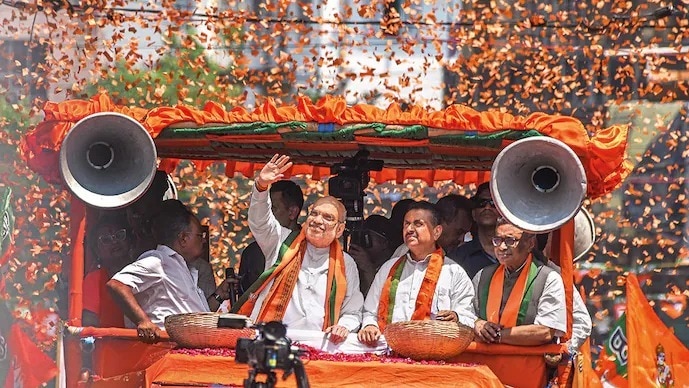
The BJP has created history in West Bengal, breaching a fortress long considered impregnable and scripting a landmark victory in the state. With the party crossing the 200-seat mark in the 294-member Assembly, it has decisively unseated the Trinamool Congress after three consecutive terms, overcoming both the weight of history and the challenges of taking on Mamata Banerjee on her home turf.
At the centre of this political transformation stood Union Home Minister Amit Shah, whose strategic acumen and firm grip over the organisation are widely seen as the key pillars behind the BJP’s breakthrough.
THE INDEFATIGABLE CAMPAIGN
Camping in Bengal for nearly fifteen days, Amit Shah – the BJP’s Chanakya – did not confine the election campaign merely to speeches. Instead, he transformed it into a meticulously organised mission.
During late-night meetings, he provided direction to party leaders, formulated strategies, and ensured that those very plans were executed to perfection on the ground the following day.
While he built momentum during the day through rallies and roadshows, he spent the nights sharpening and oiling the organisational machinery.
Through more than fifty rallies and roadshows, he infused energy into the party cadres and delivered a direct message to the electorate.
Amit Shah’s announcements during the election—such as the promise to implement the 7th Pay Commission for government employees and a commitment to strictly enforce law and order—conveyed a clear political message to the voters.
Following the first phase of polling, Shah’s bold assertion that the BJP was poised to win over 110 seats out of the 152 seats that went to polls on April 23 proved to be a significant and game-changing psychological advantage.
This created a perception among voters and gave them the belief during the second phase that a change of power was indeed possible—a perception that played a pivotal role in shifting the electoral tide in the BJP’s favour.
THE FABULOUS FIVE
However, this victory was not merely the result of one individual’s strategy.
A core team of five key leaders worked alongside Amit Shah, operating in a highly coordinated manner on every front.
Dharmendra Pradhan: The Education Minister served as the chief strategist for the entire campaign. While maintaining a delicate balance across various social and caste groups, he acted as a robust bridge between the central leadership and the state unit, thereby ensuring the effective utilisation of both resources and leadership capabilities.
Bhupender Yadav: The Union Environment Minister focused on the micro-management of the organisation. His forte lay in mobilising party workers down to the booth level and navigating the legal complexities inherent in the electoral process—efforts that significantly bolstered the party’s strength at the grassroots.
Sunil Bansal: The BJP General Secretary took on the task of fine-tuning the organisational machinery. Through the ‘Panna Pramukh’ model, he established a network of party workers that posed a direct challenge to the TMC’s entrenched cadre-based structure. Furthermore, he played a crucial role in bridging the gaps and resolving internal differences among the various leaders. Over the past four years, acting on feedback received from every constituency, the party not only addressed existing shortcomings but also took to the streets to mobilise against the Mamata Banerjee government on key grassroots issues.
Biplab Deb: Drawing upon his extensive experience, the former Tripura chief minister concentrated his efforts particularly on those regions that share socio-cultural affinities with his native state. His aggressive campaigning style infused a renewed sense of vigor and enthusiasm among the party cadres.
Amit Malviya: On the digital front, the BJP IT cell chief spearheaded the battle of narratives. Leveraging social media, he amplified various issues on a massive scale and effectively countered the opposition’s propaganda machinery, thereby playing a pivotal role in shaping public opinion.
The collective efforts of these leaders have jhargram-seats-tmc-2906295-2026-05-04″ target=”_blank”>opened up new avenues of opportunity for the BJP in West Bengal. This victory emerged not merely as an electoral outcome, but as the culmination of a meticulously planned strategy, a robust organisational structure put to work with great effect, and relentless perseverance—writing a brand-new chapter in the annals of Bengal’s politics.
Elections 2026 | West Bengal Election | West Bengal Election Constituencies | West Bengal Election Schedule
Tamil Nadu Election Result Live
West Bengal Election Result Live
Puducherry Election Result Live
– Ends