


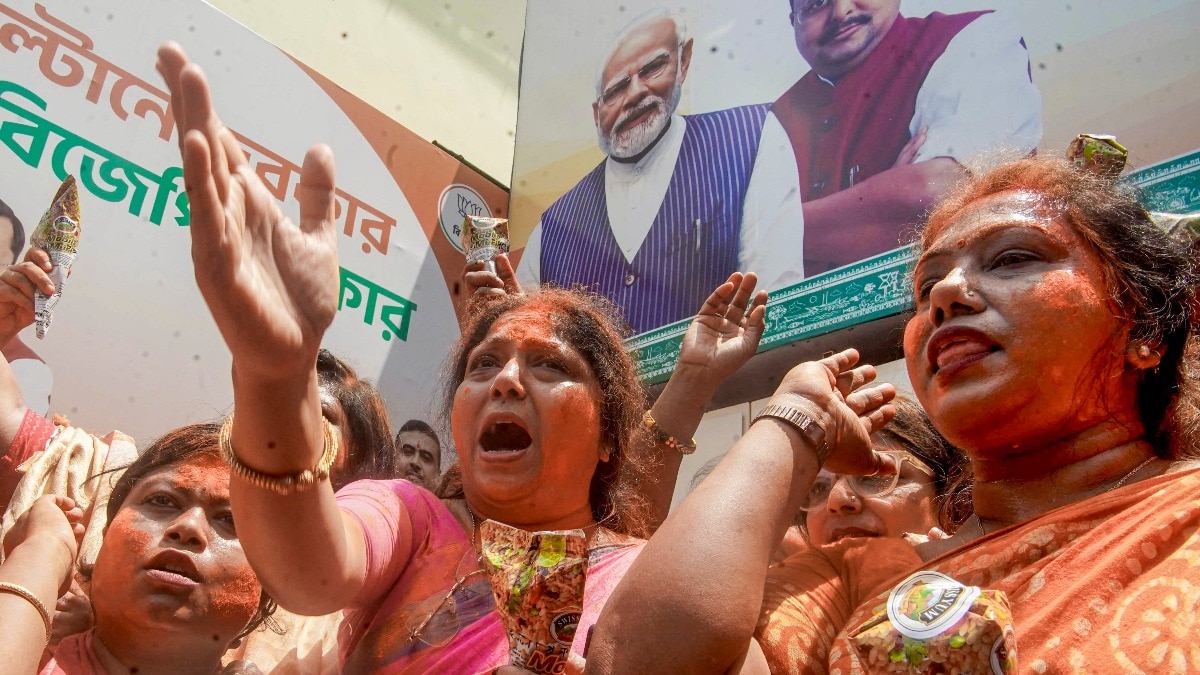
Ahead of the second phase of the West Bengal Assembly polls, at a BJP in North 24 Parganas’ Panihati, a TMC stronghold, PM Narendra Modi addressed the crowd, vowing to ensure women’s safety in the state. Standing beside him was the BJP’s Panihati candidate, Ratna Debnath, whose 31-year-old daughter, a postgraduate trainee doctor, was raped and murdered inside RG Kar Medical College in 2024. The symbolism was hard to miss, and as Monday’s results have shown, it has been devastatingly effective for the BJP.
The Mamata Banerjee-led Trinamool Congress (TMC) has been in power since 2011. But today, the uninterrupted run has been halted by the BJP. For the first time, the BJP is poised to rule West Bengal and is set to win around 200 seats, while the TMC is now preparing to shift to the Opposition benches for the first time since the Left-rule.
Fielding Ratna Debnath from TMC territory Panihati was a calculated step. It was the BJP’s direct challenge to the TMC on its own turf, with a candidate whose personal grief had become a political symbol in a case where the TMC government was slammed for inaction.
This was also a direct attack on Mamata Banerjee’s biggest voter base—women. If Trinamool wooed and nurtured the voter base with direct benefit schemes like Lakshmir Bhandar, the BJP used the RG Kar incident to highlight the safety of women in the state. The RG Kar incident had sparked organic protests, and the Mamata administration bungled in its first reaction to the horrific crime. The rape and murder of a young doctor hit the conscience of the society like Delhi was shocked after the Nirbhaya gang-rape and murder in 2012.
“RG Kar Rape case shook Bengalis to the core. I know many hardcore Communist Bengalis who voted for TMC but expressed anger the way this case was handled by Mamata and protested on streets. Female safety is a sensitive issue in our country (rightly so),” wrote journalist Parul Kulshrestha on X on Monday.
KOLKATA LAW COLLEGE RAPE ADDED TO RG KAUR TRAUMA
Incidents like Sandeshkhali, the RG Kar case, and the 2025 Kolkata Law College rape case (where one of the accused, Monojit Mishra was linked to the Trinamool Chhatra Parishad) put the TMC in the crosshairs of public anger. The TMC, known to attract more women’s votes than men’s, was caught without response.
The BJP’s message resonated far beyond Panihati. Across Bengal, the 2026 polls were shaped by an undercurrent that most exit polls had struggled to capture. A quiet, simmering anger among women voters that had been building since 2024, and came together in 2026 to hand Mamata and her Trinammol one of its biggest ever electoral setbacks.
The BJP is now poised for a historic victory in Bengal, a state it had long coveted but never could grasp until now. It is now leading on 178 seats and has already won 25.
The Trinamool, which won 213 seats in 2021, is now leading on just 75 seats, and won nine seats at the time of filing this story.
“Mamta Bannerjee didn’t lose the West Bengal elections today. She lost it the day a TMC mob destroyed vital evidence of the brutal rape and murder of a doctor in RG Kar Hospital. It’s the most fitting revenge that a grieving mother [Ratna Debnath] entered politics and helped defeat TMC herself,” wrote surgeon and author Amit Thadhani on X.
Ratna Debnath, contesting in Panihati, has a solid lead of over 20,000 votes after eight rounds of vote counting. She has won 56,167 votes so far, while her TMC rival Tirthankar Ghosh trails with 35,704 votes.
HOW MAMATA CORNERED WOMEN’S VOTE IN BENGAL EARLIER
Of West Bengal’s 6.75 crore voters, nearly half — 3.44 crore — are women. In 2021, female voter turnout stood at 81.75%, marginally ahead of men’s 81.37%, continuing a pattern of women consistently outpacing men at the booth. In 2016, nearly 52% of the TMC’s vote share came from women voters alone. A CSDS post-poll survey revealed that the TMC is the only major party in India that consistently receives more votes from women than men.
The TMC’s dominance was not accidental. Mamata built it through padyatras, neighbourhood-level outreach, and a personal political style that projected accessibility and empathy. She was the Chief Minister who met women in their neighbourhoods, listened to their grievances, and made them feel seen, and built an image of trust.
Underpinning that trust was a massive array of welfare schemes. At its centre is Lakshmir Bhandar, transferring Rs 1,500 to general category women and Rs 1,700 to SC/ST beneficiaries. Flanking it are Rupashree, which provides Rs 25,000 for marriage to over 22 lakh women, and Kanyashree, which has supported nearly one crore girl students. Scheme by scheme, Mamata had made Bengal’s women voters her own.
SANDESHKHALI TO RG KAR AND DENT TO TMC’s IMAGE
This picture began changing in early 2024. In January and February, women in Sandeshkhali, North 24 Parganas, came forward with allegations of repeated sexual assault and land grabbing by local TMC strongman Sheikh Shahjahan and his associates, including Shiban Hazra and Uttam Sardar.
The scandal broke months before the Lok Sabha elections, giving the BJP under Suvendu Adhikari potent ammunition to challenge Mamata’s carefully maintained claims of being a guardian of women’s safety and dignity.
The TMC moved quickly to contain the fallout. Sheikh Shahjahan was eventually arrested, and the party distanced itself publicly from the accused. But the damage was harder to contain, and the state’s initial response had been paralysis.
For many women voters across Bengal, it planted a seed of doubt that cash transfers alone could not uproot.
Then came August 9, 2024. The rape and murder of a young doctor inside RG Kar Medical College sent shock waves across the state and country. The accused, Sanjay Roy, a civic volunteer, was swiftly arrested and later convicted.
But public anger quickly shifted to the alleged cover-up. The episode raised serious questions about TMC government’s institutional response, from the initial attempt to pass the death off as a suicide to the hurried renovation of the crime scene within hours of the body being found. The handling of former RG Kar principal Sandip Ghosh, widely seen as close to Mamata Banerjee, further fuelled criticism as he was first transferred instead of suspended, before mounting public pressure led to his arrest by the Central Bureau of Investigation.
The protests over the crime in RG Kar, which saw women march past midnight across Kolkata demanding justice, became one of the most powerful expressions of this fury, was one of the most significant since the TMC came to power. Political parties later joined the protests, which were initially largely organic and fuelled by anguish against the state law and order machinery. The BJP, too, attacked the TMC, damaging Mamata’s image among women.
SILENT TURNING POINT OF TRINAMOOL’S BENGAL LOSS
What made RG Kar the defining silent factor of the 2026 elections was its cumulative weight. Together with Sandeshkhali and the 2025 Kolkata Law College rape case — where one of the accused, Monojit Mishra, was a member of the Trinamool Chhatra Parishad — these incidents dismantled the image of Bengal as a safe state for women and hardened the perception that the TMC reflexively shielded perpetrators through political patronage.
No amount of welfare spending could paper over what was increasingly looking like a structural failure of governance.
The BJP sensed the shift and moved to own it. Fielding Ratna Debnath from Panihati was the most visible expression of this strategy, but the effort ran deeper, from the party’s sustained campaign on women’s safety to Modi’s repeated invocations of RG Kar at rallies across the state.
Where the Left parties had led some of the early street protests following the doctor’s murder, it was the BJP that succeeded in converting grief into votes. The opposition had found, in RG Kar, a wound the TMC could not heal before polling day.
Weeks before the polls, the BJP-led Centre also introduced a bill to amend the Constitution seeking to have one-third reservation for women in legislative bodies. The bill was deemed to fail, even if the BJP leant its full support. This gave the BJP a chance to paint the TMC as a “mahila virodhi party”.
Bengal’s women voters are widely described as silent voters, who are unlikely to declare preferences in surveys or public settings, but deeply decisive at the booth. This is a characteristic that has historically worked in Mamata’s favour, their quiet loyalty delivering her commanding majorities in 2016 and 2021.
The same women who had once made Mamata invincible had, this time, made their displeasure known where it mattered most. The 2026 poll results confirmed what RG Kar had set in motion two years earlier. The TMC has seemingly squandered the trust of its most loyal constituency. It has handed the BJP the place in Bengal it had long been waiting for.
Elections 2026 | West Bengal Election | West Bengal Election Constituencies | West Bengal Election Schedule
Tamil Nadu Election Result Live
West Bengal Election Result Live
Puducherry Election Result Live
– Ends