

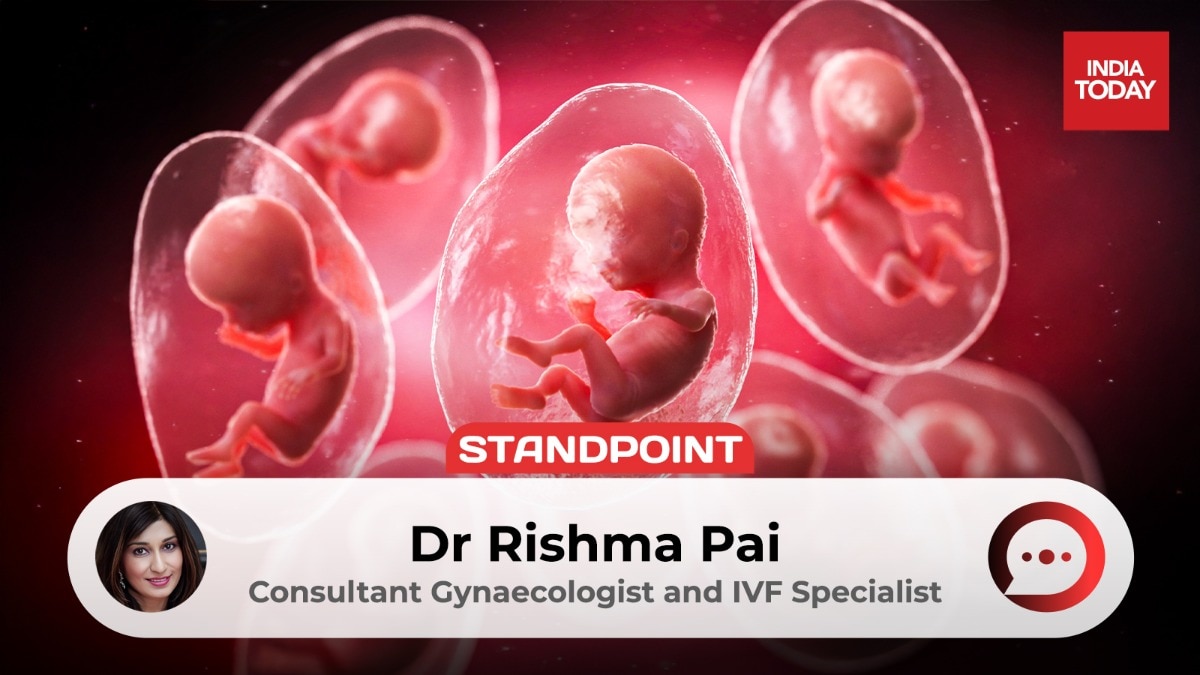
Editor’s note: On April 24, 2026, the Supreme Court of India allowed a 15-year-old to terminate a 31-week pregnancy, prioritising her rights under Article 21 over the MTP Act’s 24-week limit. The procedure is at All India Institute of Medical Sciences. In this context, gynaecologist Dr Rishma Pai, who is not involved in the case, reflects on how clinicians navigate the intersection of law, medical judgement, and personal conscience.
I have been practising for 35 years, and I can tell you this much with complete honesty, no matter how experienced you become, certain situations never stop being difficult. Cases involving very late-stage pregnancy decisions fall into that category. They are rare, they are complex, and they demand far more than just clinical judgement.
When I am asked about a pregnancy being terminated at 31 weeks, the first thing I go back to is the law, because that is the framework within which we function.
WHERE THE LAW DRAWS THE LINE
The law is very clear, and it is very strict about the fact that 24 weeks is the cutoff for medical termination of a pregnancy. It used to be 20 weeks all of these years, and then because of various considerations, particularly because sometimes cardiac disease or heart problems of a child are picked up a little bit later, it was extended after lots of debate for years and years.
Even today, this extension to 24 weeks is not open-ended. It applies under specific conditions such as serious foetal abnormalities or risks to the mother, and every doctor respects that boundary. Beyond that, it is no longer a routine medical decision.
It is only in very exceptional circumstances that if the person goes to court and the court gives the go-ahead, then that case is evaluated by a team of doctors as recommended by the court, and then if they say that this pregnancy should be terminated for the sake of the health of the mother or the foetus, then it may be allowed.
But at 31 weeks, the conversation shifts completely.
When the pregnancy touches at least 7 months (which is this case), it is really not a termination any more. It is a preterm birth or a preterm delivery that you are doing.
WHEN MEDICINE RECOGNISES A VIABLE LIFE
This is something people outside medicine often do not fully grasp. We deal with preterm deliveries regularly. Babies born at 30, 31, or 32 weeks are treated as premature, not non-viable. In fact, with the kind of neonatal care we have today, these babies stand a very real chance.
Today, a 31-week baby will survive with some degree of support, not even intense support like good support in a neonatal ICU, and that baby will usually survive reasonably well.
Of course, there are challenges. These babies may have immature lungs, they may need longer ICU stays, and there can be complications. But survival is no longer the exception.
That is where the real dilemma begins.
It is a live baby that we are bringing into the world, and it is the duty and responsibility of every single doctor to save that baby. It is not possible to not save that baby.
As a doctor, you are trained to save life. That instinct is deeply ingrained. Even at earlier gestational ages, 25 or 26 weeks, we make every possible effort.
I myself have saved 25-week babies, and they have gone home safely without any problems.
So when you are placed in a situation where a 31-week pregnancy is to be terminated, it becomes a deeply complex dilemma, ethical, emotional, and overwhelming, for both the doctor and the patient.
People sometimes assume that with experience, doctors become detached. That is simply not true. Even now, after more than three decades in practice, I find these situations moving.
It is still emotional. We are still moved by any patient’s situation. It is not like we are mechanical or machines.
Even if I have to do a 10 or 11-week termination, I am not happy doing it, because it is not something pleasant and not something you will happily do.
THE BURDEN OF CHOICE IN EXCEPTIONAL CASES
When the patient is a minor, especially a very young girl who has become pregnant through abuse, the situation becomes even more sensitive, as she does not have the understanding or emotional maturity to cope with such decisions.
These are the rare circumstances where such late decisions even come into consideration. And yet, from a medical standpoint, I still find myself thinking about what happens next.
At this point, since she has already reached 31 weeks, one might as well carry the pregnancy a little further, deliver the baby, and consider giving the baby up for adoption, because delivering at 31 weeks is almost no different from delivering at 36 weeks.
That is the clinical reality. The process of delivery does not change dramatically. What changes is how we prepare for the baby’s care after birth.
The paediatrician, the ICU, everything has to be in place, because at whichever stage the baby comes out, you need to save that baby and everything is done towards saving the baby.
This is why such cases are not handled casually or individually.
It is not for me to decide this. I have a very clear cutoff, and I almost never go beyond 20 weeks.
In practice, most of us rarely face such scenarios. Modern medicine allows us to detect most abnormalities early.
We do the main anomaly scan at 18 weeks, and all patients undergo a detailed evaluation. We also conduct Down syndrome screening early, between 12 and 13 weeks, so we have a substantial amount of information.
In a well-monitored pregnancy, almost all serious issues are identified within the legal window.
This is why cases like this remain exceptions rather than the norm. When they do arise, they are usually referred to large institutions where decisions are taken collectively.
They are normally referred to a general hospital or a municipal hospital or an institution like AIIMS, where there’s no personal benefit for any doctor in such cases.
Nobody would do something like this for financial gain; it is simply not ethically acceptable. In institutional settings, these decisions are taken collectively, with teams weighing all aspects carefully, keeping the Supreme Court’s directions in mind.
There is a lot of back-and-forth before arriving at a balanced judgement, and it is not easy for anyone involved.
BALANCING LAW, MEDICAL JUDGEMENT AND PERSONAL CHOICE
It is not easy. It is extremely difficult.
The law has been made with great consideration, and the move from 20 weeks to 24 weeks has taken years and years.
There are situations where the path is clearer, when the mother’s life is in immediate danger.
If the mother has severe high blood pressure, is in the ICU (Intensive Care Unit), and is at risk of convulsions or bleeding in the brain, then the only solution is to terminate the pregnancy.
In those moments, the decision is driven by urgency and necessity.
But outside those circumstances, a 31-week termination is something that sits heavily on the mind of any clinician. Personally, I feel it would be a huge dilemma, and I may not be able to do it actually.
(Dr Rishma Pai is Consultant Gynaecologist at Lilavati Hospital, P.D Hinduja Hospital and Sir H. N. Reliance Foundation Hospital and Research Centre. She is currently the president-elect of the International Federation of Fertility Societies, a global body representing IVF societies from 64 countries that works closely with the World Health Organisation on fertility-related matters.)
– Ends
Tune In