


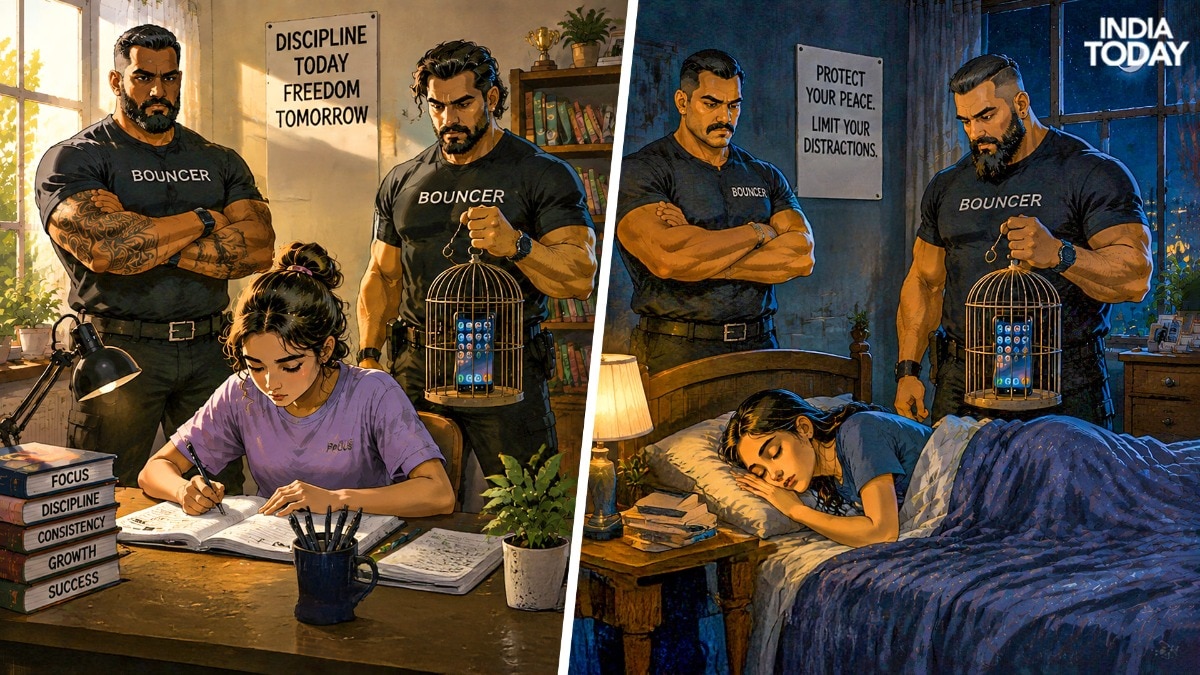
Four bouncers stationed outside a teenager’s bedroom round the clock. Parents spend nearly Rs 65,000 every month, not on celebrity security, but to stop their daughter from accessing her phone.
In another case, even the family pet reportedly had to be guarded because a gaming-addicted teenager would turn violent during angry outbursts.
At first glance, these sound like scenes from a dark psychological thriller… the kind of exaggerated family breakdown usually reserved for OTT dramas. However, confirmed reports emerging from Gujarat suggest these situations are now playing out inside real Indian homes, forcing families and doctors alike to confront a disturbing question. Can digital addiction push teenagers to the edge of behavioural collapse?
In Ahmedabad, the parents of a 16-year-old girl reportedly hired four bouncers working in two shifts to monitor her 24 hours a day after her dependence on social media and mobile phones allegedly spiralled out of control.
Doctors associated with the case said the teenager would become physically aggressive whenever her devices were taken away. During episodes of rage, she allegedly threw household appliances, damaged property and even attacked family members.
India Today attempted to contact the Surat-based security agency involved in the case for further details. However, the receptionist who answered the call initially said she was not authorised to speak on the matter.
“My boss is away, call later,” she snapped before abruptly disconnecting the phone. Subsequent calls made to the agency went unanswered.
But this was not the only case that caught our attention.
Speaking to India Today, Nikhil Sanjay Pandey, Zonal Operations Head at Force 11 Security Services in Gujarat, claimed that his agency once deployed eight bouncers in two shifts for nearly nine months, not to protect a businessman or celebrity, but a family pet!
According to Pandey, the case involved a teenager allegedly struggling with severe gaming addiction. He claimed the boy would become violently aggressive toward the dog whenever his father reprimanded him. The pet, Pandey said, shared a particularly close bond with the father, making the situation deeply distressing for the family.
Security agencies say such cases are no longer isolated. In several instances, families have reportedly hired guards to supervise teenagers recovering from substance abuse, reckless behavioural issues or severe emotional instability.
These stories have shocked people online.
But psychiatrists say the incidents are not isolated or merely sensational. Instead, they may represent the end of a growing mental health crisis linked to digital dependency among children and teenagers.
“THE PHONE BECOMES MORE THAN ENTERTAINMENT”
Mental health experts say excessive screen use is often misunderstood as simple disobedience or poor parenting. In reality, severe digital addiction can deeply affect emotional regulation and behaviour.
Dr Shivi Kataria, Consultant – Psychiatry, CK Birla Hospitals, Jaipur, said the Ahmedabad case reflects how serious behavioural dysregulation associated with digital dependence can become if ignored for long periods. “As psychiatrists, it is important not to reduce such cases to stubbornness or bad parenting,” she explained.
“When a teenager becomes physically aggressive after a device is removed, it often means the phone has evolved from a source of entertainment into a psychological coping tool.”
According to Dr Kataria, for many teenagers, social media has become their main source of emotional regulation, validation, distraction, and escape from stress. “Once that dependence becomes intense, sudden restriction can trigger reactions similar to withdrawal, anger, panic, impulsivity, agitation, or even violence,” she added.
Experts say this is one reason parents often struggle to manage such situations at home. What begins as excessive scrolling or gaming slowly develops into emotional dependency.
Teenagers may stop engaging with offline relationships, lose interest in studies, develop disturbed sleep patterns, or react strongly when internet access is interrupted.
PARENTS ARE REACHING A POINT OF HELPLESSNESS
Doctors say the most disturbing aspect of these cases may not be the teenagers’ behaviour, but the desperation of families.
Pandey confirmed that security agencies have seen a rise in requests involving teenagers. “We have handled cases involving teenagers between 16 and 19 years old. The instructions for our bouncers are clear; they are not supposed to hit the children. They are asked to remain strict, supervise behaviour, and prevent extreme phone use or risky activities,” he said.
According to Pandey, parents sometimes hire multiple bouncers in shifts for continuous supervision. “A 24-hour deployment can cost around Rs 3,000 per bouncer daily.
Dr Kataria believes the decision to hire bouncers reflects emotional exhaustion within families. “Families in such situations are often overwhelmed, frightened, and unsure how to manage escalating aggression at home safely,” she said.
However, she warned that constant physical monitoring should never become the central solution.
“While supervision may temporarily provide safety, the focus must shift towards psychiatric evaluation and structured treatment.”
WHAT MAY ACTUALLY BE HAPPENING INSIDE THE TEENAGER’S MIND
Psychiatrists say severe screen addiction rarely exists alone. Often, underlying emotional or psychological issues contribute to the behaviour.
“In cases like this, clinicians evaluate multiple factors,” Dr Kataria explained.
“These include depression, anxiety, impulsivity, sleep disruption, bullying, academic pressure, family conflict, social isolation, personality vulnerabilities, or other behavioural conditions that may be fuelling the dependence.”
She added that excessive screen use is often the only visible symptom. “The emotional distress beneath it is equally important.”
Experts say many children today use digital spaces not only for entertainment but also to escape loneliness, stress, emotional discomfort, or pressure.
Social media platforms and online games are specifically designed to keep users engaged through constant stimulation, rewards, notifications, and validation. Over time, this can create compulsive behaviour patterns.
For teenagers already struggling emotionally, screens may become the safest and easiest place to retreat.
THE PANDEMIC CHANGED CHILDREN’S RELATIONSHIP WITH TECHNOLOGY
Mental health professionals say the COVID-19 pandemic dramatically accelerated this crisis. During lockdowns, children spend months indoors attending online classes, socialising digitally, and relying on screens for almost every activity. For many teenagers, online interaction eventually replaced real-world engagement.
Doctors say the long-term impact is now becoming visible.
Dr Samant Darshi Consultant Psychiatrist & De-addiction Specialist, Director, Psymate Healthcare, Noida, said screen addiction among children and teenagers is becoming increasingly common.
“In teenagers, excessive screen time can lead to irritability, shorter attention spans, poor academics, disturbed sleep patterns, and inability to build genuine social relationships,” he said.
“Many children also show anxiety or anger when the device is taken away, which indicates emotional dependency.”
Dr Darshi also warned that toddlers are now facing similar risks.
“In younger children, excessive screen exposure can delay language development, affect emotional control, reduce curiosity, and interfere with normal social interaction,” he explained.
Experts say many parents unintentionally introduce screens very early during meals, tantrums, or busy work schedules. Over time, digital devices have begun replacing playtime, conversations, storytelling, and outdoor activities.
WHY PUNISHMENT ALONE MAY NOT WORK
Psychiatrists strongly warn against sudden punishment-based approaches, including abruptly confiscating devices without emotional support. “Aggressive restriction without therapeutic planning can worsen behaviour,” Dr Kataria said.
Instead, experts recommend gradual and structured intervention.
This may include:
-
Gradual reduction in screen time
-
Emotional regulation therapy
-
Family counselling
-
Behavioural contracts
-
Structured daily routines
-
Physical activity
-
Rebuilding offline hobbies and friendships
-
Sleep correction
-
Professional psychiatric support when required
Experts say parents must avoid turning the issue into a daily power struggle.
Children dealing with severe screen dependency often need emotional connection and professional guidance, not only discipline.
THE QUESTION PARENTS ARE NOW FACING
The stories from Gujarat are not just about bouncers standing outside bedrooms or teenagers refusing to hand over phones. They are about something much deeper. They reveal how technology, when left unchecked, can slowly reshape emotions, relationships, behaviour, and even family safety.
Experts agree that screens themselves are not the enemy. Phones, tablets, and digital platforms are now deeply connected to education, communication, and modern life.
But without boundaries, emotional support, and healthy habits, digital dependence can become difficult to control.
And perhaps the most unsettling part is this. If families are now hiring security guards to separate children from screens, it may be a sign that India’s conversation around digital addiction is only just beginning.
– Ends