

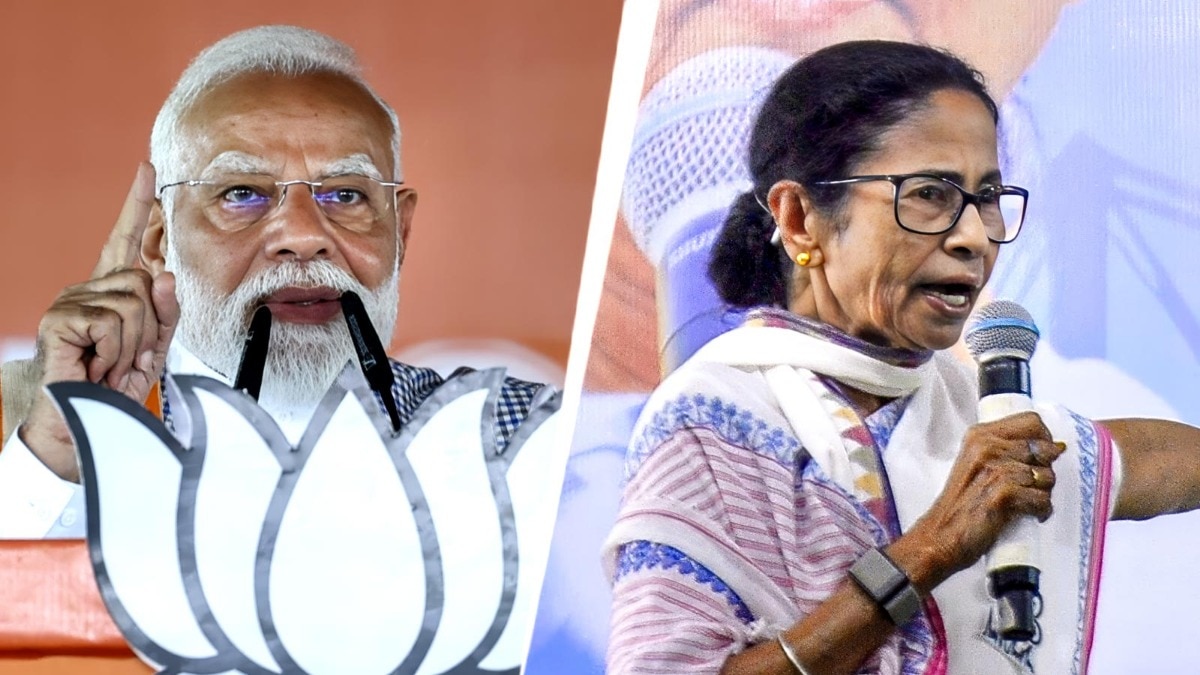
The high-voltage political contest in West Bengal will culminate in the second and penultimate phase of polling on Wednesday, when 142 of the 294 seats will go to the polls. The ruling Trinamool Congress (TMC) is locked in a pitched battle with the BJP, which is aiming to form its first-ever government in the state. While parties like the Congress and the CPI(M) are also in the fray, it’s mainly a bipolar fight between the TMC and the BJP.
The state went to the polls in the first phase on April 23, when 152 constituencies across North Bengal voted. With a record turnout of 93.17 per cent, expectations are high for similarly robust participation in the final phase. The high turnout has prompted both the TMC and the BJP to claim momentum ahead of the April 29 vote.
The final phase covers South Bengal, which has remained a TMC bastion for the past 15 years. The BJP, which performed relatively well in North Bengal in the 2021 Assembly election, will be looking to make significant inroads in the region. In the last election, the party won just 18 of its 77 seats in South Bengal, which includes Kolkata, Howrah, North and South 24 Parganas, Nadia, Hooghly, and Purba Bardhaman. The region proved decisive in the TMC’s return to power.
Hence, the BJP has deployed its full political machinery, from Prime Minister Narendra Modi to several state chief ministers, in southern Bengal as part of an intensive campaign push.
KEY ELECTION BATTLES
At the centre of this phase is Bhabanipur, where BJP’s Suvendu Adhikari will take on Chief Minister Mamata Banerjee in what many describe as the “mother of all electoral contests.” It is effectively a rematch of Nandigram, where Adhikari defeated Banerjee in 2021.
However, North and South 24 Parganas are expected to be at the heart of the larger contest, with analysts saying these districts — which together account for 64 Assembly seats — could shape the political fortunes of both parties.
Several key constituencies in South Bengal are also set to witness high-pitched electoral battles.
In Tollyganj, the stronghold of Kolkata’s film industry, TMC heavyweight Aroop Biswas is seeking to retain his seat against BJP candidate Papia Adhikary, a Bengali actress.
In Bidhannagar, TMC leader Sujit Bose is seeking re-election in a multi-cornered contest. Notably, BJP candidate Sharadwat Mukherjee drew attention during campaigning after a video of him holding a fish went viral.
Panihati will see TMC’s Tirthankar Ghosh take on BJP’s Ratna Debnath, the mother of the victim in the RG Kar Medical College rape and murder case.
In Kolkata Port, senior TMC leader Firhad Hakim is contesting against BJP’s Rakesh Singh, while in Noapara, BJP leader Arjun Singh is up against TMC’s Trinankur Bhattacharjee.
POLLING UNDER THE SIR SHADOW
The sharpest political battle, however, is unfolding over voter lists. The Special Intensive Revision (SIR) of electoral rolls has made deletions a highly sensitive issue in this phase.
North 24 Parganas recorded the highest number of deletions with over 12.6 lakh names removed, followed by South 24 Parganas with 10.91 lakh. Kolkata saw nearly 6.97 lakh deletions, while Howrah accounted for around six lakh. Hooghly reported 4.68 lakh deletions and Nadia about 4.85 lakh.
In at least 25 constituencies, the number of deleted names exceeds previous victory margins. Political observers say that if these margins are narrower than the deletions, the SIR exercise could influence not only results but also the post-poll narrative.
Meanwhile, concerns over political violence continue to shadow the region. Recent recoveries of bhangar-crude-bombs-recovered-trinamool-congress-west-bengal-deflects-blame-2901803-2026-04-26″ target=”_self”>crude bombs from a TMC worker’s house in South 24 Paraganas as well as incidents of violence reported during the first phase of polling have reinforced fears of potential clashes.
Union Home Minister Amit Shah has already said that the Central Armed Police Forces would remain in Bengal for 60 days after polling, hinting at possible violence on counting day. The TMC has dismissed the statement as “fear mongering”, though past incidents suggest that political violence has remained a major concern in the state.
THE BOTTOM LINE
For the BJP, this phase is not just the final round of polling but a crucial test of whether anti-incumbency, corruption allegations, and citizenship politics can break the ruling party’s strongest base. For the TMC, retaining its hold over South Bengal would keep its path to a fourth consecutive term firmly intact.
By Wednesday evening, voting will conclude, but the final outcome will be known only on May 4, when it will be clear whether the BJP has converted its North Bengal performance into a statewide breakthrough, or whether Mamata Banerjee has once again secured the south and, with it, her fourth term as CM.
Elections 2026 | West Bengal Election | West Bengal Election Constituencies | West Bengal Election Schedule
– Ends
Tune In