






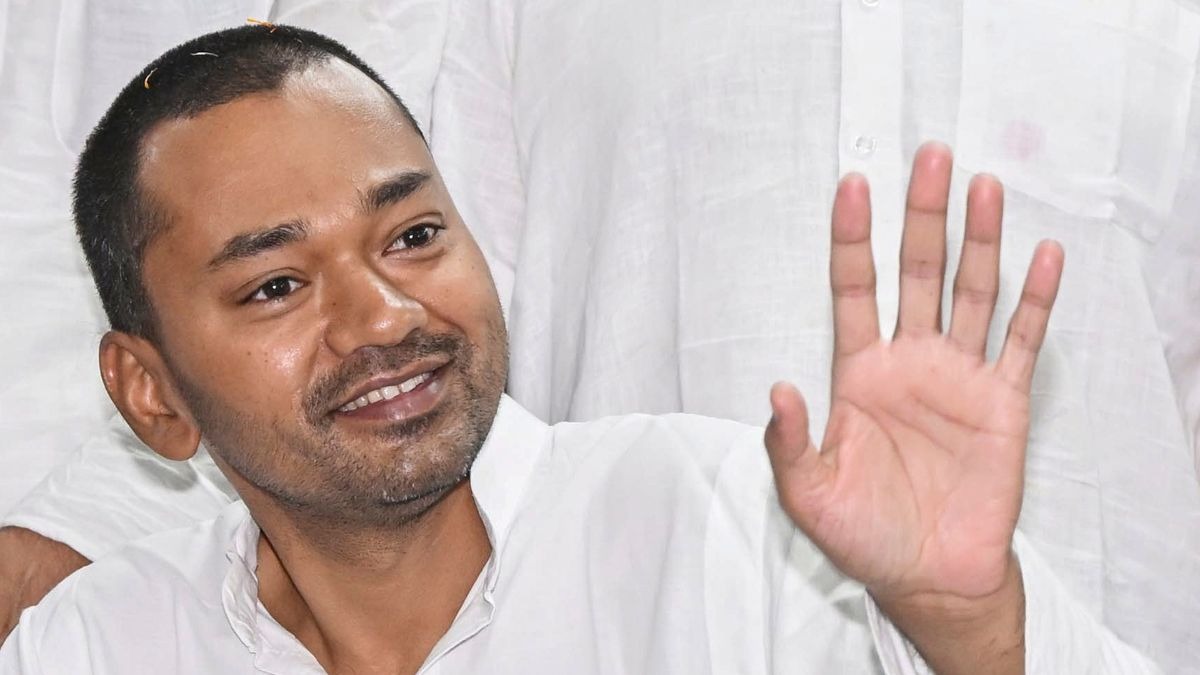
The induction of Nitish Kumar’s son Nishant Kumar into the Bihar cabinet, under chief minister Samrat Choudhary, is being seen as the formal beginning of the JD(U)’s succession experiment—an attempt to convert Nitish’s rich political capital into a transferable legacy.
The decision is striking not only because Nishant is a political rookie but also because he has been entrusted with the heavyweight health portfolio, a department that offers little room for symbolic politics and demands huge administrative credibility.
The irony is difficult to miss. Nishant entered active politics only recently, having formally joined the JD(U) in March. He has no electoral base, organisational command or administrative experience. Yet he finds himself placed at the centre of governance. This doesn’t appear as a promotion earned through a traditional political journey, rather as a responsibility conferred by necessity. The JD(U) needs Nishant as a continuity bridge to former chief minister Nitish’s support base, the expectation being that this vote bloc will gradually align behind him.
That expectation is not entirely misplaced. Nitish’s politics has, over decades, cultivated a distinct constituency—one that values governance stability, social balance and a certain administrative reliability. In Bihar’s personalised political culture, such support often attaches itself to individuals rather than institutions. The assumption within the JD(U) is that this support base, lacking a comparable alternative within the party, may shift to Nishant with relative ease.
But political inheritance has its limits. Being Nitish’s son ensures visibility, access and initial acceptance but it neither guarantees authority nor substitutes for the political instinct that defined Nitish’s rise. Nitish built his position and survival instinct by navigating alliances, caste equations and shifting political sands with precision. His authority was accumulated.
Nishant, by contrast, begins at the other end—with recognition already in place but credibility yet to be established. And this is where the health portfolio becomes central to the story. It is not a ceremonial department but one of the most demanding arms of governance. It involves hospital infrastructure, primary healthcare delivery, availability of medicines, crisis response, staffing shortages and the everyday functioning of a system that millions of citizens depend on. The failures are visible and often unforgiving. Success is incremental and hard-earned.
By assigning this portfolio to Nishant, the JD(U) has accelerated his political timeline. He is no longer just a successor-in-waiting; he is now an administrator under scrutiny. The move strips away the protective layer and places him directly in a performance-driven role. In effect, the party has chosen to test him not in the comfort of organisational politics but in the demanding arena of governance.
This is both strategic and risky. Strategic, because it offers Nishant a clear pathway to legitimacy. If he can demonstrate competence in a portfolio as complex as health, he will begin to build an identity independent of his lineage. Risky, because failure in such a portfolio is equally consequential. Public frustration with healthcare delivery is immediate and personal. Every delay, every shortage, every breakdown reflects directly on the minister. For a first-time entrant, the margin for error is narrow.
Beyond Nishant, the decision also reveals something deeper about the JD(U) itself. For years, the party distinguished itself from dynastic formations, positioning its politics around governance. The current moment marks a departure from that stance. The urgency with which Nishant has been brought into government suggests that the JD(U) is grappling with a more fundamental concern—its future beyond Nitish.
Despite years in power, the JD(U) has not produced a second-rung leader with comparable authority. The party’s organisational structure, built around Nitish’s centrality, now faces the challenge of transition. Nishant’s induction is therefore not just about grooming a successor; it is about addressing an institutional gap. At one level, the move reflects confidence—that the Nitish legacy can be extended through him. At another, it signals anxiety—that without such continuity, the party risks fragmentation.
The broader cabinet context reinforces this reading. The presence of multiple political heirs—sons of former chief ministers—normalises dynastic accommodation within a coalition that has often critiqued it. Yet Nishant’s case is distinct. He is not merely one among several entrants; he is being positioned as the inheritor of a political system built over two decades.
That brings into focus the central question: can Nishant convert inherited goodwill into durable political capital? Goodwill, as his early outreach efforts and public appearances suggest, can be generated relatively quickly. Political capital, however, is harder. It is built through decisions, performance and the ability to navigate conflict. The transition from one to the other is rarely smooth.
Nishant’s induction has, in many ways, brought that transition forward. It has removed the ambiguity around his role and placed him directly within the structure of governance. This is his moment of conversion—from a political possibility to a political actor.
For the JD(U), the stakes are equally high. The party is betting that continuity through Nishant will stabilise its future. If Nishant succeeds, the party gains not just a successor but a renewed centre of gravity. If he struggles, the underlying uncertainty about leadership will only become more pronounced. In that sense, the decision to induct him on May 7 is both a beginning and a test. Nishant has been elevated because of who he is, but he will be judged entirely on what he does.
Subscribe to India Today Magazine
– Ends