










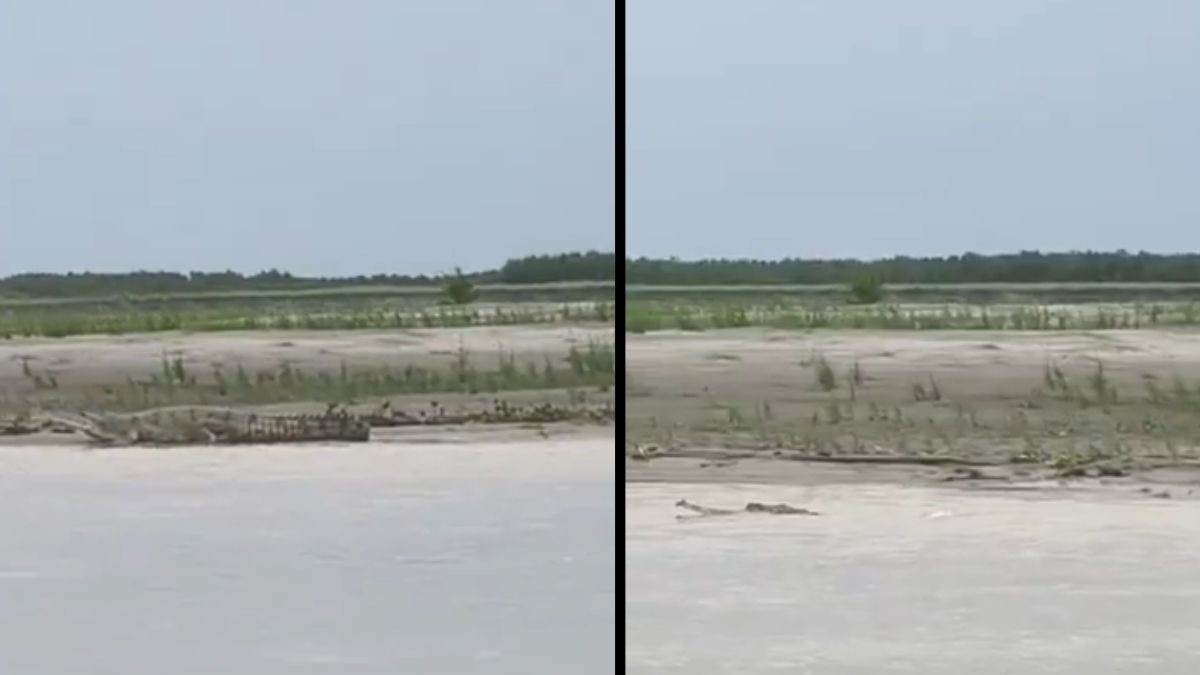
Once believed to have vanished from Assam’s rivers, the critically endangered gharial has made a stunning reappearance.
On May 8, 2026, tourists on an early-morning safari in the Burhapahar Range of Kaziranga National Park and Tiger Reserve spotted and filmed the reptile swimming in a river stretch near Dipholu Camp.
Travel guide Shishukanta Nath and tourist Diganta Kumar Sarma captured the footage.
The Chief Minister’s Office of Assam later shared an 18-second video of the animal on microblogging platform X, showing its long, unmistakable snout cutting through the water.
Forest officials confirmed the sighting. Assam Chief Minister Himanta Biswa Sarma described it as a “truly remarkable moment for wildlife conservation.”
WHAT MAKES THE GHARIAL SO SPECIAL?
The gharial (Gavialis gangeticus), sometimes called the fish-eating crocodile, is unlike any other crocodilian on the planet.
Its snout is extraordinarily long and slender, almost needle-like, shaped perfectly for slicing through water and snapping up fish. That is essentially all it eats.
It is almost entirely piscivorous, which means fish make up nearly its entire diet.
Adult males grow a distinctive, pot-like fleshy growth at the very tip of their snout.
This is called a ghara, the Hindi word for pot, and it is used to produce buzzing sounds and bubbles during courtship.
The species is listed as Critically Endangered on the IUCN Red List, one step away from extinction in the wild.
Its global wild population has collapsed by nearly 96 per cent since the mid-20th century, shrinking from thousands of individuals to just a few hundred mature ones.
Today, between 80 and 85 per cent of surviving gharials are confined to the Chambal River system in central India.
The species now occupies roughly 2 per cent of its historical range.
WHY IS THE KAZIRANGA SIGHTING SUCH A BIG DEAL?
This is the first time tourists have visually documented a gharial inside Kaziranga.
Previous sightings were recorded only by survey teams and officials.
The first confirmed record in the national park dates to March 2022, when a gharial was photographed on a sandbar in the Brahmaputra River at Silghat.
Since then, recurring sightings have been reported in the Bishwanath stretch of the Brahmaputra.
A January 2024 survey by the Biswanath Wildlife Division and the Turtle Survival Alliance confirmed the presence of a female gharial across a 160-kilometre stretch of the river.
Kaziranga is home to more than 42 species of fish, making it an exceptionally suitable long-term habitat for the species.
HOW CAN GHARIAL BE SAVED?
Conservation experts say long-term monitoring, protection of sandbanks where gharials bask and nest, and reducing threats from fishing nets, sand mining, and river modification are essential.
Experts note the sighting confirms the premise to restore the species with sustained protection.
For now, though, this quiet moment on a morning safari is proof that conservation, even when slow and silent, can work.
– Ends