








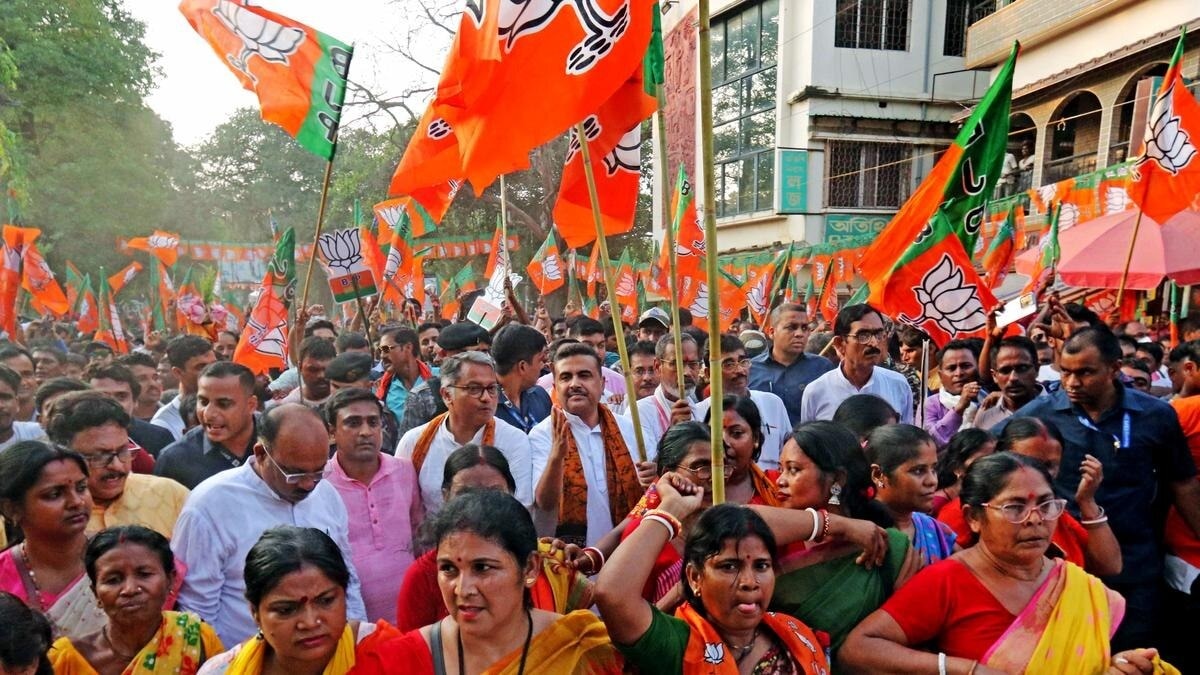
BJP’s Bengal surge was driven by data-led planning, welfare repositioning, social targeting and booth-level execution, turning local narratives and perception shifts into a disciplined, ground-up electoral breakthrough.
In West Bengal’s high-decibel political arena, the BJP’s rise was not just the result of rallies or headline speeches. It was driven by a calibrated ground operation that worked quietly, steadily and with precision.
Behind the scenes, a coordinated team, comprising data analysts, narrative planners and grassroots organisers from Uttar Pradesh, Bihar and Bengal, spent over a year mapping voter behaviour. The focus was simple: convert broad issues into personal concerns.
Women’s safety, unemployment and industrial decline were not presented as abstract data points. They were framed as lived experiences. Localised conversations replaced generic messaging. One recurring claim, that industries were leaving Bengal, became a powerful perception driver, regardless of contestation.
WELFARE POLITICS, REWORKED
The BJP’s key strategic shift came in countering the Trinamool Congress’s welfare model.
Instead of opposing schemes like Lakshmi Bhandar, the party repositioned itself as a more competitive provider. Its Annapurna Bhandar promise of 3,000 per month was designed to signal higher delivery and disrupt established voter loyalty.
This was not just policy positioning. It was a direct intervention in voter expectation.
TARGETED SOCIAL REALIGNMENT
In regions like Junglemahal — including Purulia, Bankura and Jhargram — the BJP recalibrated its outreach.
Communities such as the Kurmis were brought back into focus through specific identity-linked promises, including constitutional recognition for the Kurmali language. This was a targeted attempt to rebuild social coalitions that had shown signs of drift.
THE MICRO-STRATEGY LAYER
What set the campaign apart was its execution at the last mile.
District-level planning ensured that each booth had a customised approach. Messaging varied by geography, community and local issue.
Alongside high-profile campaigning, the BJP built a second communication layer — local influencers drawn from Adivasi, Gorkha, Matua and Rajbanshi communities. These were not external voices but embedded actors, allowing the message to travel with credibility.
The communication did not feel imposed. It felt familiar.
BREAKING TRADITIONAL STRONGHOLDS
Even in regions where the BJP had historically struggled, including Kolkata and South 24 Parganas, sustained groundwork began to show results.
Weeks of focused outreach, combined with booth-level mobilisation, translated into incremental gains that eventually turned into decisive leads.
THE BIGGER LESSON
The BJP’s Bengal performance underscores a structural shift in how elections are won.
Large rallies and central messaging remain important, but they are no longer sufficient. Electoral outcomes are increasingly shaped by data-led planning, localised narratives and sustained ground engagement.
This was not a spontaneous surge.
It was a systematically built outcome — where organisation, messaging and perception moved in alignment.
And in Bengal this time, the most decisive factor was not the loudest campaign, but came from the quietest strategy.
Elections 2026 | West Bengal Election | West Bengal Election Constituencies | West Bengal Election Schedule
Tamil Nadu Election Result Live
West Bengal Election Result Live
Puducherry Election Result Live
– Ends