




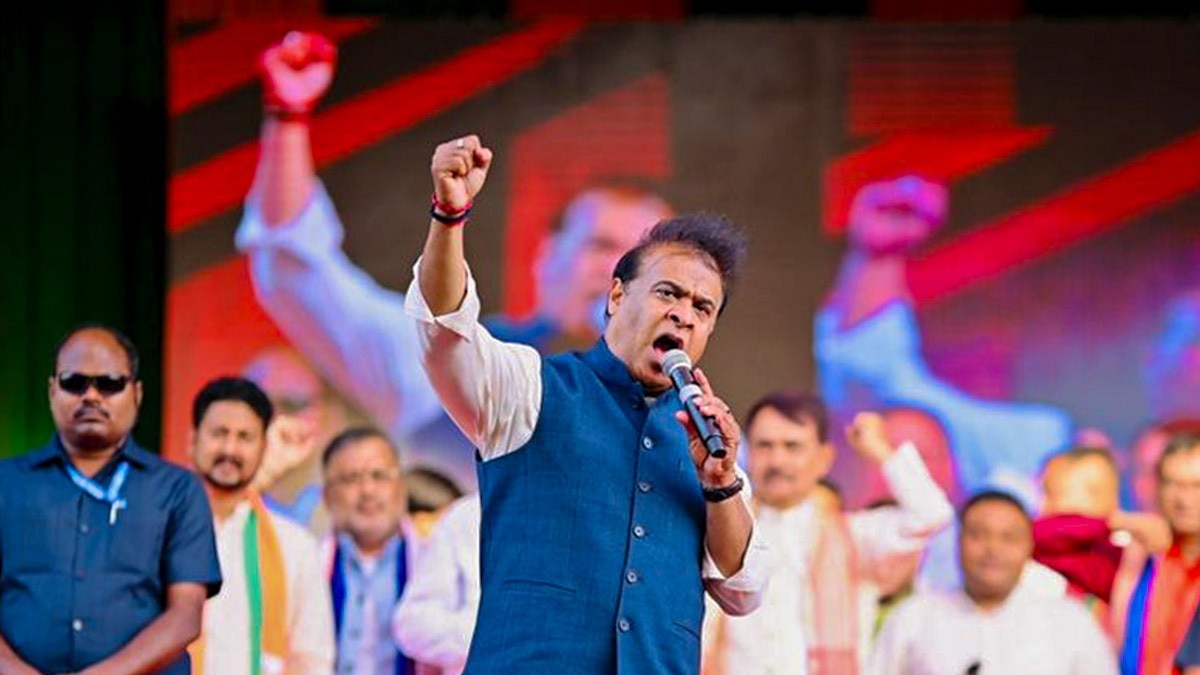
Twenty-five years ago, on May 13, 2001, a 32-year-old lawyer named Himanta Biswa Sarma walked into the Assam legislative assembly for the first time, having defeated Bhrigu Kumar Phukan, a veteran of the Asom Gana Parishad (AGP), in Jalukbari on a Congress ticket. This May 4, Sarma couldn’t have asked for a better silver-jubilee gift than the one Assam delivered to him.
Leading the BJP into an assembly election as chief minister for the first time, Sarma won his party an unprecedented landslide. The BJP took 82 of the 90 seats it contested while the BJP-led National Democratic Alliance (NDA)—with the AGP and Bodoland People’s Front (BPF) on board—accounts for 102 of the total 126 seats.
That tally is the third-largest mandate any winning party has secured in Assam since Independence. The Congress won 95 of 126 seats in 1972, and 91 in 1983, an election largely boycotted at the height of the Assam Movement. The Congress took 78 seats in 2011, and Sarma was the architect of that victory too, although he had to share the credit with then chief minister Tarun Gogoi. This time, the success is wholly his.
Such a mandate was not merely welcome, it was politically necessary for the BJP leader. Since 2011, when he was still in the Congress, Sarma had pressed his claim to be made chief minister, convinced that he could deliver more for the state than anyone else. The Congress high command was unpersuaded, and in August 2015, he walked across to the BJP. Even inside his new party, Sarma was made to wait until 2021 to take the office he had spent a decade demanding.
That elevation had its own ordeal. Sarma had been the principal architect of the BJP’s wins in 2016 and 2021, but neither result had been framed as only his. In May 2021, he had to effectively wrest the chief ministership from a leadership reluctant to displace the incumbent, Sarbananda Sonowal, in favour of a man who had been with the party for only six years. Becoming chief minister was, in that sense, half a triumph. Finishing the journey required a mandate of his own.
That is why expanding the BJP’s tally well beyond the 60 seats won in both 2016 and 2021 was crucial. This time Sarma was the face of the campaign, and the case to be made was that Assam had got its best chief minister a decade too late. By that yardstick, he has not merely delivered; he has redrawn the scoreboard.
The political ground for this verdict was prepared with method. Sarma revived the oldest anxiety in Assamese politics—the threat to indigenous Assam from illegal immigration across the Bangladesh border—and built a campaign around it. Because most undocumented migrants from Bangladesh are Muslim, the appeal had the effect of consolidating non-Muslim voters across caste and tribe. Critics called it a communal pitch but in Assam, where this fear has driven politics since the Assam Movement of the 1980s, it functions as an emotive, identity-defining issue.
To the politics of identity Sarma added the politics of cash. By his government’s own count, roughly three of every four people in Assam are now touched by at least one welfare scheme. The flagship, Orunodoi, a monthly direct cash transfer to women, is in its third iteration, with the entitlement raised to Rs 1,400 per month and the beneficiary base extended to nearly 3.8 million households. A beneficiary class has been written into the state’s social fabric, and on April 9 it turned out to vote.
The development pitch reinforced the welfare one. Roads, bridges, healthcare expansion and a steady drumbeat of investment summits gave the campaign tangible markers, while Mission Basundhara streamlined a long-broken land-records system. Job creation, accompanied by what the government insists is a transparent recruitment process, blunted Assam’s most persistent youth grievance. Taken together, these constituted a governance story Sarma’s challengers could neither match nor credibly demolish.
The electoral map itself had got redrawn—to Sarma’s advantage. The Election Commission’s 2023 delimitation cut the number of seats in which Muslim voters were decisive from around 36 to 22, by carving up Muslim-majority pockets, merging others and reserving some once-Muslim seats for Scheduled Castes and Scheduled Tribes. The Opposition cried gerrymandering but the BJP called it an overdue protection of the indigenous people. Either way, the new arithmetic narrowed the path through which any Congress-led front could win.
Then came the perception battle, which Sarma won well before polling day. In the months leading up to the election, he ushered a string of Congress leaders into the BJP. Among them were two-time MP Pradyut Bordoloi and former Assam Congress president Bhupen Borah. Both won on BJP tickets. By the time the Asom Sonmilito Morcha, the eight-party Congress-led front, was unveiled, the optics had already shifted. The BJP looked irresistible, the Opposition depleted.
Sarma had also learnt from his own mistakes. In 2024, when Gaurav Gogoi, the Assam Congress president, fought the Jorhat Lok Sabha seat, Sarma ran a high-decibel personal campaign against him. The contest looked like David versus Goliath, and Gogoi rode a wave of sympathy to a healthy win. This time, when Gogoi, as Opposition’s chief ministerial face, chose to contest the Jorhat assembly seat, Sarma kept his pitch deliberately low-key. The result was clinical: Gogoi lost by 23,182 votes to the BJP’s Hitendra Nath Goswami, a five-time MLA. The would-be challenger was bruised before he could properly begin.
The campaign Sarma ran in those weeks was, in form and feel, unmistakably presidential. From Dhubri to Sadiya, he asked voters to trust him personally, if not the local candidate. He could afford to do so because two decades as a minister have built a reputation in Assam that he delivers—fairly or unfairly—on what he promises. To his admirers he is decisive. To his critics he is impatient with rules. To most voters, he is simply effective.
Layered on this is the persona of “mama” (maternal uncle) that Sarma has cultivated over the past five years. He responds to messages from villagers he has never met, allows strangers to touch him at rallies, and accepts and consumes the water and food they offer despite Z-plus protection. Detractors point to his use of unparliamentary, sometimes communal, language as unbecoming of a constitutional office. He has consciously demystified that office. For many Assamese voters, that is the appeal.
What this verdict does, beyond Assam, is reposition Sarma in the BJP’s internal hierarchy. He is now spoken of in the same breath as Devendra Fadnavis (Maharashtra chief minister) and Yogi Adityanath (Uttar Pradesh)—leaders being talked about as the next-generation prime-ministerial possibilities for an era after Narendra Modi and Amit Shah. He is already the duo’s most-trusted lieutenant and the troubleshooter dispatched whenever a state government needs to be toppled or a stuttering campaign needs to be rescued. He is known, above all, for mobilising resources at short notice when crisis demands.
This mandate is different in kind. It rests on Sarma’s own performance and popularity, not on a wave generated by Modi or by national circumstance. That makes Sarma an unusual figure in the BJP ecosystem, not just another chief minister with a strong record but a leader with an independent franchise. Twenty-five years after walking into the Assam assembly as a debutant, he has finally won a mandate signed in his own name.
Subscribe to India Today Magazine
– Ends