






Strange things are unfolding in writer-director Ritwik Pareek’s debut feature from the get-go. There’s a drunk man riding his motorbike on a highway in darkness and barely holding it together. He meets his death in the ghastliest manner in a hit-and-run accident while his Luna remains unscathed.
A peculiar billboard featuring a magician, image of a body split into half, and two sultry women is the only witness. And so begins Pareek’s trippy, wild adventure that’s invigorating and amusing while partially losing direction.
At the centre of Dug Dug is a mystery: for three nights, the Luna somehow manages to escape from the police chowki and end up at the accident site. How did it get there? Who drove it? Is it a ghost? The puzzling case of the driverless bike consumes the village, perplexing police officials and even drawing the attention of a local politician.
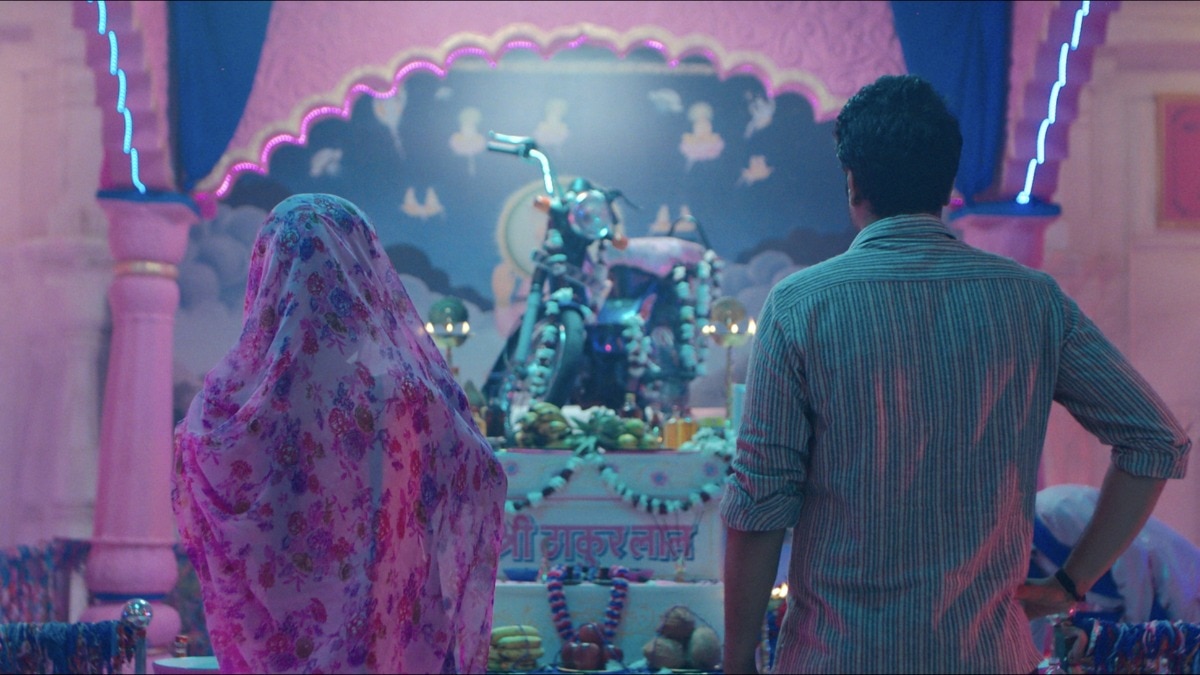
Soon rumours begin in the Rajasthan village that the victim’s wandering spirit is harboured in the vehicle. A baba declares that the only way for the soul to rest is by setting up a shrine. In what becomes a clever commentary on blind worship, the motorbike becomes the idol.
What was once a site of death turns into to a carnival where droves of people bring flowers and alcohol to pay obeisance to the driver and his two-wheeler. The worship fervour spreads and it isn’t long before divinity becomes a commercial, money-spinning enterprise.
Shops and businesses emerge in the name of the victim and donations start pouring in. The roadside shrine soon becomes a temple, with the Luna centre-stage. If audiences are tickled at the bizarre events, then the makers throw in a bouncer in the beginning of the second half, disclosing that the religious satire is, in fact, inspired by real events.
Regardless of it, Pareek already has viewers hooked not just with the ingenious premise but also through the striking imagery and peppy background score, which lends the narrative a humorous punch and infuses spirit. Aditya S. Kumar’s cinematography, with its juxtaposition of vibrant colours like pink and blue against a stark, barren landscape and tight close-ups and low-angle shots, helps builds a visual palette that’s distinctly attractive.
Even when Dug Dug seems to be repeating and dragging its message, which it does for a significant chunk of the second half, Salvage Audio Collective’s background score is the saving grace, ensuring that viewers don’t lose interest. The bombardment of montage sequences showcasing what’s now familiar and reiterating the same point is the key blip in what’s otherwise a refreshing narrative.
Beginning with a Lynchian vibe before venturing into filmmaker Wes Anderson’s blend of quirk and visual poetry, Dug Dug may not have known faces spearheading the cast, but it does have memorable characters, including Manfool (Durga Lal Saini), an elderly police constable whose belief in the magical powers of the bike feeds into the cult, and Pyare Lal (Gaurav Soni), the solitary non-believer in the village.
Dug Dug impresses in how it tackles our obsession to put things on a pedestal without logic and find spiritual solace in the unlikeliest of quarters. “Aastha aur andh vishwas ke beech mein patli si dhaara hoti hai (There’s just a thin line between faith and blind faith),” says one character, capturing what’s essentially the leitmotif of the film. That it does without mocking believers and by simply playing up the absurdity of it all and showcasing how devotion can be manufactured is where Prateek shows his strength as a filmmaker.
Subscribe to India Today Magazine
– Ends