






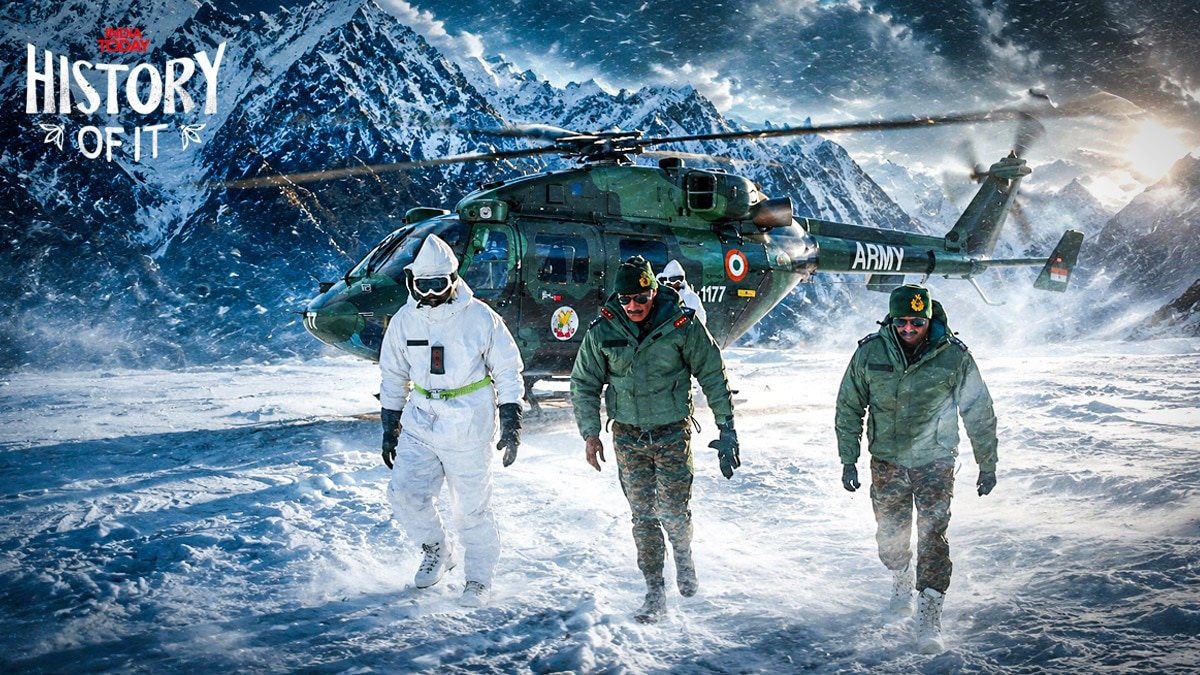
More than 18,000 feet above sea level, where the air is razor-thin, and no landing ground existed, two soldiers jumped into the void, after a brief prayer. Armed to the teeth, and dressed in basic extreme winter gear, they looked down at an endless expanse of snow before jumping from hovering IAF’s Cheetah helicopters. This is how Captain Sanjay Kulkarni of 4 Kumaon Regiment and his radio operator were inserted onto the Siachen Glacier, even as another platoon climbed on foot to take positions. It was April 1984 and the mission was to secure the glacier before Pakistani troops could move in. The account is documented by Colonel Ajay Singh (Retired), in his book, India’s Battlefields: From Kurukshetra to Balakot.
Operation Meghdoot, which began in 1984, has been on ever since. It has been 42 years since the operation, which cemented the foothold of Indian forces on the world’s highest battlefield, was launched.
We revisit Operation Meghdoot, often regarded as the longest-running mission of the Indian Army, as we mark a year of the commencement of Operation Sindoor, which was India’s retaliatory strike on Pakistani terror hideouts.
Chief of Army Staff, Upendra Dwivedi, said earlier this year, said, “Operation Sindoor remains ongoing, and any misadventure by the adversary will be dealt with effectively.” The warning came in January, months after the guns had fallen silent after the brief four-day-long military mission. Operation Sindoor was launched after Pakistani terrorists killed 26 civilians in Pahalgam in April 2025. The Indian retaliation, the military said, is not a closed chapter.
There are operations that end with the mission, and there are operations that redefine how a nation responds to threats from a rogue adversary. Operation Sindoor obliterated Pakistan’s air defence infrastructure and terror hubs in just 22 minutes. Defence strategist and internal security expert, Lieutenant General Dushyant Singh (Retired), said, “Operation Sindoor 2.0” is not just possible, it is “inevitable”.
While Operation Sindoor continues, this is not the first time the Indian military has remained locked in an indefinite military campaign. Operation Meghdoot, which started four decades before Operation Sindoor, never truly ended as the Pakistani threat over Siachen never fully disappeared.
Launched 42 years ago on April 13, 1984, it is India’s longest-running military mission. While the world’s attention keeps shifting to newer conflicts, thousands of Indian soldiers still guard the world’s highest battlefield, under conditions that test human endurance to its limits. India’s daily expenditure on Siachen at around Rs 5 crore, according to reports.
On the first anniversary of Operation Sindoor, we revisit one of the toughest military missions ever accomplished anywhere in the world.
WHY INDIA LAUNCHED OPERATION MEGHDOOT? WHY IS SIACHEN SO IMPORTANT TO INDIA?
In the early 1980s, the 76-km-long river of ice sheet in the Karakoram range, the Siachen Glacier, although an Indian territory, remained in a grey zone due to a technicality. The 1949 Karachi Agreement had left the area beyond map point NJ9842 undemarcated. Pakistan began showing cartographic aggression, issuing permits to foreign mountaineers and planning its own military movement, codenamed Operation Ababeel.
Under Operation Ababeel, the Pakistan Army had a plan to capture the strategic glacier before India could secure it, and seize key positions across the glacier and dominate the strategically vital Saltoro Ridge. The Saltoro Ridge is a towering structure that overlooks the entire Siachen region and determines military control of the area.
Indian intelligence picked up these signals. Under the leadership of Lieutenant General Prem Nath Hoon and with the approval of Prime Minister Indira Gandhi, the Indian Army decided to act first and fast.
But first, let’s understand why this remote, barren glacier mattered so much, and still matters.
Siachen is not just a piece of ice. It is a strategic shield. The Saltoro Ridge, where Indian troops have been deployed since 1984, is at an altitude ranging between 15,000 and 22,000 feet. The possession of the strategic glacier gives India a commanding view over the region, which acts as a natural wedge between Pakistan-Occupied Kashmir (POK) and the Shaksgam Valley, which Pakistan captured and illegally ceded to China in 1963.
By holding these heights, India prevents any direct physical or military linkage between Pakistan and China at this critical tri-junction. The glacier also dominates key approaches to Ladakh.
Losing it would expose vital mountain passes and make the defence of Leh and surrounding areas far more difficult. Moreover, it provides India with a tactical advantage of “the high ground”. Pakistani troops remain at lower altitudes and are largely blind to movements on the Indian side.
In military terms, this is a priceless edge. As long as Indian forces stay on the Saltoro Ridge along the Actual Ground Position Line (AGPL), no surprise incursions can easily succeed. Siachen, in short, is India’s forward defence line in one of the most sensitive borders in the world.
HOW ARMY, AIR FORCE JOINED HANDS TO BEAT PAK IN THE RACE TO SIACHEN IN OPERATION MEGHDOOT
On the morning of April 13, 1984, chosen strategically as Baisakhi, when Pakistani forces were least expecting any major Indian military move, Indian troops launched Operation Meghdoot.
Intelligence had confirmed that Pakistan was preparing its own Operation Ababeel, with reconnaissance planned for around April 17, and full deployment in early May. India decided to strike just days ahead.
The Indian Air Force played a pivotal role in the operation. After airlifting of troops and supplies by IL-76, An-12, and An-32 aircraft to forward bases, smaller helicopters took over the most dangerous last leg. Operating at the extreme edge of their capabilities in thin air and treacherous winds, IAF’s Cheetah and Chetak helicopters ferried soldiers to altitudes of 15,000 to 18,000 feet and beyond.
These light choppers, often carrying just two personnel at a time, just hovered over snow rather than landing on the passes.
At around 5.30 am on April 13, the first Cheetah helicopter, piloted by IAF’s Squadron Leader SS Bains, carried Captain Sanjay Kulkarni of the Army’s 4 Kumaon Regiment, and his radio operator toward Bilafond La, a critical pass on the Saltoro Ridge, at nearly 18,000 feet.
By then, Major RS Sandhu had already begun a gruelling climb with his platoon towards the heights of the ridge, becoming the first Indian Army officer to be deployed there.
At least 17 such daring sorties followed throughout the morning. By around 10 am, roughly 29-30 soldiers had been positioned at Bilafond La.
In the raging blizzard, the soldiers unfurled the Tricolour for the first time on Siachen.
Over the next few days, additional units under Captain PV Yadav climbed and secured Sia La, another mountain pass situated on Saltoro Ridge. By April 17, another pass, the Gyong La, was also under Indian control. Troops from the Kumaon Regiment and Ladakh Scouts were involved in the mission.
OPERATION MEGHDOOT: 1, OPERATION ABABEEL: 0
By the time Pakistani advanced reconnaissance parties reached the area on April 17, they found that India had already set foot on all the commanding heights and the three vital passes on the Saltoro Ridge. Pakistan Operation Ababeel became a mission that never got accomplished.
Pakistan’s desperate attempts to dislodge the Indian positions, including a strong counter-attack at Bilafond La in June 1984, were repelled effectively with mortar and Grad-P rocket fire.
What followed in the coming weeks was a swift and determined consolidation. Indian soldiers, often carrying loads in freezing blizzards, turned temporary camps into permanent forward posts.
Operation Meghdoot was a stunning pre-emptive success in the highest battlefield on earth, as India gained full control of the entire 76-km-long Siachen Glacier, its tributary glaciers, and the dominating heights of the Saltoro Ridge — roughly 2,550 square kilometres of strategically vital territory.
HOW INDIAN TROOPS HAVE ENDURED SIACHEN GLACIER FOR 4 DECADES
It has been over 42 years since the glacier has been guarded by the Indian military, and its story is written in the blood and sweat of India’s soldiers who continue to defend it every day.
Siachen’s terrain is merciless. Temperatures drop to minus 50 degrees Celsius or lower, daily. Blizzards can last for days, reducing visibility to zero. Avalanches and hidden crevasses have claimed hundreds of soldiers’ lives.
Since Operation Meghdoot began, more than 1,000 Indian soldiers have made the supreme sacrifice. Official figures by the Indian Army from earlier years put the number at around 869 by 2015, with later statements indicating over 1,100 by 2019. The vast majority, nearly 97%, died not in combat but due to the environment.
Altitude sickness, like high-altitude pulmonary oedema and cerebral oedema, strikes suddenly. Frostbite and snow blindness are constant threats. Even routine tasks like cooking or walking can become life-threatening.
Avalanches, sudden weather changes, and medical complications linked to extreme altitude have been the biggest killers in Siachen.
Combat deaths have been far fewer, especially after the 2003 ceasefire.
For those who survive the posting, the ordeal does not end easily. Many return with lasting health issues, like respiratory problems, joint pain, and psychological strain.
THE ECONOMIC COST OF THE HIGHEST BATTLEFIELD, SIACHEN
Maintaining troops at such extreme altitudes comes at an enormous cost. Supplies have to be airlifted or carried by porters and mules over treacherous routes.
Special high-altitude clothing, oxygen equipment, heated shelters, and medical facilities add to the cost. Reports from a few years ago estimated India’s daily expenditure on Siachen at around Rs 5 crore.
Over four decades, this has run into thousands of crores. Every litre of fuel, every kilogram of rations, and every piece of equipment must be transported at huge logistical effort. The Indian Air Force’s helicopters and transport aircraft fly thousands of sorties each year just to keep the posts supplied.
The Indian Army has worked relentlessly to improve living conditions, but in Siachen, there is only so much human endurance can overcome.
WHY INDIA CANNOT WITHDRAW FORCES FROM SIACHEN
Many wonder why not pull out the troops from the Siachen Glacier and save lives and money? But with two rogue adversaries in the neighbourhood, pulling soldiers out of the region remains nearly impossible. We saw the result of pulling back troops from the lower reaches in Kargil in the late 1990s. When the Indian forces went back to the high-altitude posts in the region after the winter of 1998-1999, the Pakistanis had captured some of them. And it resulted in the Kargil War of 1999.
The strategic reality is also very different. There is no formal agreement on the Actual Ground Position Line (AGPL). If India withdraws unilaterally, Pakistan could move in and occupy the heights. This would not only hand over tactical advantage but also create a direct link between Pakistan and China, turning the region into a potential launch pad for coordinated threats against Ladakh and Jammu and Kashmir.
Indian military experts are unanimous over the fact that withdrawal without a mutually accepted demarcation would be a security disaster.
Until that happens, the soldiers of Operation Meghdoot must stay, watching, guarding, and holding the line.
Forty-two years on, Operation Meghdoot has stood as a testament to Indian military’s ingenuity and the extraordinary courage of its soldiers. As India marks the first anniversary of Operation Sindoor, the endurance of Siachen offers a parallel to carry on, regardless of what the economic cost might be. It is India’s territory, and come what may, the armed forces will do what has to be done. There is no question about that.
Like Opearation Sindoor, Operation Meghdoot continues.
– Ends