









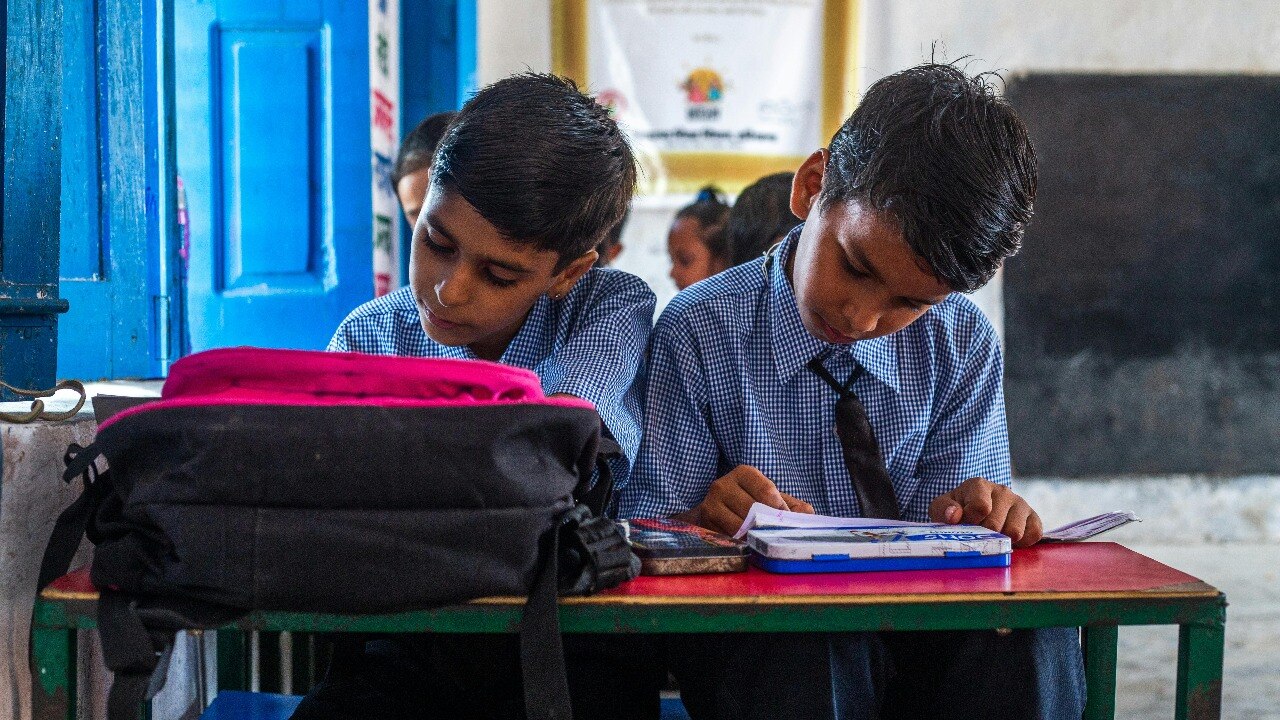
India’s school system is massive by any measure. There are over 14.71 lakh schools, catering to nearly 24.69 crore students, supported by more than 1 crore teachers.
Access has expanded across the country. At the primary level, schooling is now close to universal.
Even overall enrolment has remained broadly stable over the past decade, rising from 26.95 crore in 2014–15 to 27.10 crore in 2015–16, before settling at 24.69 crore in 2024–25.
The slight decline over the past three years is linked to changing demographics, especially lower fertility rates shrinking the school-age population, along with school consolidation and ongoing challenges in retaining students at higher education levels.
Most children are entering the system, and the long-standing goal of access has largely been achieved.
But what happens after that is where the story begins to change.
The numbers from the Niti Aayog School Education System India 2026 report suggests that while children are entering the system in large numbers, staying through all stages remains a challenge.
THE NUMBERS THAT TELL A DIFFERENT STORY
If you look beyond the overall enrolment numbers, a gap becomes visible.
While participation remains high in early grades, it drops steadily as students move ahead. By higher secondary, the Gross Enrolment Ratio stands at just 58.4%.
This means that a significant portion of students who start school do not make it to Classes 11 and 12.
The decline is not sudden. It builds over time.
The gap becomes clearer when broken down by stage. The Gross Enrolment Ratio stands at 90.9% at primary and 90.3% at upper primary, but drops to 78.7% at secondary before falling sharply to 58.4% at higher secondary.
INDIA’S SCHOOL PIPELINE IS LEAKING
If you map the journey of a student, the problem becomes clearer.
Children enter school in large numbers. Many continue till upper primary. But the pipeline narrows sharply after Class 8 and again after Class 10.
This pattern is also visible in transition rates. About 92.2% of students move from primary to upper primary, and 86.6% make it to secondary.
But only 75.1% transition from secondary to higher secondary – meaning nearly one in four students does not make it from Class 10 to Class 11..
By the time higher secondary begins, a large share has already exited. This “leak” is the real crisis.
The Niti Aayog report tracks trends over a full decade, from 2014–15 to 2024–25, and the pattern holds across years. Participation improves at early stages but weakens as students move ahead.
This is not a one-year disruption. It reflects how the system functions across stages.
The issue is not about children never enrolling, but about them not staying long enough to complete school.
WHY ACCESS ALONE IS NOT ENOUGH
For years, education policy focused on expansion. Schools were built, infrastructure improved, and enrolment drives ensured that children entered classrooms.
That phase delivered results.
But the system is now facing a different challenge. Keeping students engaged through all stages of schooling till the end.
The Niti Aayog report frames education across three key dimensions: access, equity, and quality.
India has made strong progress on access. But continuity and quality remain uneven.
The concentration of students in Indian schools shifts across stages. Primary classes account for over 42% of total enrolment, while higher secondary makes up just around 11%, showing how participation narrows at the top.
Different stages of schooling often function in silos.
Movement from one level to another is not always seamless. Each transition point becomes a moment where students can fall behind or drop out altogether.
THE INVISIBLE EXIT
One reason this crisis does not get enough attention is because it does not happen all at once.
There is no single point where students leave in large numbers. Instead, the system loses them slowly.
The drop from 92.2% to 75.1% across stages reflects a gradual thinning of students rather than a single point of dropout.
Attendance weakens. Engagement drops. Some students fail to transition to the next stage.
By the time the numbers show up in higher secondary data, the exits have already happened across earlier years.
This gradual decline makes the problem less visible but far more widespread.
A SYSTEM THAT DOES NOT HOLD STUDENTS
The Niti Aayog report data suggests that the system is effective at entry but weaker as students progress to higher classes.
Students are entering school in large numbers, but the structure does not always support them through the full journey.
The report points to gaps in how stages are connected. Without stronger continuity, even small disruptions can push students out.
These include transitions to a different school after Class 8 or 10, limited availability of higher secondary sections nearby, uneven teacher deployment across subjects, and infrastructure gaps that make progression harder.
This is especially visible after upper primary, where the first major drop begins, and again after secondary, where another significant fall is seen.
WHAT NEEDS TO CHANGE
The focus is now shifting from enrolment to retention.
The Niti Aayog report suggests strengthening the links between different stages of schooling. Better integration through school complexes and more continuous academic pathways can help students move forward without disruption.
The idea is simple. A child’s journey through school should feel like one continuous system, not a series of disconnected steps.
THE REAL TEST FOR INDIA’S EDUCATION SYSTEM
India has solved the problem of getting children into school. The harder task is ensuring they stay.
From a GER of over 90% in early schooling to just 58.4% at higher secondary, data from the Niti Aayog School Education System India 2026 report sows that the system loses students step by step.
A system cannot be judged only by how many children enrol in Class 1. It must be judged by how many make it to Class 12.
Right now, that journey is incomplete for millions.
– Ends