







BJP’s Bengal win was driven by booth-level strategy, women and youth outreach, football, cultural messaging and leadership push, converting anti-incumbency into votes through a structured, data-backed and narrative-driven campaign.
The BJP’s victory in West Bengal was not a sudden surge but a deeply structured political operation, built on booth-level precision, targeted outreach and a carefully crafted narrative of change.
At the heart of the campaign were three core slogans — “Bachte Chai, BJP Tai (Want BJP to live)”, “Paltanor Darkar, Chai BJP Sarkar (Change is necessary, hence BJP is mandatory)” and “Bhoy Out, Bharosa In (Fear out, faith in)” — which together framed the election as a choice between fear and trust, continuity and change.
BOOTH MACHINE AS THE BACKBONE
The BJP’s most decisive advantage lay in its booth-level machinery. The party set up committees across 70,671 booths, assigning responsibility to nearly 8,76,765 workers. In areas where committees could not be formed, booth presidents were appointed.
Using data from the 2019 and 2024 Lok Sabha elections and the 2021 Assembly polls, the BJP identified 210 focus constituencies. This was complemented by micro-level booth analysis to pinpoint “focus booths”.
The strategy was clear: elections would not be won on stage, but booth by booth.
DIRECT OUTREACH TO WOMEN: TRUST AS A TOOL
Women voters were placed at the centre of the BJP’s outreach. The party conducted nearly 1,96,000 drawing room meetings, taking political messaging into private spaces rather than public platforms. Alongside this, the Matri Shakti Bharosa Card campaign was rolled out.
According to party data, around 1.60 crore forms were filled by women. Combined with the youth outreach effort, more than 2 crore “bharosa cards” were collected.
This converted promises into physical engagement, turning manifesto commitments into household-level interaction.
YOUTH CONNECT: SPORT, JOBS AND MOBILISATION
For younger voters, the BJP combined symbolism with policy messaging. The Narendra Cup football tournament saw participation from around 1,200 men’s teams and 18,000 players, along with 253 women’s teams – primarily targeting the 18–25 age group.
Simultaneously, the “Chakri Chai Bangla” (Bengal Wants Jobs) campaign was rolled out across 220 constituencies to register job-seeking youth.
By foregrounding unemployment, the BJP positioned change as an economic necessity rather than just a political choice.
CULTURAL CONNECT: NATIONALISM WITH LOCAL ROOTS
The campaign also leaned heavily on cultural symbolism. Events marking 150 years of Vande Mataram included padyatras, collective singing and flag distribution, reaching over 1 lakh people.
During Ram Navami, Hanuman Jayanti and Poila Baisakh, BJP workers connected with religious and cultural leaders at 6,250 locations, reaching over 2 lakh people.
This allowed the party to embed its messaging within Bengal’s cultural landscape rather than appearing as an external force.
PARIVARTAN YATRA: TAKING CHANGE TO THE GROUND
The BJP conducted nine Parivartan Yatras, covering 217 Assembly constituencies. Across these journeys, 560 events were held with the participation of over 7 lakh people.
The messaging was direct and consistent: Bengal needs political change.
CHARGESHEET POLITICS
The BJP weaponised accountability through structured charge sheets. A state-level document was released by Union Home Minister Amit Shah, detailing alleged governance failures and corruption.
Additionally, constituency-level chargesheets were issued in 220 Assembly segments, localising the critique of the ruling government.
EXPANDING THE NETWORK: MIGRANTS AND LOCAL GROUPS
The BJP extended its reach beyond traditional party structures. A total of 9,498 Bengali migrants from 21 states participated in the campaign. The party also connected with 19,250 clubs and NGOs.
At the grassroots, 8,315 Shakti Kendras hosted meetings, strengthening local networks and widening influence.
HIGH-VOLTAGE LEADERSHIP PUSH
The campaign was amplified by top leadership. Prime Minister Narendra Modi held rallies and roadshows, while symbolic moments – such as eating jhalmuri in Jhargram or temple visits – were projected as cultural connections. One such moment reportedly reached over 10 crore people.
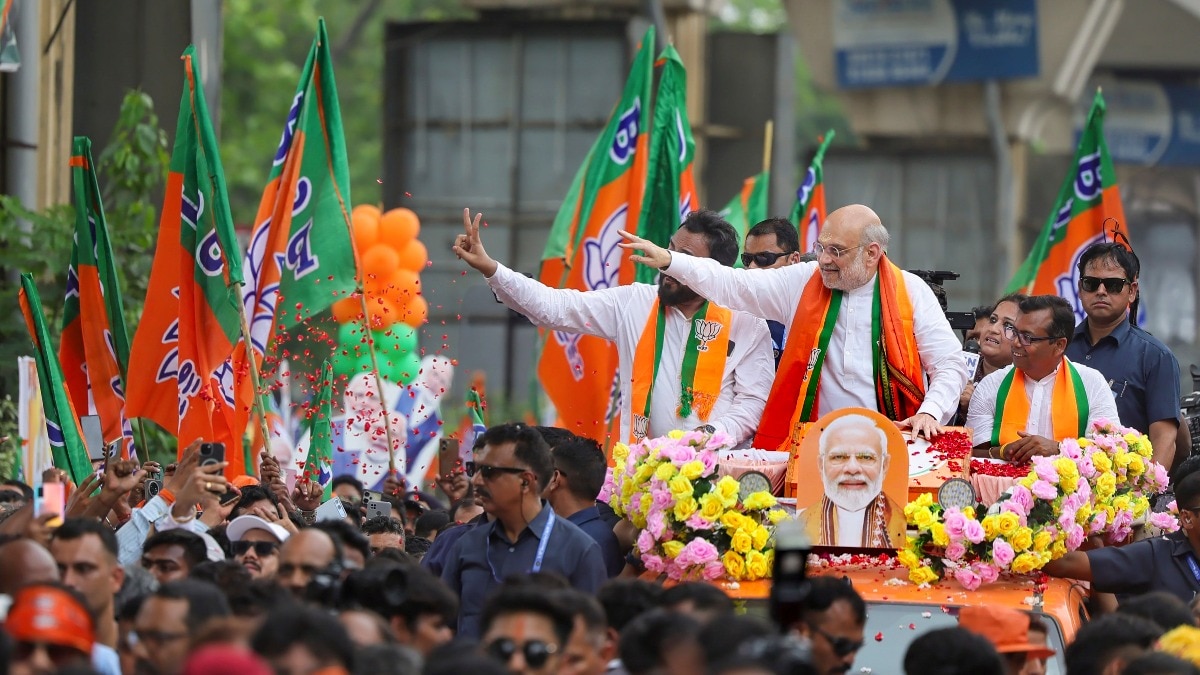
Amit Shah complemented this with rallies, roadshows and four major organisational reviews covering all 294 constituencies.
National leaders held programmes across 128 constituencies, while nine BJP chief ministers addressed 101 rallies. At the state level, 25 leaders conducted 232 events.
BRIGADE RALLY: SHOW OF STRENGTH
The Brigade rally in Kolkata emerged as a major show of strength, with the party claiming a turnout of 7.5 lakh people.
Beyond numbers, it signalled that the BJP had built momentum even in the state’s political and symbolic centre.
‘CHUP CHAP KAMAL CHHAP’: THE SILENT VOTE
In the Kolkata Presidency region, the BJP deployed a targeted strategy at the ward level. Special teams worked alongside party cadres to reach undecided voters. The slogan “Chup Chap Kamal Chhap” was aimed at silent voters — those unwilling to express preferences publicly but decisive on polling day.
THE CORE NARRATIVE
The BJP’s campaign rested on three clear messages:
“Bachte Chai, BJP Tai” — positioning itself as the answer to fear
“Paltanor Darkar, Chai BJP Sarkar” — reinforcing the need for regime change
“Bhoy OUT, Bharosa IN” — framing the election as a shift from fear to trust
THE STRATEGY IN SUM
The BJP’s Bengal victory was the result of layered execution – booth preparation, women-centric outreach, youth mobilisation, cultural integration, network expansion and leadership-driven campaigning.
At its core, the strategy converted anti-incumbency into votes, promises into engagement, and slogans into a wider narrative of change.
This was not just a campaign. It was a political system built to win.
Elections 2026 | West Bengal Election | West Bengal Election Constituencies | West Bengal Election Schedule
Tamil Nadu Election Result Live
West Bengal Election Result Live
Puducherry Election Result Live
– Ends